As an Amazon Associate, TrustedBarber earns from qualifying purchases.
A patchy beard is a shape problem before it is a growth problem. Give thin spots twelve weeks of honest growing, then use barbering, light and filler to make what you have read as full. This guide follows the method in Seancutshair’s patchy beard trim tutorial: fade the edges, shape the line, and let density do the rest.
The fastest visual upgrade for thin cheeks is a pencil filler like the Beard Pen Filler for Men, but the order of operations below is what keeps a patchy beard from looking worse after every trim.
Top picks
Check Price on the Beard Pen Filler
Check Price on the Viking Beard Brush and Comb Set
In this guide
Why beards look patchy
Three things make a beard read as patchy, and only one of them is actual density. First is density itself: some areas of the face simply grow thinner hair, and the cheeks are the usual suspect. Second is contrast: darker hair against pale skin shows every gap, while a lighter beard looks fuller at the same density. Third is shape: an edge drawn too high or too wide exposes the thinnest part of the cheek, while a lower, tighter line hides it.
That is why a barber never attacks a patch first. They set the outline so the outline passes through your strongest growth, then they manage contrast and length inside it. Hair length matters too: a short, even length across the cheek reads fuller than a patchwork of different lengths, because the eye reads gaps rather than hairs when the surface is uneven.
Age counts as well. Most men’s cheek density keeps improving well into their late twenties and thirties, so a patch that looks permanent at twenty-three often fills in on its own. The routine below buys you time by making the beard look better every month while density catches up.
The barber method from the video
Seancutshair works a patchy client beard in one pass with three moves: a faded taper along the cheek line, a reshaped neckline, and razor lining to sharpen the edges so the shape itself carries the style. It is worth watching before your next trim, because the camera follows the same order this guide uses: establish the outline, taper what surrounds it, and only then decide whether any spot still needs filling.
One thing the video makes obvious is how little hair a good shape needs. The beard in the tutorial is thin across the mid-cheek for most of the cut, and it still reads as a full, deliberate beard by the end because the perimeter is clean and the length transition is smooth.
Step 1: set the growth baseline
Stop trimming the patchy zones for at least three weeks before any shaping session. Cheek hair grows about a millimeter every few days, so three weeks gives sparse areas a real chance to connect with the denser growth around them. Set your neckline low and tight during this window and leave the cheek line alone entirely; every cheek line you draw at this stage is a guess against hair that is still deciding to show up.
While you wait, run the routine that supports what you have: wash the beard a few times a week, work oil through to the skin, and brush daily to train the hairs to lie across the gap instead of away from it. Direction is a real part of the fix. Hairs that spiral out of the cheek make a patch look twice its size; brushing them toward the thinner zone borrows their length for it.
An Honest Amish beard oil keeps the skin under a growing beard comfortable enough to leave it alone, which is the whole point of the baseline phase. It runs about $10-15 for a 2-ounce bottle.
Check Price on the Honest Amish Beard Oil
Step 2: clean the lines without stealing coverage
When you finally trim, the neckline comes first. Find the point where your neck meets your jaw by turning your head slightly and feeling for the crease, then set the line just above it. A neckline set too high eats your beard from below and makes the cheek look patchier by comparison, which is the most common self-inflicted patch in men’s grooming.
The cheek line is the opposite trade: you can gain the look of density by setting it slightly lower than the natural growth line, but only by a millimeter or two. Our guide to shaping the neckline, cheek line and lip line walks the full placement, and our hairline line-up guide covers the razor work if you line yourself up between cuts.
Use the shortest possible trimming pass on the cheek boundary and stop before you see skin. The goal is a crisp edge on strong growth, never a line drawn through the thin zone. If the natural cheek line runs straight through a sparse area, leave that stretch soft and undefined; a soft edge there looks like natural growth, while a hard edge through a gap looks like a mistake.
Step 3: fade and taper the edges
The taper is what turns a thin beard into a shaped one. Instead of one hard stop where the beard ends, step the length down in two or three passes: long at the mass of the beard, shorter at the transition, and nearly bare at the line. The gradient moves attention to the shape and away from density, which is exactly what the video’s fading pass does along the cheek.
A compact trimmer makes self-fading easier because you can see the blade against the skin as you work. The Wahl Peanut is the barber standard for this job: a rotary motor, a narrow head, and a body small enough to pivot along the jaw at about $60-70.
Check Price on the Wahl Peanut
Work in short upward strokes along the neck taper and downward strokes along the cheek, stepping down one guard length at a time. Flick the blade out at the end of each stroke instead of stopping against the skin; stopped strokes cut a shelf, and shelves are what make a fade look homemade. Brush out the area between every guard change so you can see the true length before the next pass.
Step 4: fill and soften thin spots
Once the shape is set, fill what still reads as a gap. A color pencil is the honest version of this: it adds pigment to skin, not fake hairs, so a light hand at the edge of a patch reads as density from across the room. The Beard Pen Filler for Men is this kind of pencil (the linked listing is black), and its listing says it is built to last through the day without smudging. Match the shade to your beard at the temples, not the darkest hair on your chin, or the fill reads two tones darker than everything around it.
Check Price on the Beard Pen Filler
For gaps you would rather grow into than cover, balm does quiet work. A heavier wax-based balm gives short hairs enough grip to stand at a slight angle instead of lying flat, and that half-millimeter of lift closes small visual gaps. The Honest Amish Heavy Duty Beard Balm is a solid pick at $10-15: a firmer hold than most, a matte finish, and a scent that stays close to the beard.
Check Price on the Honest Amish Heavy Duty Beard Balm
Skip the fiber powders and spray-on fillers. They photograph well for ten minutes and then drift, cake, or transfer onto a pillow or collar, and they are the reason a filled patch sometimes looks worse in person than in a photo. A pencil plus grooming beats a spray every time for daily wear.
The daily routine that keeps it full
The maintenance loop is short. Wash two or three times a week with a dedicated beard wash and plain water on the days between. Apply oil to damp skin after every wash, then balm on top when you want hold. Brush once a day in the direction you want the beard to read: down and slightly forward at the cheek, down and outward at the chin.
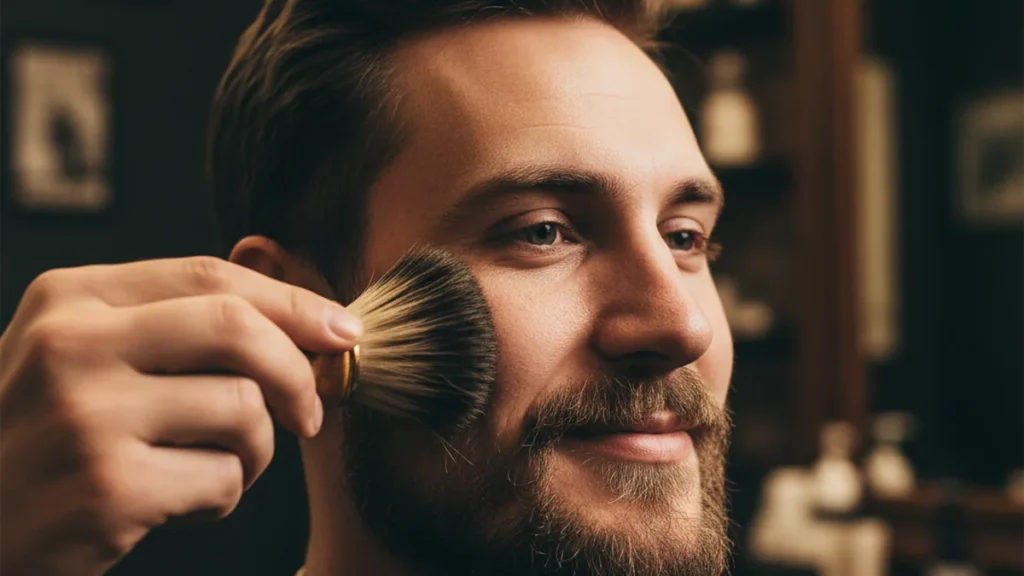
The Viking Revolution beard brush and comb set covers both jobs, a wooden brush for training and oil distribution and a double-sided comb for the longer chin growth, at about $8-12. The brush is the useful half: they lift the short hairs at a patch’s edge so the pencil and balm have something to work with.
Check Price on the Viking Beard Brush and Comb Set
Revisit the actual trim every two to three weeks and repeat the same order: lines, taper, then fill. Keeping the sequence fixed matters more than any single technique, because it stops you from trimming the patch itself, which is the move that resets your progress to zero.
Mistakes that make patches worse
Shaving the patch to stimulate it. Cutting hair at the skin does not change what grows back, and it deletes months of the length you were growing as insurance.
Trimming to the thinnest zone. Matching the whole cheek down to a sparse area evens the beard out by making everything thin. Match long to strong, and shape around the weak zone instead.
Drawing the cheek line through a gap. A hard edge across a sparse stretch advertises the very thing you are hiding. Soft edges on weak stretches, hard edges only on strong growth.
Filling before shaping. A pencil drawn into an unshaped beard marks time at best and builds an outline you then have to trim around at worst. Shape first, fill last.
FAQ
Does shaving a patchy beard make it grow back thicker? No. Shaving cuts the hair at the skin and has no effect on the follicle, the density map, or the growth cycle. The blunt tip can feel coarser for a day or two, which is where the myth comes from, and meanwhile you have lost the length you were growing.
How long does it take for patchy spots to fill in? Most men see their cheek density keep building into their late twenties, and a meaningful change in a given patch takes about eight to twelve weeks of uninterrupted growth. In the meantime, shaping and filler handle the look.
Does beard oil help patches grow? Oil conditions the hair and the skin underneath it, which keeps a growing beard comfortable and reduces breakage of the hairs you do have. That helps a beard look its best at its real density. It does not create new follicles, so treat it as care, not growth.
Should I see a barber instead of doing this myself? For the first shape after a long grow-out, yes if you can. A barber sets the outline once, correctly, and you maintain it at home with the same order of operations. After one professional baseline, the routine above is enough to keep it sharp between visits.
Verdict: a patchy beard is managed in this order: grow past the awkward stage, set lines through strong growth, taper the edges so shape carries the look, and only then fill what is left with the Beard Pen Filler for Men. Run that loop for one season and most beards that read as patchy today read as deliberate by the new year.