As an Amazon Associate, TrustedBarber earns from qualifying purchases.
From Kitchen Scissors to $1 Million Dollar Salon: What Barbers Can Learn from a Self-Made Success Story
The world of cosmetology is brimming with opportunities for passionate individuals, and as a
Starter gear from this story
Lee started with clients at home and a camera phone. If you are starting the same way, these are the basics we cover below.
Check Barber Strong The Barber Cape Price
Check Barbicide Disinfecting Jar Price
The Unconventional Path to Success: A Summary of Sess Lee Cannon’s Journey
In 2007, when she was 20, Sess Lee Cannon was getting a tattoo when the artist complimented her friend’s haircut. Lee had given it hours earlier with a pair of kitchen scissors. He asked where her salon was, and told her she might want to reconsider what she did for a living. At the time Lee was an accounting clerk at Maui Jim, the sunglasses company, after being promoted from customer service. She told CNBC Make It she craved the creative freedom she felt doing hair. The next morning she registered at Regency Beauty Institute, a cosmetology school in Peoria, Illinois.
The program took about 18 months and cost $22,000, according to CNBC Make It, with classes five days a week; she waitressed at a steakhouse to cover tuition and bills. After securing her license in 2009, Lee started small, taking on clients at home and working part-time in a natural hair salon in Peoria. She made close to $30,000 in her first year as a stylist. Her breakthrough came with the rise of social media. She set up a Facebook business page, sent friend requests to potential clients, and documented her work in photos and videos. That way she showcased her talent, particularly with curly and natural hair, a niche she understood intimately due to her own biracial background. This strategic use of social media helped her build a strong reputation and a loyal following.
In January 2016, after a long weekend visiting Austin and Dallas, she moved her family to Arlington, Texas. The move propelled her to take the ultimate leap: opening her own salon, Flourish Curls Salon. With $50,000 of her savings and ten months of hard work, her dream became a reality in 2017. Her foresight in building an online presence paid off, as Flourish Curls quickly gained popularity, with a waitlist of eager clients.
Today, Flourish Curls Salon boasts 11 stylists (including Lee, who now takes on only a few clients monthly) and brought in $1.1 million in revenue in 2023, the first year it passed $1 million, according to financial documents CNBC Make It reviewed. Lee’s take-home pay after business expenses and taxes is between $100,000 and $150,000 a year, and she says she works three days a week most weeks. Her success is a testament to identifying a niche, leveraging technology, building a strong team, and prioritizing work-life balance.
Her Timeline at a Glance
Every date and figure below comes from the CNBC Make It profile. It is worth seeing the whole arc in one place, because the “overnight” success took about 16 years.
| Year | What happened | Detail |
|---|---|---|
| 2007 | Kitchen-scissors compliment | Quits accounting clerk job |
| 2007–2009 | Cosmetology school | About 18 months, $22,000 |
| 2009 | Licensed | Home clients, part-time salon |
| First year | Close to $30,000 | Waitresses on the side |
| 2016 | Moves to Arlington, Texas | January, with four children |
| 2017 | Flourish Curls opens | 10 months, $50,000 savings |
| 2023 | $1.1 million revenue | 11 stylists, two virtual assistants |
Source: CNBC Make It, “37-year-old’s hair salon brings in over $1 million a year,” September 1, 2024.

Career Advice for Aspiring Barbers: Lessons from a Million-Dollar Stylist
Sess Lee Cannon’s journey offers invaluable lessons for any aspiring
- Embrace Your Passion and Niche Down: Lee’s story highlights the power of following your true calling. She loved doing hair for fun, and that genuine passion eventually translated into a highly successful career. As a
barber , identify what truly excites you about the craft. Do you love intricate fades, classic shaves, or modern texture work? Finding your niche – whether it’s working with specific hair types, styles, or even client demographics – can help you stand out and attract a dedicated clientele. - Master Your Craft (and Keep Learning): While Lee had a natural “gift,” she still invested in formal education and continuously honed her skills. Cosmetology school provided the foundation, and her personal experience with curly hair led her to specialize. The barbering industry is constantly evolving. Invest in ongoing education, attend workshops, and stay updated on the latest trends and techniques. The more skilled you become, the more value you can offer your clients.
- Harness the Power of Social Media: This is perhaps one of the most critical takeaways from Lee’s success. In today’s digital age, social media is your free marketing tool.
- Create a Professional Portfolio: Use platforms like Instagram and Facebook to showcase your best work with high-quality photos and videos.
- Engage with Your Audience: Respond to comments, answer questions, and build a community around your brand.
- Offer Value: Share tips, product recommendations, and behind-the-scenes glimpses of your work to keep your audience engaged.
- Consider YouTube: If you’re comfortable on camera, creating tutorial videos or style guides can significantly expand your reach, as evidenced by Lee’s nearly 60,000 YouTube subscribers.
- Build a Strong Network and Clientele: Lee started by taking on clients at home and working part-time in a salon, building her reputation organically. As a new
barber :- Seek Mentorship: Learn from experienced barbers in your area.
- Provide Exceptional Customer Service: Word-of-mouth referrals are powerful. Make every client feel valued and give them a reason to return.
- Consider Assisting or Apprenticeships: Many states require it, but even if not, working as an assistant can provide invaluable practical experience and a foot in the door at a reputable establishment.
- Think Like an Entrepreneur (Even if You’re Employed): Lee’s eventual leap to salon ownership was fueled by an entrepreneurial spirit. Even if you’re not planning to open your own shop right away, adopt an entrepreneurial mindset:
- Manage Your Finances: Understand your income and expenses.
- Market Yourself: Treat your personal brand as a business.
- Develop Strong Communication Skills: This is crucial for client relations and networking.
- Don’t Be Afraid to Take Calculated Risks: Lee made a significant career change and then a big move to a new state to pursue her dreams. While not every risk pays off, being open to new opportunities and stepping outside your comfort zone can lead to incredible growth.
- Prioritize Work-Life Balance: Lee’s ability to earn a six-figure income while working only three days a week is inspiring. As you progress in your career, remember to create a sustainable work schedule that allows for personal time and avoids burnout. Building a strong team, as Lee did, can be instrumental in achieving this.
What the Numbers Actually Say
The headline is $1 million, but the more useful number for a new barber is the gap between revenue and pay. Flourish Curls brought in $1.1 million in 2023. Lee’s own take-home pay was $100,000 to $150,000 after business expenses and taxes, CNBC Make It reported. That gap is rent, payroll for a team of 11 stylists, two virtual assistants, products, insurance and everything else a shop costs. Owning a shop can raise your income, but revenue is not salary.
Two other figures stand out. Her first year as a licensed stylist brought in close to $30,000, and she kept waitressing for two more years to cover her bills. And the salon’s services, which include cuts, twists, scalp exfoliation and styling, cost $150 to $375 according to the article. She built a high-ticket specialty, not a high-volume walk-in shop.
Takeaway for barbers: your first year will probably look more like Lee’s first year than her best year. Plan for a second income or savings while you build a book.
Stylist or Barber: Check Your License First
Lee trained as a cosmetologist, not a barber. CNBC Make It notes that requirements vary by state, but generally mean finishing a program at an accredited school, passing a written and practical exam, and in many states completing an apprenticeship or working as an assistant first. Barbering is often licensed separately from cosmetology, with its own training hours and exam, and the services each license covers can differ from state to state.
Before you enroll, read your state barber board’s current rules on hours, exams and apprenticeships. Our guide to choosing a barber school near you walks through what to compare.
Starting Like Lee: A Basic Kit for Your First Clients
Lee’s first clients came to her home while she worked part-time in a salon. Many states regulate home-based services, so check your board’s rules before you take paid clients anywhere outside a licensed shop. If you are cleared to work from home or rent a chair, the basics are the same, and none of them are expensive:
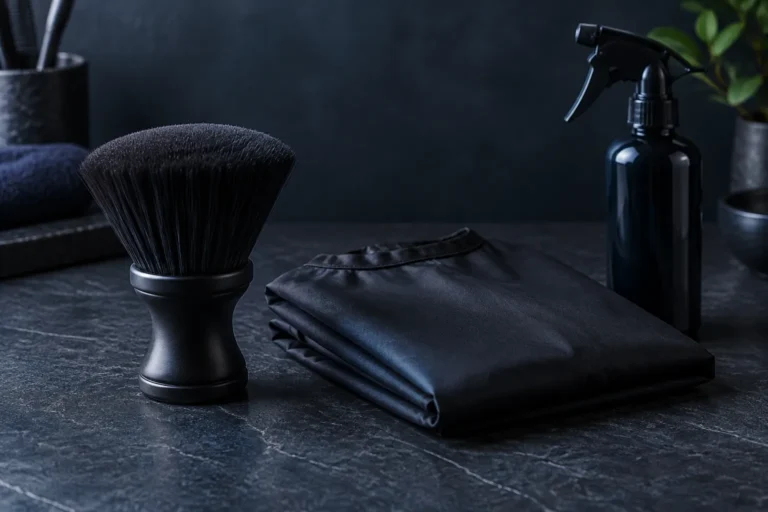
- A cape that sheds hair: the Barber Strong The Barber Cape is water-resistant and made to shed clippings.
- Neck strips: a fresh strip under every cape, like the Graham Sanek Neck Strips.
- Disinfection: a Barbicide Disinfecting Jar with Barbicide Disinfectant Concentrate. Follow the label and your state board’s sanitation rules.
- Shears: a dependable pair such as the Equinox Professional Razor Edge Barber Scissors.
- Water and sections: a BeautifyBeauties Continuous Spray Bottle and AIMIKE sectioning clips for longer and curly hair.
For clippers and the rest of a starter setup, see our essential barber tools guide.
Photographing Your Work the Way She Did
Lee’s following started with photos and videos of her own work on Facebook, then grew across YouTube and Instagram, where she posted tutorials, client testimonials, style how-tos and product recommendations. Her YouTube channel had nearly 60,000 subscribers when CNBC profiled her. You do not need a studio to start, but consistent light and angles make a portfolio look professional:
- Even light. A ring light such as the NEEWER RL-18 Ring Light kit gives the same light at any hour, so every cut looks comparable.
- Show the back. A handheld double-sided back-of-head mirror lets the client see the back, and gives you a second angle for your photo.
- Same three angles every time: front, side and back, before and after.
- Ask permission. Get the client’s OK before you post their photo, and tag them if they want it.
Check NEEWER RL-18 Ring Light Kit Price
Finding a Niche: Why Textured Hair Worked for Her
Lee is biracial, and she told CNBC Make It that her mother had straight hair and did not know how to style her curls when she was growing up. That pushed her to experiment on her own hair as a teenager. Years later, it became her business: she says there are not many salons near her that specialize in curly and natural hair, and that many schools and salons still do not train stylists to work with those textures.
The lesson for barbers is to look for the clients nearby who are underserved. That might be curly and coily textures, long hair, kids, or clients who want a quiet appointment. If textured hair is your niche, know the retail products your clients already ask about. Leave-in and curl creams like Cantu Coconut Curling Cream and wash sets like the SheaMoisture Curl & Shine Shampoo & Conditioner Set come up often. Recommend what suits each client’s hair, not what you happen to stock.
How She Avoids Burnout
The three-day week is not luck. CNBC Make It says Lee sees only a few clients a month now. She credits building up her staff and hiring two virtual assistants with helping her avoid burnout and the urge to “always be on.” She front-loads meetings and appointments Monday through Wednesday so she has more time with her children.
A new barber cannot hire assistants on day one, but the principle scales down. Batch your admin, use online booking so you are not answering messages mid-cut, and block the days you are off. Lee told CNBC that in her 20s she thought success meant working 50-plus hours a week, and that she has built a six-figure career working three days a week most weeks.
FAQ
Who is Sess Lee Cannon? The founder of Flourish Curls Salon in Arlington, Texas, featured on CNBC Make It in September 2024. She left an accounting clerk job at Maui Jim, went to cosmetology school and built a following on social media with curly and natural hair.
How much does Flourish Curls Salon make? According to the CNBC Make It story, the salon brought in $1.1 million in revenue in 2023, its first year over $1 million, with 11 stylists. Lee’s own take-home pay after expenses and taxes was reported at $100,000 to $150,000 a year, working three days a week most weeks.
How much did it cost to open Flourish Curls Salon? Lee used $50,000 of her savings and spent ten months getting it open. She opened in 2017 after moving to Texas in 2016.
Do you need a college degree to succeed as a barber or stylist? Not according to Lee’s story: she built her business without a traditional bachelor’s degree. She did complete a cosmetology program and get licensed first.
How can a new barber build a clientele? Lee started with clients at home and part-time work in a salon, then used social media to show her work. The post also points to mentorship, strong customer service for referrals, and assisting or apprenticeships.
How much did her cosmetology school cost? About $22,000 for a program that took roughly 18 months, with classes five days a week, according to CNBC Make It. Barber programs and costs differ by state and school, so compare current prices before you enroll.
What does a new barber need to take first clients? Your license and your state’s rules come first. After that: a cape, neck strips, a way to disinfect tools such as a Barbicide Disinfecting Jar, shears, clippers and a spray bottle. See the kit list above.
How did she use social media to grow? She started with a Facebook business page, friend requests to potential clients and photos and videos of her work, then posted tutorials, testimonials, how-tos and product recommendations on YouTube and Instagram. Consistent photos, for example under a NEEWER RL-18 Ring Light, make that kind of portfolio easier to build.
Sess Lee Cannon’s journey from kitchen scissors to a million-dollar salon is a powerful reminder that success in the beauty industry is within reach for those with passion, perseverance, and a willingness to adapt. By applying these lessons, barbers entering the field can build not just a job, but a thriving and rewarding career.