
As an Amazon Associate, TrustedBarber earns from qualifying purchases.
The best barber schools for your shortlist are the ones that fit the state where you plan to work, your schedule and the full cost of finishing. A famous name is not enough. Neither is a short advertised course if it does not lead to the license you need.
Choose the state first. Then compare the exact campus and beginner program, ask for the full written cost, and visit the student clinic. The nine school options below cover different markets and schedules; their order is not a national performance ranking.
Do not buy a second kit yet. Ask what the school supplies and requires. If you need a clipper comparison, the Wahl Magic Clip is one option to compare by exact model, not a universal school requirement.
The quick picks
Nine school options to compare
Compare the campus and entry route
These are examples to investigate, not a national ranking. The linked program sections below explain the entry requirements and checks for each option.
Oakland, Hayward, San Pablo, CA
Beginner barbering
Des Moines, IA
Basic barbering, no prior experience
New York
500-hour Master Barber program
Louisville, Florence, Owensboro, KY
Confirm course and entry route locally
Ohio
Beginner or licensed-cosmetologist crossover
Daytona Beach, FL
Barbering or cosmetologist bridge
Texas, exact campus to confirm
Check campus program disclosures
Location-specific
Confirm local barber track
Bridgeview or Norwood Park, IL
Barbering; Norwood Park crossover
Moler Barber College: Bay Area campus choices
Current school program information. Moler lists its 1,000-clock-hour beginner barbering program at Oakland, Hayward and San Pablo. Its program page describes theory, practical training and supervised clinic experience, with exam preparation as part of the course. That gives a Bay Area applicant specific campuses to compare rather than assuming every location offers the same course.
Ask which schedule is available at the campus you can reach reliably. Moler ties completion time to attendance, schedule and progress. It also says graduates must meet the California board’s requirements, so completing the school program and receiving a license are separate steps.
American College of Hairstyling: a Des Moines option
Current school program information. The college’s Basic Barbering and Hairstyling page describes a beginner program for people with no prior hair-care experience. It lists 1,500 clock hours and a basic barbering diploma. Use those concrete details as the start of your inquiry rather than choosing on the strength of an old founding date.
The page is brief. Ask admissions for the current catalog, schedule, full costs, clinic arrangements and the licensing pathway for the state where you want to work. A diploma description does not by itself answer how out-of-state licensing or transferred hours will be handled.
American Barber Institute: New York schedule comparison
Current school program information. ABI advertises a 500-hour Master Barber program with morning, afternoon and weekend schedules. Its page separates tuition from tools, books and supplies, which are purchased separately. That is a useful distinction when one school quotes a kit-inclusive total and another advertises tuition alone.
Do not translate a program’s advertised length into a guaranteed license date. New York’s Department of State lists approved schooling and a practical exam among the licensing steps. Ask ABI about the exact campus, schedule and preparation, then check the state requirements yourself before committing.
American College of Barbering: Kentucky campus verification
Current school program information. The Kentucky Board of Barbering lists American College of Barbering locations in Louisville, Florence and Owensboro. The school’s own site lists those campuses and says to contact it for start dates. This is a useful example of checking the exact campus against a state list, not treating a familiar school name as enough.
The school advertises financial aid for those who qualify and limits its VA-benefit statement to Louisville and Florence. Ask about your chosen location rather than applying one campus’s funding information to all three. Request the current enrollment agreement and program details before making comparisons.
Dayton Barber College: distinguish beginner and crossover courses
Current school program information. Dayton lists a beginner 1,800-clock-hour Barber/Stylist program for someone with no background or experience. It separately lists a 1,000-clock-hour course for licensed cosmetologists. Those are different entry routes, so the shorter course is not a like-for-like alternative for a complete beginner.
Ask the school which course matches your existing license or experience and what evidence it needs. Then compare the applicable schedule and full cost. A shorter advertised course can be the wrong comparison if it assumes training you have not already completed.
Daytona State College: a public-college option
Current school program information. Daytona State describes a full-time barbering program at its Daytona Beach campus with day and evening classes. Its page sets out an application process and separately describes a bridge course for licensed cosmetologists. Check which route you qualify for before comparing course lengths.
The public-college setting is a reason to put it on a Florida shortlist, not proof that it is cheaper than every private school. Ask for the current total for your residency status and program, including supplies and any fees. Confirm the next available start and the timetable you would actually attend.
Career Schools of Texas: inspect the campus disclosures
Current school program information. Career Schools of Texas identifies itself as the former Texas Barber College. Its school-information page describes barber-program licensing by the Texas Department of Licensing and Regulation and links admissions, cost, transfer and financial-aid information. Read those disclosures for your campus rather than relying on the brand’s years in business.
Its placement-services language makes an important distinction: it offers help finding work but does not guarantee a job. Ask how any published outcome rate was calculated, which graduates it includes and which reporting period it covers. A headline percentage without those details is a poor basis for a tuition decision.
Paul Mitchell Schools: confirm the barber track locally
Current school program information. Paul Mitchell describes a barber program with Core, Adaptive and Creative phases, including classroom and supervised clinic-floor work. Its national page explicitly says programs vary by location. Use the location finder and speak to the individual campus before treating a nearby beauty school as a barber-program option.
The page also describes a student kit. Get the exact contents and cost for your campus in writing before buying extra tools. Brand familiarity does not establish local start dates, aid eligibility, completion outcomes or whether the particular program fits the state where you want to work.
Tricoci University: Illinois barber-campus choices
Current school program information. Tricoci’s current barber-program page lists 1,500 hours and identifies Bridgeview and Norwood Park as its Illinois barbering campuses. It describes a separate 500-hour crossover at Norwood Park for licensed cosmetologists. Keep that entry requirement attached to the shorter course when comparing options.
The school says tuition varies by campus and schedule and includes a professional kit. Ask for the itemized quote and the timetable at the location you can attend. Do not assume a university-wide program page means every campus offers barbering, or that a completion estimate is a guaranteed graduation date.
Completion of the program does not guarantee licensure.
How to compare a program
For the local-search step, use our barber school near me guide. The examples above are a national starting list, not a ranking of campuses near you. Once a school confirms its required kit, compare the student clipper guide before buying duplicate tools.
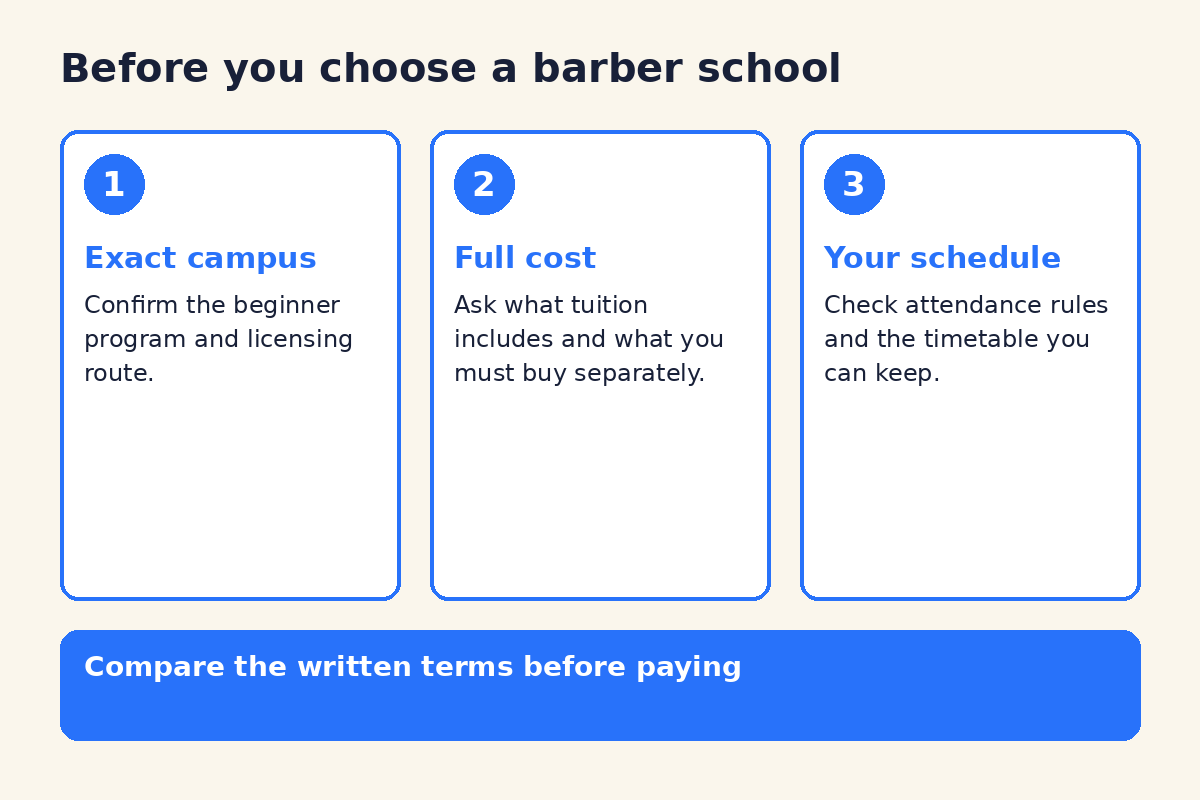
Make the comparison campus by campus. Write down whether you are entering as a beginner or already licensed, the required clock hours, class times and how missed time is made up. Ask to see the student clinic and how instructor feedback works. Those questions help turn a tour into a comparison instead of a sales presentation.
For Kentucky, use the board’s college list to check the location. For New York, read the Department of State licensing pathway rather than assuming a school certificate is the final license. If you expect to move, ask the destination licensing body how it treats your proposed training before enrolling.
Programs vary by location.
Tuition, kits and financial aid
Ask every school for the same written breakdown: tuition, registration, kit and books, required fees, payment schedule and refund terms. Compare the total, not just the first payment. ABI explicitly separates tools and books from tuition; Tricoci describes a kit within its core tuition. Neither format is automatically better, but they are not the same quote.
Accreditation alone is not a promise that you personally qualify for federal aid. The Federal Student Aid Handbook distinguishes school eligibility from individual program eligibility. Ask the financial-aid office about the exact campus and course, your eligibility and the difference between a grant and a loan.
Career Schools of Texas cannot and will not guarantee a job to any student.
Watch barbers discuss the school decision
These credited videos provide two barber perspectives on starting out. Use them to build questions for admissions, not as a substitute for current licensing rules, the school catalog or a written cost quote. A personal school experience is not a promise about another campus.
Video credit: Watch this BEFORE starting Barber School, Seancutshair.
Video credit: How to become a barber in 12 steps, Chris Bossio.
Check for closures before paying
Old school directories can outlive the schools themselves. The Tennessee Higher Education Commission closure notice says The Barber School in Memphis and Jackson closed in April 2019 and identifies the Memphis Jackson Avenue address. That school is not a current recommendation in this guide.
Before paying, confirm the campus is operating, the intended program is accepting students and the school has written transfer, withdrawal and refund terms. Ask who keeps attendance and completed-hour records and how you obtain them if you leave. A polished website or an old directory entry cannot answer those questions.
Also worth a look
Wahl color-coded guards are an accessory option if compatible with your exact clipper. Check the school’s kit list first; do not pay twice for included accessories.
Wahl Cordless Detailer Li is an outlining-tool option to compare after the school confirms its requirements. It is an editorial example, not an endorsement by any school listed here.
FAQ
What is the best barber school? Start with the campus that fits your intended licensing state, schedule and budget. Compare the exact beginner program and written terms rather than choosing on national name recognition.
How long does barber school take? The schools above publish different hour requirements and entry routes. Ask about your program, attendance plan and exam process; a licensed-cosmetologist crossover is not the beginner course.
Does graduation guarantee a license or job? No. Check the licensing body’s remaining steps and read the school’s placement disclosures. Moler specifically separates course completion from licensure; Career Schools of Texas separates placement help from a job guarantee.
Should I buy tools before enrolling? Ask for the exact kit contents and required extras first. Compare models after you know what the school supplies.