
As an Amazon Associate, Trusted Barber earns from qualifying purchases.
A travel plug adapter can make a charger fit the socket without making the voltage right. Before packing clippers for an overseas holiday, read the input label on the equipment you actually plan to plug in.
The short answer
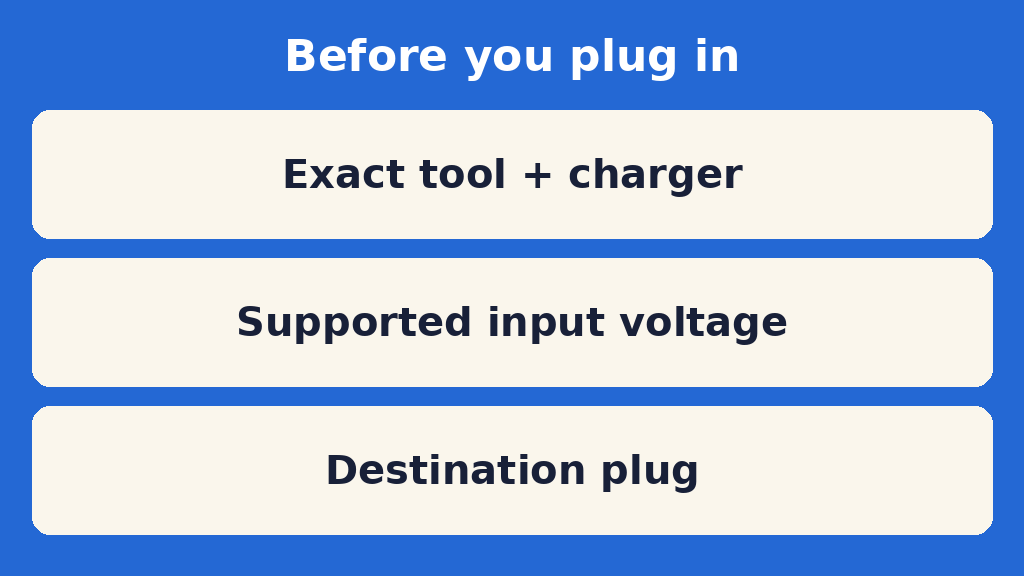
Check three separate things: the exact tool and charger, their supported input voltage, and the plug needed at the destination. A clipper sold as cordless is not automatically a worldwide-voltage model. A universal-looking travel adapter is not automatically a voltage converter.
If the destination’s supply is outside the input range printed on the equipment, do not try it with a shape-changing adapter. Check the manufacturer’s instructions for that exact model before choosing another power arrangement.
Read the input label first
Ceptics’ voltage guide points buyers to the specification label and the word INPUT. A single rating and a supported range are different information. The company gives 100-240V as an example of a broad-range input, while a single-voltage device needs its supply matched to that rating.
Look at the actual charger or corded appliance you own. A photograph of a similar model’s charger is a research lead, not confirmation of the one in your hand. Model numbers, market versions and included power supplies can differ even when the tool’s name sounds familiar.
Do not confuse the input rating with a charger’s output. The input describes the supply the charger accepts; the output describes what it delivers to the tool. Keep both labels and the matching model instructions in view rather than choosing a replacement on the connector shape alone.
“For safety, always check the device’s nameplate to confirm its voltage requirement and compatibility.”
An adapter and a converter do different jobs
SKROSS says its travel adapters connect different country plugs and sockets. They do not convert voltage. Ceptics makes the same distinction for its CTU adapters: confirm the appliance is compatible with the country’s voltage before connecting it.
That means two purchases that look similar can solve different problems. An adapter addresses the physical connection. A voltage converter changes the electrical supply. Seeing the word universal on a listing does not settle which job the product performs or whether it is appropriate for a particular clipper.
“SKROSS® travel adapters are not voltage converters.”
Do not turn that distinction into a recommendation to buy any converter and carry on. The tool’s instructions, supported supply and the converter’s own compatibility still need to match. If the manufacturer does not confirm an appropriate route, choosing a suitable travel tool is a separate option from improvising with electrical accessories.
Similar grooming tools can have different ratings
The current maker pages give useful examples of why the model number matters. Wahl’s Color Pro rechargeable kit 09649P, identified as clipper model 9649, lists worldwide voltage of 110-240V. Wahl’s newer Cordless Color Pro Lithium-Ion 3025769 page lists 100-240V and a USB-A charging cord in the box. The listed box contents name a USB-A cord, not a wall charger. Check the required USB power supply in the model instructions. Those figures come from the named product pages; they are not a blanket statement about every Color Pro.
On the other hand, Wahl’s Elite Pro corded kit 3029684 specifications list 120V. A review calling a clipper powerful or travel-friendly would not expand that input rating. The exact electrical specification is the fact to carry into the travel decision.
Wahl Color Pro rechargeable 09649P
Maker-listed input: 110-240V worldwide voltage. Check the actual supplied charger and the destination plug.
Wahl Cordless Color Pro Lithium-Ion 3025769
Maker-listed input: 100-240V. It is a different named model from the earlier rechargeable kit.
Wahl Elite Pro corded 3029684
Maker-listed voltage: 120V. Do not treat a plug adapter as a change to that rating.
Andis’ Slimline 2 item 24800 is another model-specific example. Its page lists a dual-voltage charger, with 120-240V and 50-60Hz in the specifications. That is useful information about this trimmer, not every Andis charger or a similarly named older unit.
Check the charger, not just the clipper
A rechargeable tool has at least two things to identify: the grooming device and its power supply. Braun’s Series 3 300s page, for example, attributes automatic 100-240 voltage adjustment to the Smart Plug. The statement belongs to that model’s charging arrangement rather than to an arbitrary charger that happens to fit.
Keep the correct charger with the tool. If it is missing, use the maker’s replacement route for the exact model. A travel adapter is not a replacement charger, and a compatible wall plug does not establish that the small connector and electrical output suit the clipper.
Also check whether the tool can run while connected. That is a separate feature from input voltage. Wahl’s 09649P page specifically describes corded and cordless use; another rechargeable model’s worldwide input does not establish the same operating mode.
“The Smart Plug comes with automatic 100-240 voltage adjustment, so you can use your Braun shaver worldwide when travelling.”
Wahl’s power-mode explainer
The description accompanying WahlHomeProduct’s How to Power Your Trimmer separates corded, corded/cordless rechargeable, cordless rechargeable and replaceable-battery trimmers. It is a useful distinction before packing: the ability to run plugged in is a feature to verify, not something the word rechargeable promises. This video is a companion to that power-mode check, not a voltage specification for the clippers above.
Credit: WahlHomeProduct, How to Power Your Trimmer.
What to ask before buying for travel
Ask for the full model number and the input rating of the supplied charger, not just a seller’s yes to whether it works abroad. Check which market’s version is being sold and what power supply is in the box. A listing’s broad family name is not enough to match it to a maker page.
If you are buying a plug adapter, verify the destination socket and the adapter’s own supported connection and load. If you are replacing a charger, verify the maker’s compatibility information for the tool. These are different checks, even when both accessories sit in the same travel pouch.
For a gift, ask where the recipient will use the equipment and whether they already have the correct charger. Buying a second grooming tool does not fix an unidentified charger problem, and a random adapter can add another unanswered compatibility question.
When to leave a tool at home
Leave it out of the travel kit until the compatibility question is settled if the label is unreadable, the charger is unverified or the destination supply falls outside the supported input. That is more useful than experimenting in a hotel room with equipment you depend on.
A suitable alternative might be a different model with maker-documented input compatibility, or a grooming routine that does not need that corded tool during the trip. Choose based on the actual job you need to do, rather than replacing a full haircut setup with a small detailing trimmer and expecting the same work.
Power compatibility is separate from packing rules
A tool that accepts the destination’s electricity still has to be packed correctly for the flight. Our travel-clipper guide covers tool choices; electrical compatibility remains a separate check. TSA’s hair-clipper listing and FAA’s battery guidance answer baggage questions, not socket compatibility. Spare batteries and powered charging accessories can have different packing rules from the tool itself.
Before closing the bag, keep the three checks separate: can the equipment use the destination supply, do you have the correct physical connection, and is it packed according to the airline and security rules? Passing one does not answer the others.
FAQ
Which grooming kit travels best overseas?
The one whose maker documents worldwide input voltage. Wahl’s rechargeable Color Pro kit and Braun’s Series 3 (3010s wet & dry) are both examples of tools sold with that documentation in the specifications, which is what turns a plug adapter from a gamble into a formality. A tool that documents only 120V stays home.
Should I buy a converter for a 120V-only clipper?
That is a decision the maker’s instructions should make first. Some manufacturers spell out what their tool can and cannot take, and following that guidance is the only path that protects the motor. A generic converter label is not maker guidance.
Does a plug adapter convert voltage? The SKROSS and Ceptics travel adapters discussed here do not. Read the selected accessory’s own specification.
Are all cordless clippers dual voltage? Do not infer that from cordless operation. Read the exact charger and maker information.
Can two Color Pro models have different input ranges? The two named Wahl pages above list different ranges. Match the full model number and supplied power unit.
Does a broad input range mean no plug adapter is needed? No. Supported voltage and the physical socket connection are different checks.