TrustedBarber is reader-supported. If you buy through links on this page, we may earn a commission from Amazon at no extra cost to you.
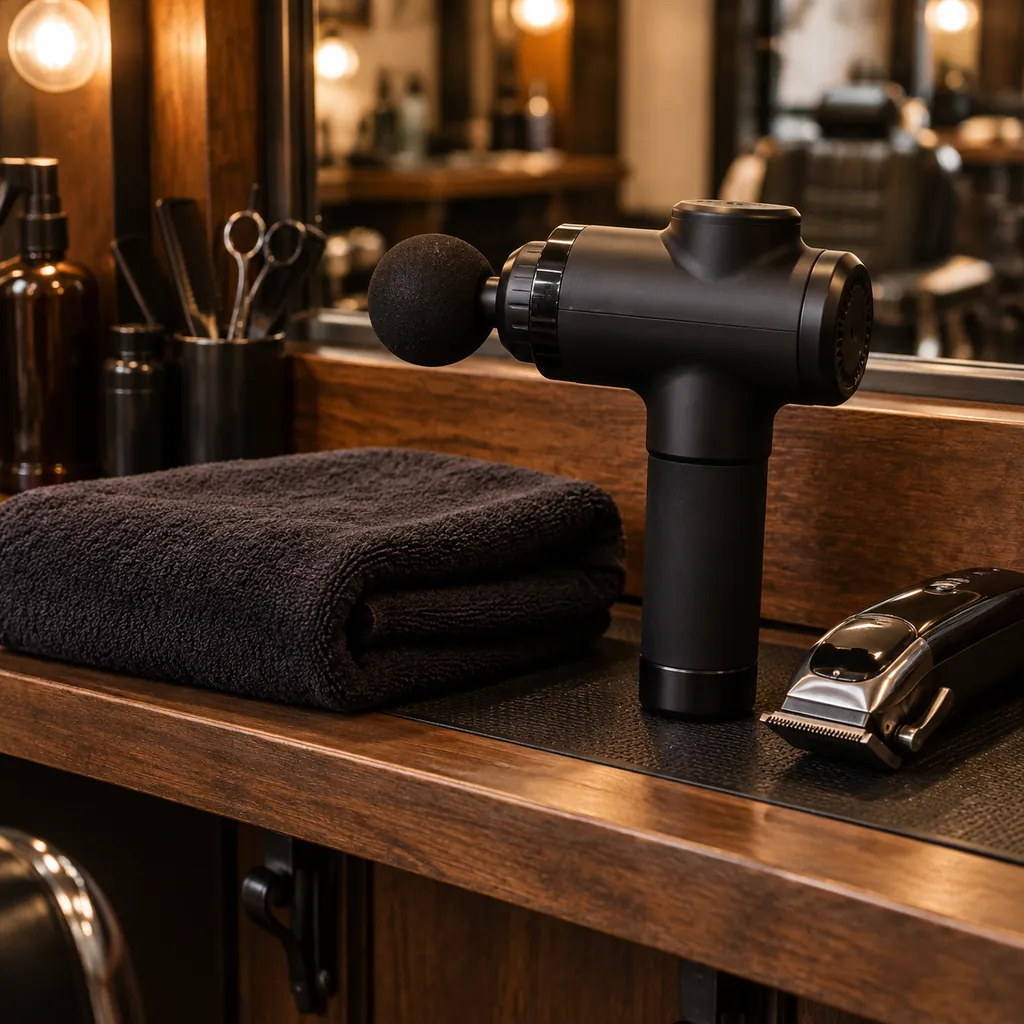
Barbering is a physical job. Ten hours on your feet, shoulders rounded over a head, wrist and forearm doing thousands of tiny corrections a day, and by Friday your hands feel like they belong to someone twice your age. Massage tools are not a luxury for this trade: they are how a lot of working barbers keep their forearms, traps and lower back usable through a busy week. This guide covers every type of massager worth a barber’s money, from full-size percussion guns to the $9 roller stick that lives in a shop drawer, and how to actually use them without bruising yourself.
- Best overall: Theragun Prime (6th Gen) – the deepest stroke for the money
- Quietest and longest battery: Hypervolt 2 – listed at $229
- Best budget: TOLOCO Massage Gun – $39.99, the #1 best seller in electric back massagers
- Why barbers beat up their forearms and shoulders
- Every type of massager, and which one a barber needs
- What actually matters in a massage gun
- Theragun Prime (6th Gen): the one to buy first
- Hypervolt 2: the quieter alternative
- Theragun Mini and Hypervolt Go 2: the travel picks
- The budget pick: TOLOCO
- Shiatsu kneading pillows: the VIKTOR JURGEN pick
- Air compression for hands and wrists: Medcursor
- The $9 manual tool: IDSON muscle roller stick
- A five minute end-of-shift routine that works
- How to use it without hurting yourself
- FAQ
Why barbers beat up their forearms and shoulders
Every haircut is a static hold plus repetition. Your non-cutting arm holds tension in the comb hand, your clipper wrist deviates hundreds of times per fade, and your traps carry your arms at chest height for hours. Add standing on concrete and you get the classic barber complaints: tight forearms, burning between the shoulder blades, stiff neck, sore lower back.
Stretching helps, sleep helps more, but targeted percussion is the fastest way to get blood into a locked-up muscle at the end of a shift. Physical therapists Bob and Brad, whose channel has millions of subscribers, put the basic case plainly:
“Massage guns work by increasing blood flow and decreasing muscle tension, and they can be an effective tool when used correctly.”
– Bob and Brad, physical therapists
Every type of massager, and which one a barber needs
Massage tools are not one category, and buying the wrong type is the most common mistake. Here is the full field, and where each one fits a working barber:
- Percussion massage guns deliver rapid pulses deep into muscle. This is the tool for locked forearms, traps and lower back after a long day of cutting, and it is the core of this guide.
- Vibration massagers buzz the surface rather than punch into it. They are cheaper, quieter and gentler, which makes them fine for warm-ups and light soreness, but they do not reach deep fascia the way percussion does.
- Shiatsu kneading massagers use rotating nodes that knead like thumbs. These are the pillows you lean into after a shift; they are excellent on neck, shoulders and upper back, and they do the work for you instead of asking you to aim a gun.
- Air compression massagers inflate and deflate around a body part, most commonly hands and wrists. For barbers whose complaint is a swollen, tired grip hand rather than a knot, this is the type that fits.
- Manual massage tools, like muscle roller sticks and massage balls, have no motor at all. They cost almost nothing, never run out of battery, and stay in a shop drawer for quick use between clients.
If you buy only one tool, make it a percussion gun, because it covers the widest range of barber complaints. Then add the cheap manual stick for the drawer and you are covered from both ends of the price scale.
What actually matters in a massage gun
- Amplitude: how deep each stroke travels. 12 to 16mm reaches real muscle; cheaper guns with 6 to 8mm mostly buzz the skin.
- Stall force: how hard you can press before the motor quits. Budget guns stall the moment you lean in.
- Noise: anything you use at home at 10pm needs to stay quiet. Look for a brushless motor.
- Battery: two hours or more means charging weekly, not nightly.
- Weight and grip: you will hold it one-handed against your own shoulder. Around 2 pounds with an angled or triangular grip is the comfortable zone.
Theragun Prime (6th Gen): the one to buy first
The Theragun Prime is the entry point of the Therabody line and the right level of gun for a barber. It delivers 16mm amplitude percussive therapy, the deepest stroke in its price class, which is what lets it work through a locked forearm or trap instead of tickling it. The current 6th generation model is built tougher than the older Primes and runs about two hours per charge.
Therabody’s own summary of what it is for:
“A deep tissue massage gun that uses percussive therapy to relieve muscle pain, increase flexibility and speed up recovery.”
– Therabody, on the Prime
The triangle handle is the underrated feature: it lets you grip at three angles, so you can reach your own upper back and the outside of your forearm without contorting. It is HSA and FSA eligible, FDA registered, and carries a one year warranty. Expect to pay in the $250 to $300 range depending on color and sales. This is the gun this guide would buy first.
- 16mm amplitude, the deepest in class at this price
- Triangle multi-grip handle for self-treatment
- About 2 hours of battery, USB charging
- Best for: barbers who want one gun that handles forearms, traps and back
Hypervolt 2: the quieter alternative
The Hypervolt 2 is the other name every shop knows. It trades some depth for refinement: a brushless 60 watt motor, three speeds from 2,000 to 2,700 percussions per minute, about three hours of battery, and Hyperice’s QuietGlide sound dampening, which makes it the quieter living-room option. It weighs 1.8 pounds and ships with five head attachments, one more than the Prime.
The Hypervolt 2 is currently listed at $229 for the standard model, well under the Prime, and it holds a 4.1 star average across more than 400 ratings on Amazon. Buy it from Hyperice rather than a third-party reseller and you keep the full one year warranty. The Pro version is also in stock at $349 if you want the stronger model, though the standard covers what a barber actually needs.
- 3 speeds, 2,000 to 2,700 PPM
- About 3 hours battery, the best in this guide
- Five attachments including a fork for forearms and spine
- Best for: noise-sensitive homes, anyone who values battery life over stroke depth
Theragun Mini and Hypervolt Go 2: the travel picks
A second gun that lives in your bag beats carrying your main one between shop, home and conventions. Compact guns trade amplitude for size, so treat them as lighter-duty tools, not replacements.
The TheraGun Mini (3rd Gen) is the strongest small gun in Therabody’s line. It is listed at $219.99, holds a 4.6 star average across nearly 2,000 ratings, and runs the same quiet brushless motor family as the full-size Prime in a body that fits a jacket pocket. It suits barbers who travel for guest spots and education and want one recovery tool in the carry-on.
The Hypervolt Go 2 is Hyperice’s compact option at a much lower $139, with a 4.4 star average across more than 2,000 ratings, free returns, and the same QuietGlide quietness as the Hypervolt 2. For most barbers the Go 2 is the smarter travel buy: it costs about $80 less than the Mini and covers the same forearm-and-trap duty on the road.
- TheraGun Mini: $219.99, 4.6 stars (about 2,000 ratings), pocket-size with the Prime’s feel
- Hypervolt Go 2: $139, 4.4 stars (over 2,100 ratings), quiet, free 30-day returns
- Best for: guest spots, barbershopping on the road, and a bag that already has clippers in it
Check Price on Amazon Check Price on Amazon
The budget pick: TOLOCO
Not everyone can start at $230, and the budget tier has one genuine standout. The TOLOCO Massage Gun is listed at $39.99 (down from a $59.99 list), carries a 4.4 star average across more than 62,000 ratings, and is the #1 best seller in electric back massagers on Amazon. It ships with 10 massage heads and a silent brushless motor, sold by TOLOCO’s own storefront with a 30-day refund policy.
The honest limits of the budget tier still apply: shorter stroke, lower stall force, and a battery that may fade within a year. But at this price the math is different. A TOLOCO you use every night beats a Theragun you keep in the box because you did not want to spend the money yet. If the habit sticks, upgrade later and keep the TOLOCO in the shop drawer.
- $39.99, 4.4 stars across 62,000+ ratings
- #1 best seller in electric back massagers
- 10 heads, quiet brushless motor, 30-day refund policy
- Best for: first percussion gun, shop break-room gun, backup for travel
Shiatsu kneading pillows: the VIKTOR JURGEN pick
Some barbers do not want to hold anything at the end of the day. A shiatsu pillow does the work for you: rotating 3D kneading nodes dig into your neck and shoulders while you lean into it, usually with a heat function layered on top.
The VIKTOR JURGEN Shiatsu Back Massager is the category’s long-running favorite: 4.3 stars across more than 36,000 ratings, currently on a limited-time deal at $35.99 (typical price $39.99), sold by VIKTOR JURGEN’s own storefront with free returns. Drop it on a chair, lean your traps and neck into it, and let the nodes and heat do fifteen minutes of work while you decompress.
It is corded rather than cordless, so it lives where you recover rather than travelling with you. Pair it with a gun: the gun for the forearms you have to aim at, the pillow for the neck you just want to melt into.
- 3D kneading nodes plus heat, for neck, shoulders and back
- 4.3 stars across 36,000+ ratings
- $35.99 limited-time deal (typical $39.99), free returns
- Best for: end-of-shift neck and trap relief without holding a device
Air compression for hands and wrists: Medcursor
Percussion and kneading treat muscles, but the complaint many barbers describe is different: a hand that feels swollen and tired from gripping tools all day. That is what air compression devices target. They wrap the hand and inflate in sequence, applying and releasing pressure along the palm, fingers and wrist.
The Medcursor Hand Massager combines that sequential compression with heat, aimed at stiff joints and tired hands. It is listed at $69.99, holds a 4.4 star average across more than 3,300 ratings, and is sold and shipped by Nekteck Direct with free returns. Slip the hand in after closing, let a session run, and the grip hand gets circulation work that a gun cannot give it.
One caution that applies to every tool in this guide: compression and percussion are not treatments for nerve problems. If you have numbness or tingling that does not fade overnight, that is a doctor conversation, not a gadget one.
- Sequential air compression plus heat for palm, fingers and wrist
- 4.4 stars across 3,300+ ratings, $69.99
- Cordless and rechargeable, sold by Nekteck Direct
- Best for: the swollen, overworked grip hand at the end of a cutting day
The $9 manual tool: IDSON muscle roller stick
The oldest massage technology is still worth a spot in the shop: a rolling stick you run along a muscle with your own hands. It has no battery to die mid-session, it cannot stall, and it costs less than a pack of blades.
The IDSON Muscle Roller Stick is the category’s standard: 4.5 stars across more than 26,000 ratings, listed at $8.89, with over 900 bought in the past month alone. Roll it down your forearms and calves during a slow afternoon and it does real myofascial work. Keep one in the shop drawer and one in your bag. At $8.89 this is the highest-value recovery tool in this guide, and it belongs in every barbershop drawer.
Rollers are also the tool of choice for legs. Barbers stand all day, and calf and IT-band work is where a stick outperforms a gun you cannot easily reach behind yourself with.
- 4.5 stars across 26,000+ ratings, $8.89
- Works forearms, quads, calves and IT band with zero setup
- Best for: shop drawer, between-client quick release, leg work
A five minute end-of-shift routine that works
The tools only work as part of a short ritual, not as a random grab when something already hurts. Here is the sequence experienced barbers describe: two minutes on each forearm with the gun while you are still at the station and the muscles are warm, a minute per trap leaning against the wall, then thirty seconds per calf before you sit down for the first time all day. Finish with a slow wrist stretch, fingers interlaced, palms pressed out for thirty seconds.
On the nights you are too wrecked to aim a gun, swap the forearm work for the shiatsu pillow and the compression glove. The sequence matters more than the specific device.
Do that five days a week and the end-of-week hand fatigue stops compounding. Skip it for a month and the same aches creep back. Consistency beats intensity every time with recovery tools. For the skin side of the same problem, see our guide to hand care for barbers.
Video credit: Bob and Brad
How to use it without hurting yourself
- Start on the lowest speed for the first week. More intensity is not more recovery.
- Glide, never press and hold. Move the head slowly along the muscle, about an inch per second.
- Thirty seconds to two minutes per muscle group is enough. Forearms, traps, pecs, glutes, calves.
- Never run it over bone, the front of the neck, or directly on the spine. Muscle only.
- Use it after your shift, not right before gripping clippers for six hours. Freshly percussed muscles are temporarily looser and weaker.
Which attachment for which spot
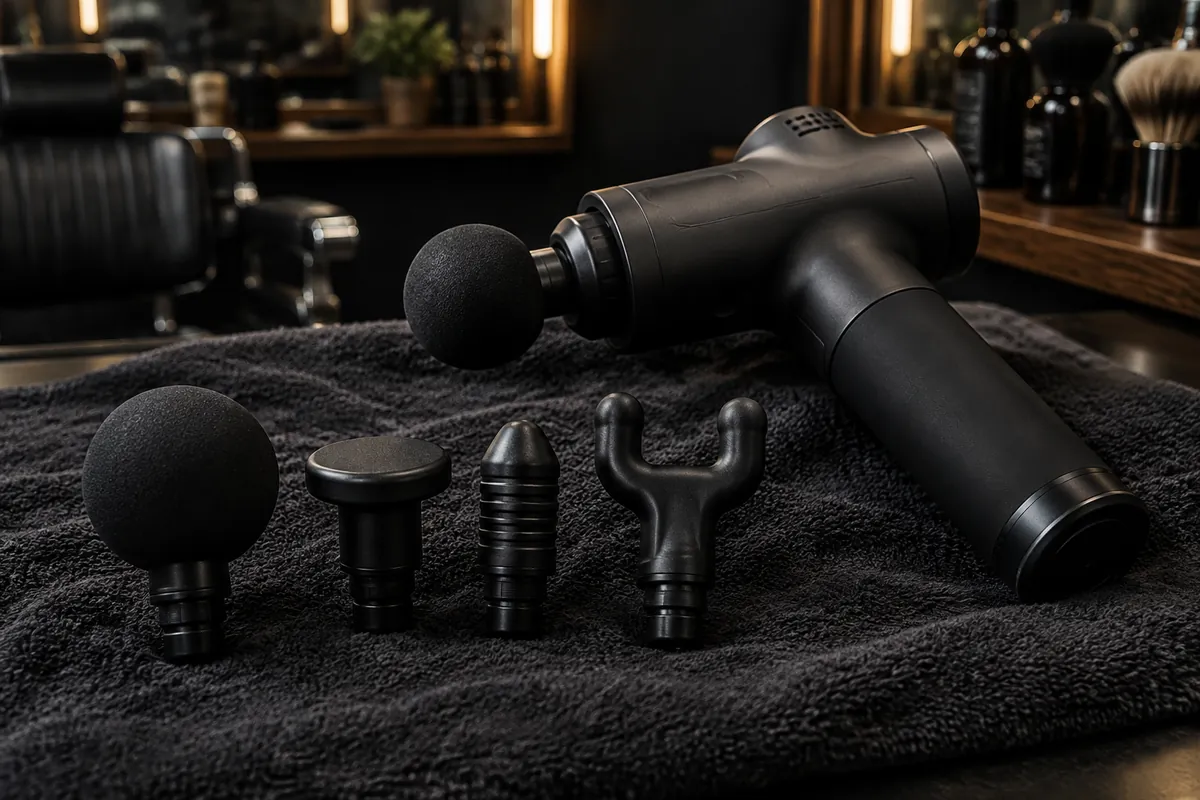
Use the big round ball for large muscles like traps and glutes, the flat head for forearms and quads, the bullet for a specific knot you can point to with one finger, and the fork around (never on) the spine. The dampener or cushion head is the one for bony spots like the back of the hand.
FAQ
Which type of massager should a barber buy first?
A percussion gun. It covers forearms, traps, back and legs, which are the four places barbering actually hurts. Add the $9 roller stick and you have most of your needs covered for under $250 total with either main pick.
Can a massage gun fix carpal tunnel?
No. Carpal tunnel is a nerve compression issue, not a muscle knot, and percussion on the wrist can make it worse. See a doctor for numbness or tingling.
Is a compression hand massager better than a gun for hands?
For a swollen, tired grip hand, yes, that is the compression device’s whole job. For knots in the forearm flexors, the gun is the better tool. Many barbers use both.
How often should a barber use one?
Daily use on tight spots is fine as long as you keep sessions short and stay on muscle. Most working barbers settle into five to ten minutes after the shift.
Is the Theragun worth it over a cheap gun?
If you use it three or more times a week, yes. The 16mm stroke is the difference between a real deep tissue effect and a surface vibration, and the motor will outlast several budget replacements. If you are unsure the habit will stick, the $39.99 TOLOCO is the honest starting point, and if you are shopping for someone else, this guide pairs well with our list of gifts for barbers who have everything.