As an Amazon Associate, Trusted Barber earns from qualifying purchases.
Your razor handle and its spare blades do not necessarily belong in the same bag. That is the packing detail to settle before a holiday flight, especially if your usual shaving routine uses removable blades.
The short answer
For U.S. TSA screening, electric razors and hair clippers are listed as allowed in carry-on and checked bags. Disposable razors are allowed too. A safety razor may go through the checkpoint without its blade, but loose razor blades do not belong in carry-on. Shaving liquids, gels, creams and aerosols have a separate container-and-bag rule.
This guide covers ordinary personal grooming items under U.S. TSA and FAA guidance checked October 27, 2026. Your airline and an overseas airport can have additional restrictions. The TSA officer makes the final checkpoint decision.
What goes in which bag?
Electric razor
Carry-on: Yes, TSA listing
Checked bag: Yes, TSA listing
Battery rules still apply.
Hair clippers
Carry-on: Yes, TSA listing
Checked bag: Yes, TSA listing
Protect a battery-powered tool from accidental activation.
Disposable razor
Carry-on: Yes
Checked bag: Yes
Wrap or cover sharp items in checked baggage.
Safety razor with removable blade
Carry-on: Handle without blade
Checked bag: Yes
Remove the blade before reaching screening.
Loose razor blades
Carry-on: No
Checked bag: Yes
Sheath or securely wrap them.
Scissors
Carry-on: Less than 4 inches from pivot
Checked bag: Yes
Measure the blade section, not the full handle-to-tip tool.
Shaving cream aerosol
Carry-on: Up to 3.4 oz/100 ml container
Checked bag: Yes, with limits
Protect the release button and check toiletry quantity limits.
These cards combine TSA’s electric-razor and hair-clipper entries with the other item pages and FAA battery guidance. It is not a promise that every accessory in a bundled grooming kit has the same rule. Open the kit and inspect the separate parts.
Choose the razor before packing
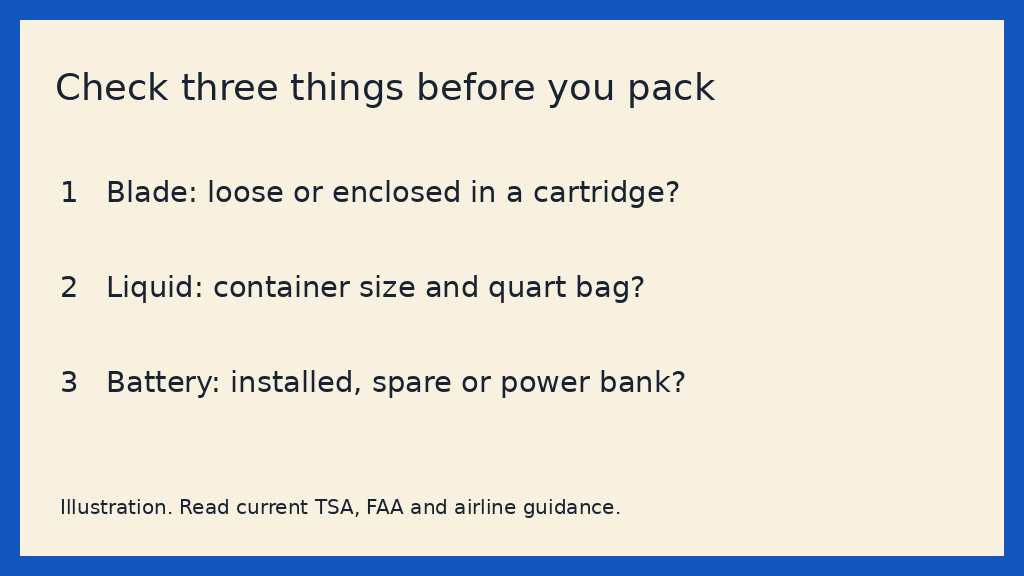
TSA lists disposable razors as allowed in both bags. Its travel checklist also permits shaving blades enclosed in a safety cartridge from which the blade cannot be removed. That is different from packing loose replacement blades for a traditional safety razor.
For a safety razor, TSA says the blade must be removed before entering the checkpoint. Officers are not authorized to remove it from the holder for you. Do that job while packing, not while standing at the belt with an open bag.
“A Safety Razor is allowed through the screening checkpoint without the blade.”
If you are checking a bag, TSA permits razor-type blades there and says sharp objects should be sheathed or securely wrapped. A spare blade tucked loose into a side pocket misses that packing instruction even though checked baggage is the right route.
For carry-on-only travel, choose a shaving setup that fits the rules rather than expecting an exception for your favorite blade. An electric razor is one option; a permitted disposable or cartridge setup is another. The right choice is the routine you can pack correctly and still use at your destination.
Put grooming liquids in the right containers
TSA’s liquids rule covers liquids, aerosols, gels, creams and pastes, not just products that pour like water. It permits travel-size containers of 3.4 ounces or 100 milliliters or less, fitting together in one quart-size bag per passenger.
Look at the container size before packing shampoo, conditioner, shaving cream or other grooming products. TSA directs containers larger than that limit to checked baggage. The rule is about the container, so do not choose an oversized bottle merely because you have used most of what was inside it.
“Each passenger is limited to one quart-size bag of liquids, gels and aerosols.”
Checked baggage is not an unlimited aerosol cupboard. TSA’s shaving-cream page lists the FAA limit for restricted toiletry articles as 2 kilograms or 2 liters total per person, with each container no larger than 0.5 kilograms or 500 milliliters. It also requires aerosol buttons or nozzles to be protected against accidental release. Check the actual product and the applicable rule before adding a large can.
TSA’s liquids-rule video
TSA’s own 3-1-1 explainer puts the container limit and quart-sized bag together. Its description includes liquids, aerosols, gels, creams and pastes. That is the rule to use for the grooming products in this section, rather than treating a small amount left in a large bottle as a travel-sized container.
Credit: TSA, TSA’s 3-1-1 Liquids Rule.
Measure scissors from the pivot
TSA’s scissors page says carry-on scissors must be less than four inches from the pivot point. That is a specific measurement. The overall length printed on a grooming-scissors package may include the handles and does not answer the question by itself.
Measure the part TSA names. If you are packing scissors in checked baggage, cover or securely wrap the sharp parts. A zippered toiletry bag is organization; it is not a substitute for protecting an exposed sharp point inside it.
Do not extend the scissors rule to a folding multi-tool with a knife. TSA has a separate multi-tool entry, and tools with knives are not allowed in carry-on. Check every part of a travel grooming kit rather than assuming a small accessory gets a free pass.
Separate the tool from its spare batteries
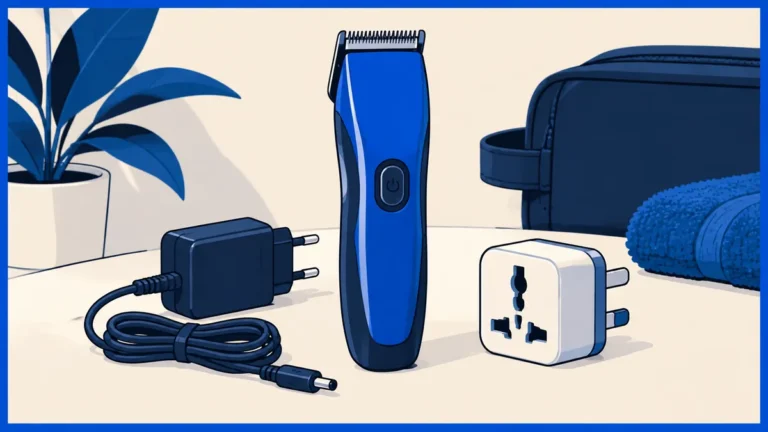
TSA’s yes for an electric razor or hair clipper does not cancel FAA battery requirements. FAA recommends keeping portable electronic devices containing lithium batteries in carry-on baggage. If such a device is checked, it must be completely powered off and protected from accidental activation and damage.
Spare lithium batteries and power banks belong in carry-on, not checked baggage. Protect them from damage and short circuits. FAA’s passenger guidance includes battery charging cases in that spare-battery category, so check a powered travel case separately from an ordinary protective case.
“Spare lithium batteries (including power banks and portable chargers) must be carried on and cannot be checked.”
Battery capacity and airline limits still matter. Use the battery’s marking and the airline’s guidance instead of treating a compact-looking accessory as automatically permitted. If you cannot identify the battery rating or the required packing method, settle that before leaving home.
Repack if the carry-on gets checked
A bag that started as carry-on can become checked baggage at the gate. FAA explicitly says spare lithium batteries must be removed when a carry-on is checked at the gate or planeside and kept with the passenger in the cabin.
Keep those items accessible rather than buried under clothes. Also check that any battery-powered device going into the hold is fully off and protected. This is a change in where the bag travels, not a reason to forget the contents you packed under carry-on rules.
A final bathroom-counter check
- Empty the toiletry bag first, including the pockets that might hold an old blade.
- Check the razor type and remove a safety-razor blade before screening.
- Measure scissors from the pivot if they are going in carry-on.
- Fit permitted grooming liquids into the passenger’s quart-size bag.
- Protect aerosol release devices and any checked sharp objects.
- Keep spare lithium batteries and powered charging accessories on the correct route.
- Check your airline and any overseas departure airport separately.
Our travel-clipper and toiletry-bag guides cover choosing the equipment and organization. This is the separate packing decision: what is inside, which bag it belongs in and what changes if the airline checks that bag.
A kit that keeps the rules simple
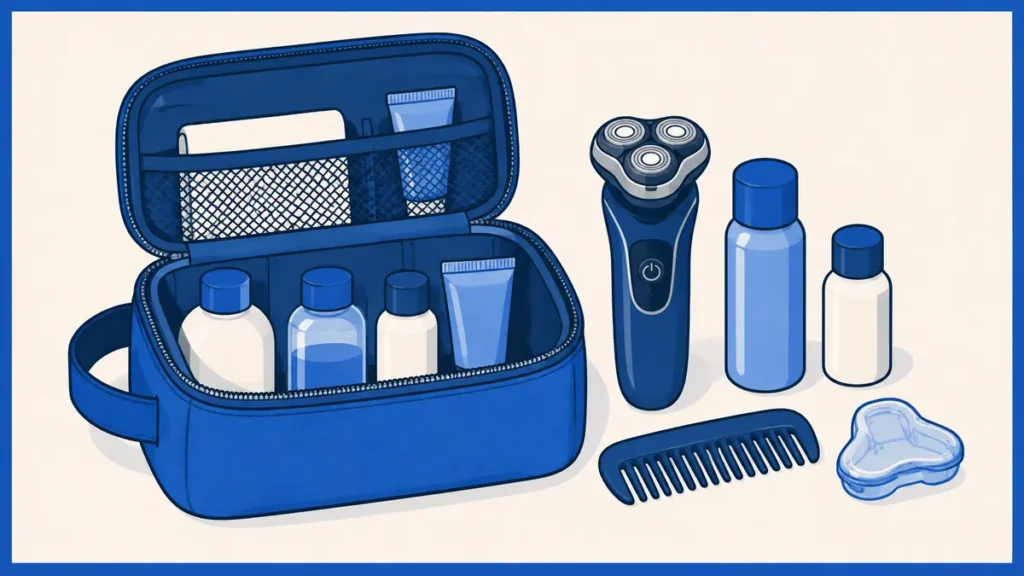
The rules above get easier when the kit itself is simple. A cordless wet/dry trimmer removes most of the batteries-and-blades questions at once: the Panasonic wet/dry beard trimmer and Wahl’s Aqua Blade both charge from a single cord, are rated for wet and dry use, and pack in a case small enough for a carry-on. Liquids are the part travelers still get wrong, and a set of silicone travel bottles in the 3.4-ounce carry-on size turns the 3.4-ounce size limit from a guess into a formality: fill them below the line, cap them, and the bin at security stops being a risk. A duplicate kit that lives in the toiletry bag, assembled once, means the packing decision is already made the next time a flight comes up.
FAQ
Can an electric razor go in carry-on? TSA lists electric razors as allowed. Follow the battery rules for the device and any separate charging case or spare battery.
Can a safety razor go through without its blade? TSA says yes, with the blade removed before the checkpoint. Loose razor blades are not permitted in carry-on.
Does a small amount of cream make a large container acceptable? TSA specifies travel-size containers no larger than 3.4 ounces or 100 milliliters. Pack the container that meets the rule.
Are these worldwide rules? No. These are U.S. TSA and FAA sources. Airlines and international security rules can be more restrictive.