Video credit: Benson Hedges, Cadmin Academy, on YouTube. The hot towel shave is one of those services that looks like theater and is actually physics. In his hot towel shave tutorial, educator Benson Hedges of Cadmin Academy walks through the full service, and the core of it is simple: preparation decides the outcome. A hot towel shave can take up to eight layers of dead skin off the face, which is why it has a reputation for leaving skin clearer, and the technique behind it works the same on your bathroom floor as it does behind the chair. Here is the method, step by step, with the products that carry each stage.
Disclosure: this article contains Amazon affiliate links. As an Amazon Associate we earn from qualifying purchases, at no extra cost to you. It does not change what we recommend.
Key theme: The whole service rests on three fundamentals: the stretch of the skin, the angle of the blade, and how much hair you take off in one stroke. Get those right and irritation barely shows up.
Why the hot towel shave earns its reputation
People ask why they would pay for a shave they can do themselves. Hedges gives two answers. The first is the experience: a relaxed, reclined thirty minutes where someone else handles the details. The second is the skin. A straight razor pass exfoliates as it cuts, lifting away layers of dead skin you cannot reach with a washcloth, and that is where the clear-skin reputation comes from. Done badly, the same blade irritates the face and causes breakouts instead. The difference between a great shave and a bad one is almost entirely preparation.
Setting up: the two-towel rule
The service starts before anything touches the face. Hedges uses two towels with different jobs. The first gets its corners connected into a triangle so the neck sits in the opening, then it tucks into the collar. Its whole purpose is catching lather drips so nothing stains the shirt. The second towel lays across the chest and becomes the wipe-down surface for the blade between strokes. At home, a towel on the shoulders and one on the chest does the same job, and if you plan to do this regularly, a dedicated towel warmer keeps the hot part of the routine effortless.
Pre-shave oil and reading the grain
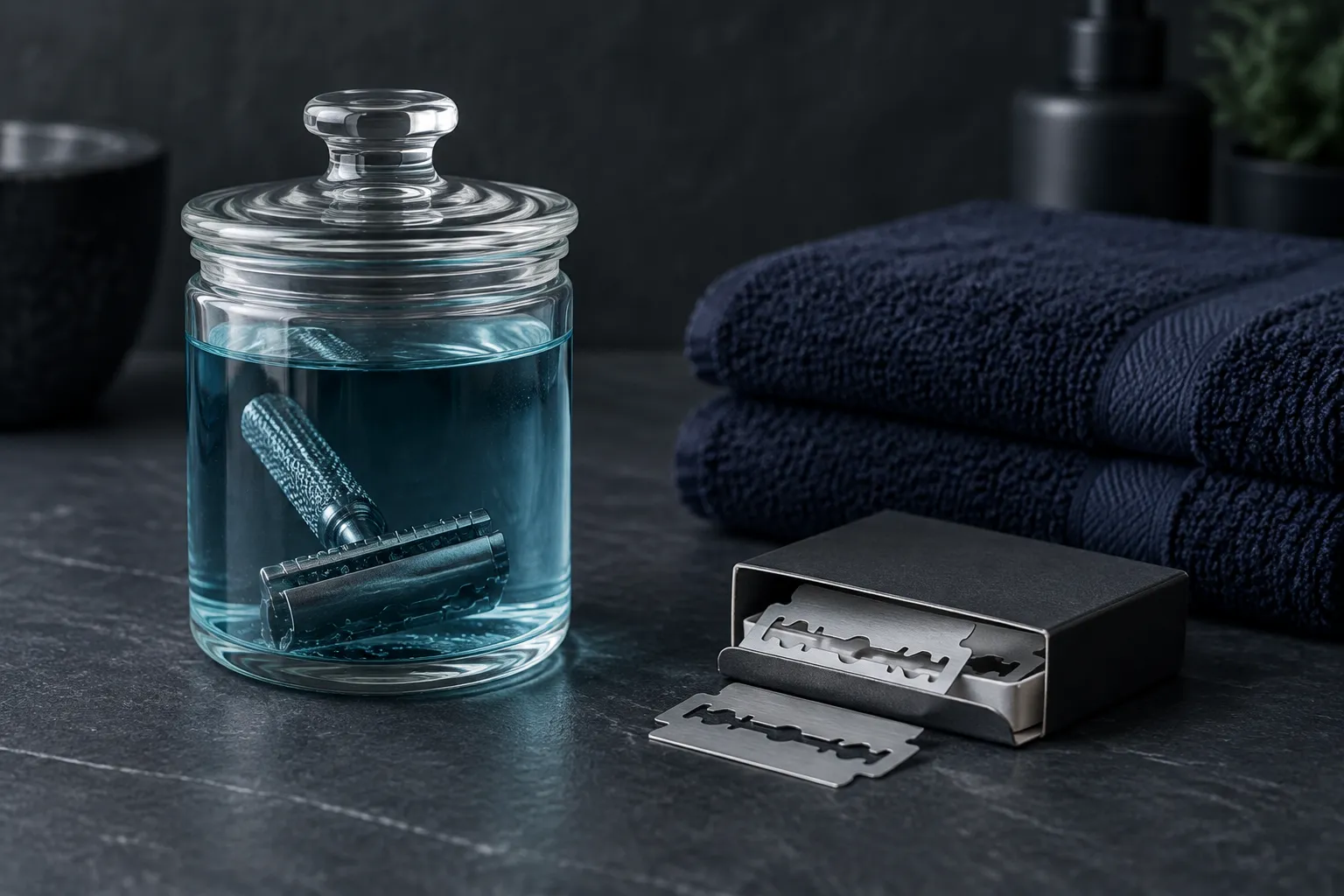
The first product on the skin is pre-shave oil, massaged in gently. Hedges uses this moment for something most home shavers never think about: feeling out the direction the hair grows before the blade ever lands. Cheek hair usually runs downward, but neck hair frequently grows upward or sideways, and shaving down the neck means going against that growth, which turns an aggressive pass into an irritating one. Two minutes of reading the grain with your fingertips tells every later stroke where to go.
For the lubricating step, a dedicated pre-shave cream does the same work the oil does: it sits between skin and blade and cuts friction.
Key theme: Neck hair lies. It often grows upward where cheek hair grows down. Read it with your fingers during the pre-shave massage and let every pass follow what you find.
Lather that gets under the beard
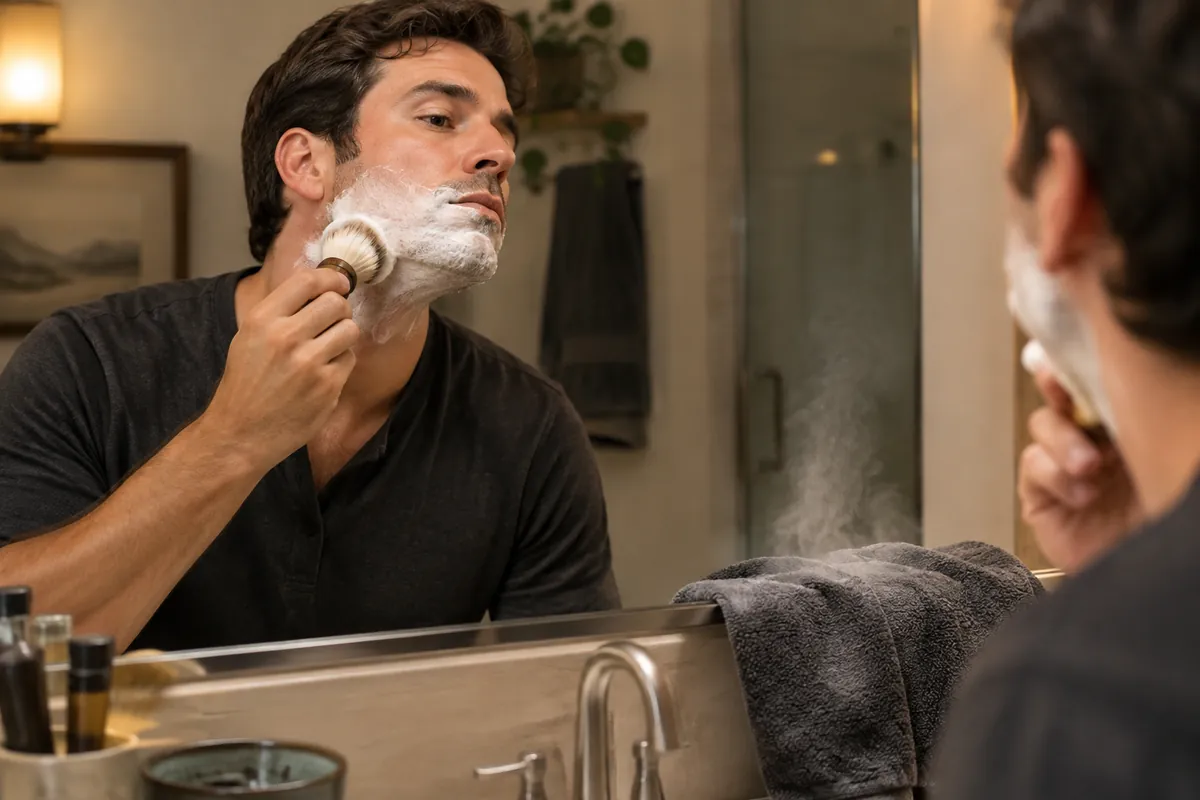
Next comes the first layer of shaving cream, whipped into a proper foam and worked in with a circular motion. The detail that matters: apply the lather against the grain so it pushes underneath the hair instead of flattening it. This works whether the beard is long or already trimmed, because the goal is contact with the skin, not coverage of the hair. A dense cream with real cushion holds moisture through all three passes.
The hot towel itself: one minute at a time
The towel comes off the warmer, and the first test is against your own hands: it should feel safe to the touch before it reaches a face. Fold it so it sits under the nose, then wrap it through the contour of the chin. Each hot towel stays on for roughly a minute, and it comes off while it is still hot. A towel that sits until it cools has stopped doing its job. The heat softens the skin and opens everything up so the blade glides instead of dragging, which matters more than most people expect: anyone who has shaved cold, tight skin knows exactly how rough that glide feels.
Between passes, the lather goes on again and the hot towel goes on again. That rhythm is also how the service flexes. More towels means more time in the chair, which is why barbers stack a shoulder massage onto the longer versions. If the person is drifting off, keep the second towel layered on top of the first so the eyes stay covered and nobody has to wake up under bright lights.
Key theme: Take the towel off before it cools. A minute of real heat does more than five minutes of lukewarm fabric, and warm skin is what makes the blade feel effortless.
The three passes, in order
Barber shaves are not one pass. They are three, each with a name and a purpose:
- Pass one, with the grain: the gentle pass. It removes the most hair but leaves the shave at its least close.
- Pass two, diagonal across the grain: the middle setting. Closer than the first pass without the aggression of the third.
- Pass three, against the grain: the closest shave and the most aggressive one.
Why three passes instead of one strong one? Because the stages do the work pressure would otherwise do. Each pass takes less hair than the last, so the blade never fights a full beard, and the skin gets a fresh towel and fresh lather between rounds instead of a longer, harder scrape.
The honest part of Hedges’ tutorial is what he does with pass three. Most people cannot take a full against-the-grain pass without irritation, and he says so from experience. His client needed two passes, with the diagonal as the finish. The skill is reading the skin as you go: if it flushes red or looks inflamed, the shave stops there, because protecting the skin outranks chasing one more level of closeness. Skipping stages is what makes home shaves burn; going with, then diagonal, then only against the grain if the skin allows, is what keeps it comfortable.
Blade control: small strokes and a real stretch
The technique notes that separate a trained hand from a casual one:
- Stretch the skin close to the blade. Tension falls off with distance, so the fingers pulling the skin tight should sit right beside the stroke.
- Use the heel or the toe of the blade, not the full edge. A couple of hairs per stroke, then reset. Full-width strokes pull and grab.
- Start where there is no hair and glide into it. Dropping the blade into the middle of dense growth is where pulling starts.
- Thicker hair gets smaller bites. The chin is usually the coarsest zone, so it takes the smallest strokes of the whole shave.
Forehand or backhand is personal, set by hand size and position. What is not optional is the stretch. Hedges even recruits the client for it: a tongue pushed up under the lip flattens the lower lip area perfectly, and he calls the same trick under the nose the piggy-nose stretch, tightening the most sensitive strip of the whole face. A sleeping client can be gently woken for one; the stretch is worth it.
One more blade note: a thick beard dulls an edge faster than people expect. If the blade stops doing the work and you find yourself powering through, change the blade. Pushing a tired edge is the fastest route to razor burn there is.
Key theme: Fewer hairs per stroke beats more pressure every time. The blade should cut on its own; the moment you push, the skin pays for it.
The lip and mustache: the most sensitive strip
Hedges is blunt about where shaves go wrong: the lip is one of the most sensitive areas to shave, and his whole blade technique grew out of working on the most sensitive zones. The rules stay the same there, just stricter. Only the toe or the heel of the blade touches the skin, never the full edge. Start at the bottom edge of the mustache where there is little hair, work slowly upward, and cut a little more with each pass instead of trying to clear the whole lip in one line.
The piggy-nose stretch does the rest. Pushing the lip up from the inside tightens that fine, sensitive strip under the nose, and the tighter the skin sits under the nose, the less irritation you will have. A sleeping client gets gently woken for that one stretch, because the alternative is a loose, moving lip under a live blade.
The finisher: powder and a foil shaver
Here is the trick Hedges saves for the end. Once the blade passes are done, he wipes the face clean, dries it fully, and dusts on talc powder until the skin no longer grabs. Then comes the surprise: a foil shaver finishes the shave against the grain with none of the straight razor’s aggression. The powder gives the shaver a dry, frictionless surface, and it sweeps up whatever stubble the blade left behind, including the spots everyone misses on the upper cheek. The client gets the closeness of an against-the-grain finish and the comfort of never going against the grain with a blade at all. At home, this is the single easiest upgrade to the routine, and a quality foil shaver does the same job. The Andis ProFoil Lithium Titanium Foil Shaver is the home-friendly version of the barber-grade foil, and the Clubman Pinaud Finest Powder is the classic barbershop talc that sets up that dry, smooth surface.
Cold towel, moisturizer, done
The service ends with a cold towel to close the pores, calm redness, and stop any minor nick from bleeding. Then a moisturizer goes on, and Hedges is firm about why: freshly exfoliated skin that hits cold, dry air tightens around the mouth and nose and feels like it is cracking. The moisturizer is the protective layer that prevents it. A dedicated post-shave balm does exactly this job.
Key theme: The cold towel is not optional ceremony. It closes what the heat opened, settles redness, and stops small nicks before they become noticeable.
What to do when the skin pushes back
Even with good technique, faces have opinions. Hedges’ answer is the hot towel again: another towel laid over an irritated patch keeps the skin soft while you decide whether to continue. If redness keeps climbing, the shave ends there, and the cold towel at the finish settles what is left. Small nicks respond to the cold towel too, which is part of why it sits at the end of the routine rather than being decoration. Some faces will not take even the diagonal pass, and Hedges’ client needed the shave to stop after two. That is a successful shave by his definition: the integrity of the skin comes before the closeness of the finish. Density and sensitivity decide how long a shave runs, which is why some sessions end early and others stack towel after towel. The rule worth keeping: irritation is feedback, not an obstacle to push through.
Assembling the routine at home
Four products carry the whole service. A towel warmer keeps the hot towels coming at the right temperature without a kettle ritual. The pre-shave cream handles lubrication and the grain-reading massage. A dense, cushioned shaving cream holds up across three passes, and a post-shave balm closes the routine the way the barber’s moisturizer does. Skip any one of them and the weak link shows up immediately: no pre-shave means friction, thin lather means blade drag, no moisturizer means that tight, cracked feeling an hour later. Two additions from the barber chair close the gap to a full service. A talc-style finishing powder readies the skin for the foil pass, and the foil shaver itself replaces the riskiest pass of the shave with a calm one.
None of them need to be exotic. The point of each step is what it changes about the shave, and each one here changes something you can feel.
Why it feels worth paying for
Hedges frames the service from the barber’s side: a proper hot towel shave can add around fifty dollars to a ticket, and clients keep coming back because of how their skin feels afterward. Flip that around and it tells you what a well-done home version is worth: the steam, the lather, the passes, the powder finish. The routine above is the full method, and every step in it exists for a reason you can feel the first time you skip one.
Video: Hot Towel Shave Tutorial, Benson Hedges / Cadmin Academy, via YouTube.
Keep the momentum going with the shaving creams and soaps that earn their place in a routine, see how barbers handle the neckline, cheek line and lip line, or get the lowdown on beard oil versus balm versus butter for the days you skip the blade.