TrustedBarber is reader-supported. If you buy through links on this page, we may earn a commission from Amazon at no extra cost to you.
If you want a shaved head without ever dragging a razor across your scalp, there is a barber method built for exactly that. Barber and educator BelieverBarber walks through it in his head shave tutorial: a three-tool approach using clippers, trimmers and a shaver that gets your head, in his words, razor close without actually having to use the razor. He made the video after his barber-focused version pulled questions from regular people, including women who shave their heads and guys thinking about doing it for the first time. Here is the method.
Why barbers skip the razor
The pitch is simple: you can get down to what looks and feels like a fresh razor shave using only electric tools. No blades against the skin, no lather routine, and a result BelieverBarber describes as razor close. For anyone nervous about taking a blade to their own scalp, or anyone who just wants a faster weekly routine, that trade is worth a lot.
The three tools you need
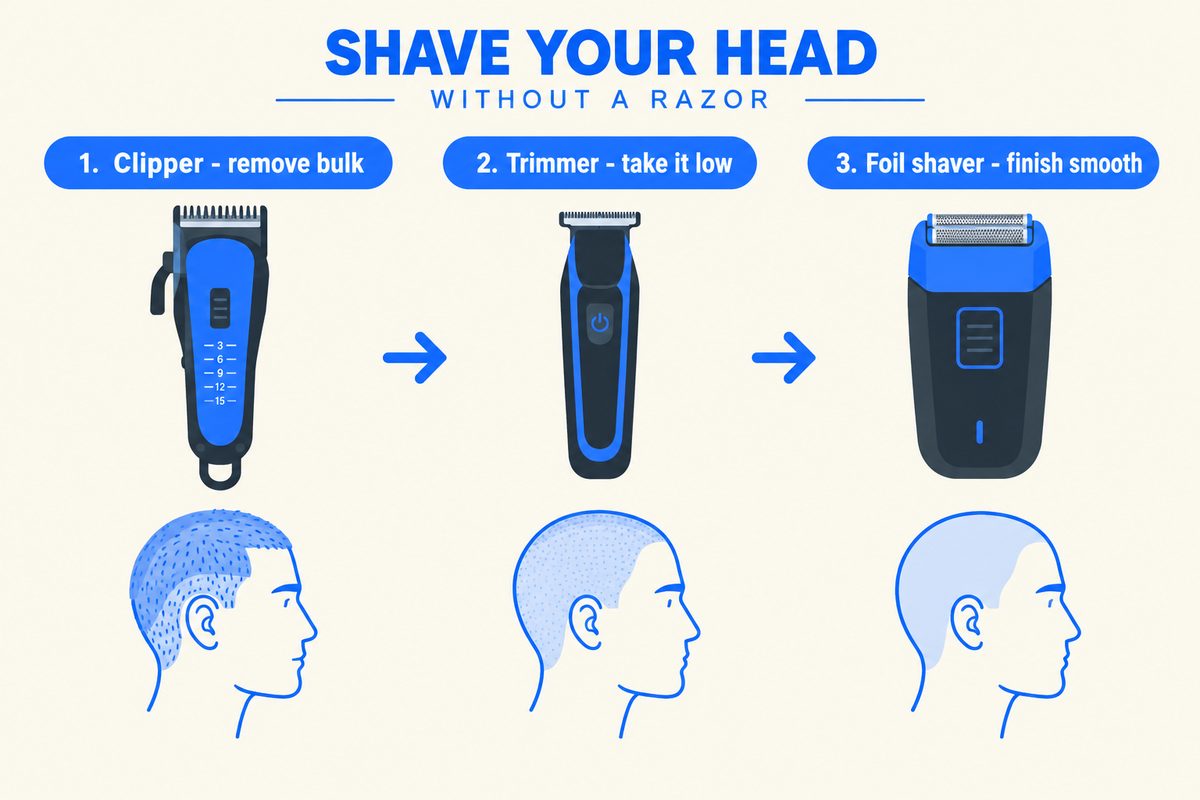
1. An adjustable clipper, if you have longer hair
If you are starting with any real length, the first tool is an adjustable clipper. BelieverBarber’s point is that the motor matters: a full-size clipper motor is built to go through all lengths of hair, and if your hair is thick, you want that bigger motor because it is far more powerful and effective at removing bulk than smaller tools.
Our pick for this role: the Wahl 5 Star Magic Clip Cord/Cordless, from Wahl’s professional 5 Star line. It runs corded or cordless, and the adjustable taper lever lets you open the blade up for bulk removal or close it down as you refine, so one clipper covers the whole first pass.
Check the Magic Clip on Amazon
2. A trimmer to take it down low
Once the bulk is gone, or right away if your hair is already short, you move to a trimmer. This is the tool that takes everything down as low as it will go before the finishing pass. A T-blade trimmer gives you the control to work around the ears and the back of the head cleanly. The Wahl 5 Star Cordless Detailer pairs an extended T-wide blade with cordless handling, made for this kind of close, controlled work.
3. A foil shaver to finish
The third tool is the one that replaces the razor: a foil shaver. This is the finishing pass that takes the trimmer’s stubble down to skin. The Andis ProFoil Lithium is a cord/cordless shaver with a titanium foil head and a lithium battery, built for exactly this finishing pass. For more options, see our best foil shavers for barbers roundup.
Why three tools instead of one
Each tool in the sequence does one job the others cannot. The clipper’s motor is there for raw bulk removal, which is why BelieverBarber puts so much weight on motor power for thick hair. The trimmer trades that power for control: a smaller blade that takes the whole head down to its lowest even length and stays accurate around the ears and neckline. The foil shaver is the only one of the three built to cut at skin level, which is what turns a very short buzz into a smooth head.
That division of labor is the whole design. Skipping the clipper on long hair overworks the trimmer, and stopping at the trimmer leaves the finish short of smooth. The sequence only works because each pass hands off to a tool made for the next stage.
The pro habits: grip, angles, tight skin
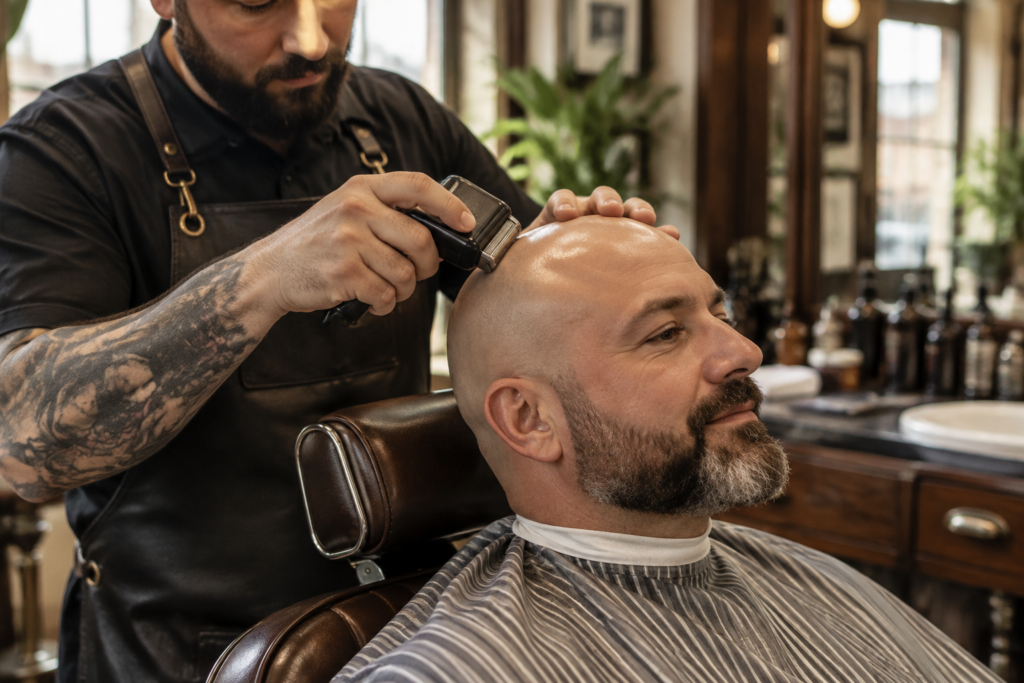
Wahl’s professional education team breaks the physical technique down further than most tutorials bother to, and four of their habits transfer straight to a home cut. First, grip follows direction: take an overhand grip when you work front to back, because it lets you control the blade angle and keep it flush to the scalp on every stroke, and switch to an underhand grip going back to front so the clipper moves freely in the harder to reach areas. Second, whatever the grip, keep the surface of the blade flush to the scalp; that is what gives a consistent cut with no pulling or snagging.
Third, cut from various angles rather than one direction, because hair grows in different directions and a single pass direction will miss some of it. Fourth, for the bumps and dents every head has, work the corner of the blade in short strokes from several angles so no contour keeps a longer, darker patch. And underneath all of it: pull the skin tight wherever you are cutting. Tight skin keeps the clipper from catching and lets the blade glide, and it costs you nothing but a free hand.
The method, step by step
- Remove the bulk with the adjustable clipper. If your hair is long, this is a required first pass. Let the clipper’s motor do the work and get everything down to a short, even length. If your hair is already short, BelieverBarber says you can skip this step and jump straight to the trimmer.
- Take it down with the trimmer. Work over the whole head until the hair is as low as the trimmer can get it, including the edges around the ears and the back of the neck.
- Finish with the foil shaver. Go back over the entire head with the foil. This is the pass that turns a very short buzz into a smooth, razor-close head.
If you are shopping for a clipper specifically for bald work, our best clippers for bald heads guide covers the tools built for it.
The mistake that leaves stubble
BelieverBarber calls out the most common error directly: most people use the trimmer and then stop. What they find is uneven spots or stubble, and by the very next day the head does not feel bald anymore. The foil shaver pass is not optional. It is the step that separates a genuinely smooth head from a shadow that grows back by morning.
That next-day difference is also how you judge your own work. If the head felt smooth right after the trimmer but rough by morning, the trimmer was asked to do the foil’s job. Add the finishing pass and the result holds.
Watch the full tutorial
Video credit: BelieverBarber on YouTube.
FAQ
Why does my head shave come out patchy?
Usually direction or contours. Wahl’s pro guidance is to cut from various angles, since hair grows in different directions, and to work the corner of the blade in short strokes over the head’s bumps and dents. Patches left longer are almost always a spot the full blade never reached flush.
Can I really get a smooth head without a razor?
Yes, according to BelieverBarber. The combination of clipper, trimmer and foil shaver takes you to a razor-close finish without a blade ever touching your scalp.
What if my hair is thick?
Start with an adjustable clipper that has a bigger motor. Thick hair needs the power to remove bulk efficiently before you move to the trimmer and shaver stages.
Can I skip the clipper if my hair is already short?
Yes. BelieverBarber notes that if your hair is very short to begin with, you can go straight to the trimmer and start taking it down. The clipper pass exists for anyone starting with real length.
Do I need all three tools?
For the razor-close finish, yes. The trimmer alone leaves stubble and uneven spots, which is the exact mistake he warns about. The foil shaver is what carries the result past day one.