
As an Amazon Associate, TrustedBarber earns from qualifying purchases.
In this guide
- What Makes a Great Barber Backpack
- The Cocco MBS Barber Backpack and Mobile Station: Best Value
- The G&BPRO Mobile Workstation Backpack: Best for Full Mobile Setups
- Backpack or Rolling Case?
- How to Pack a Barber Backpack So Nothing Gets Damaged
- Keeping the Bag Itself Clean
- Frequently Asked Questions
- The Verdict
Top picks
Best value: the Cocco MBS Barber Backpack and Mobile Station.
Best for full mobile setups: the G&BPRO Mobile Workstation Backpack.
Cocco MBS Barber Backpack G&BPRO Mobile Workstation Backpack
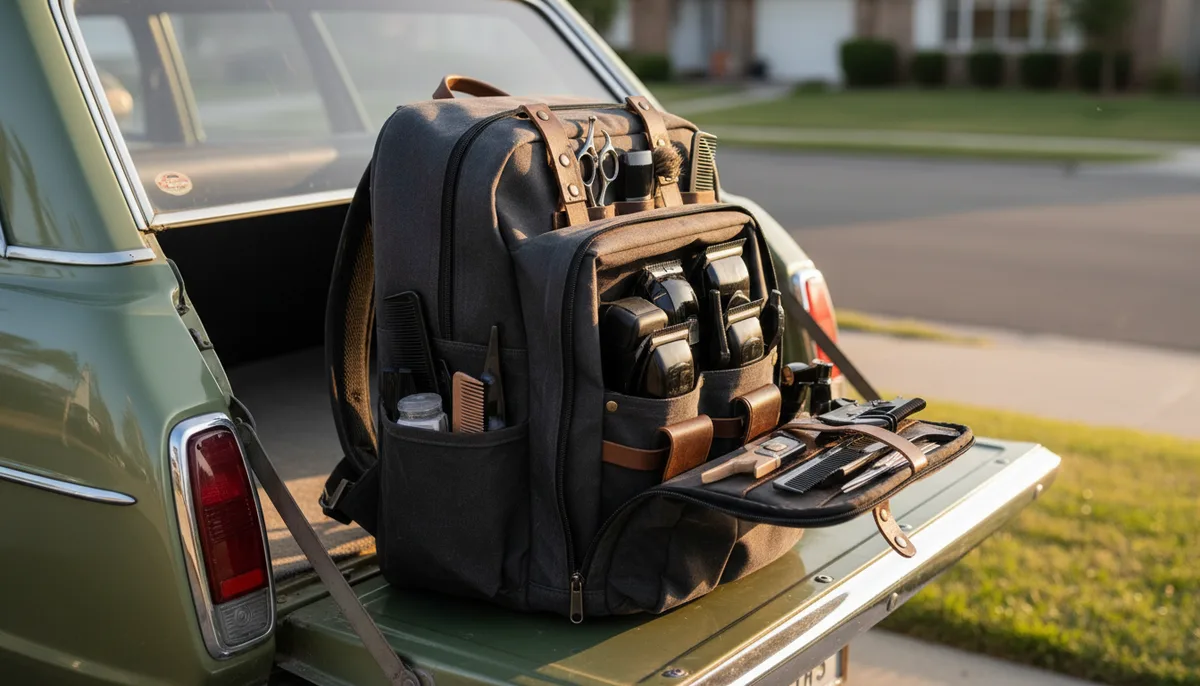
A barber’s chair is wherever the client says it is. House calls, wedding parties, senior-care visits, and on-site bookings all come down to one question: how do you get a full cutting kit across town without wrecking the tools or your back? A proper barber backpack answers that. It keeps cordless machines, shears, guards, capes, and sprays organized, padded, and off the floor of someone’s hallway. The Cocco MBS Barber Backpack and Mobile Station is the one most traveling barbers should start with, because it’s a hard-shell mobile station at a price that leaves room in the kit budget for a second machine.
Why a backpack instead of a roller bag? Because most of your work lives on foot, on transit, and up flights of stairs. A rolling case is great on smooth floors and useless on a porch step, and it announces itself at the door in a way a backpack doesn’t. When everything rides on your shoulders, you keep both hands free for the door, the sign-in sheet, and the coffee table you’re about to turn into a workstation.
What Makes a Great Barber Backpack
Capacity comes first, and it’s the spec people get wrong. Count your actual kit before you shop: two cordless machines, a trimmer, guards, shears, a cape or two, a spray bottle, clipper oil, batteries, chargers, and a cleaning kit. That fills a small suitcase before you know it, and a bag that looks roomy online can turn out to be a shoe compartment with delusions. Look for a stated capacity in the 20-to-40-liter neighborhood for a full setup, and treat the maker’s number as a rough guide rather than a promise.
Protection is the next filter, and it’s where hard-shell designs earn their price. Clippers have glass lenses, precise blade drives, and charging ports that do not enjoy being crushed under a book of laminates. A structured shell with dedicated padded slots means your machines don’t touch each other, your guards don’t rattle loose, and a drop off the back seat doesn’t end the day early.
Organization decides whether the bag actually saves you time. The best designs give every tool a fixed home: machines upright in their slots, guards nested in order, a zip pouch for liquids so a leaky spray bottle can’t ruin a cape, and a separate pocket for the used-tool side of the job. Lockable zippers matter more than you’d think if you leave the bag in a car or a studio between stops, and a water-resistant shell keeps a parked-outside-in-the-rain moment from becoming a service call on your electronics.
Comfort rounds it out. Fully loaded barber kits run heavy, so look for padded shoulder straps, a sternum strap, and a back panel that breathes. If a bag skimps there, you’ll feel it on the third house call of the day.
The Cocco MBS Barber Backpack and Mobile Station: Best Value
The Cocco MBS is built around one idea: the backpack is the workstation. The hard shell opens into a stable mobile station, so your setup and teardown both happen in the bag itself instead of on whatever surface the client’s kitchen offers. For barbers who work in living rooms, hotel rooms, and studio rentals, that alone separates it from ordinary soft backpacks.
The security side is unusually complete for a bag at this price. It carries a TSA lock, which keeps the main compartment zipped shut in transit and is the lock type screeners can open without cutting anything if your bag gets inspected. There’s also a built-in charging port, so a power bank inside the bag can keep a cordless machine topped up between stops, which is exactly the kind of small thing that saves a booking when the day runs long. At last check it was sold by Cocco Hair Pro and shipped by Amazon, with typical pricing in the low-to-mid hundreds.
Inside, the MBS layout fits the standard traveling kit: cordless machines in dedicated slots, room for guards and shears, and enough compartment separation to keep the clean side and the used side apart, which matters when you’re working out of one bag all day. The hard shell also means the bag holds its shape when it’s half empty, so small items don’t migrate to the bottom.
This is the pick for the barber who does regular house calls and wants one bag that does everything: protects the machines, doubles as the workstation, and doesn’t cost more than the clipper it carries. If your kit is two machines and a trimmer rather than a full book of laminates and a hot-towel setup, the MBS will carry it comfortably with room to grow.
The G&BPRO Mobile Workstation Backpack: Best for Full Mobile Setups
The G&BPRO Mobile Workstation Backpack (Full Size) takes the same concept further. It is built as a roomy full-size pack, and the defining feature is the extending tray: the pack opens up into a full mobile workstation, which is the closest a bag gets to bringing a folding table without carrying one. For event work, barbershop pop-ups, and expo-style bookings where you’re cutting outside your own four walls, that tray turns any flat spot into a station.
Where the G&BPRO earns its higher price is capacity and structure. The full-size model is built to swallow a bigger load than a starter kit: multiple machines, a guard set, shears, capes, and the sundries that go with them, all in a layout that keeps weight distributed instead of pooled at the bottom. It was sold directly by the maker, GANDBPRO, on Amazon at last check, and stock ran low when we looked, with typical pricing in the mid-to-upper hundreds.
One buying note: with any structured pack that leans on straps and frame panels, check the stitching and strap padding in person before you trust it with a heavy daily load, and use the return window to test it fully loaded for a week. That advice applies to every bag in this class, and it’s the honest way to buy one.
Choose the G&BPRO when the tray is the feature you need, when your kit is at the top of the size range, or when you want the maker-direct option. If your work is mostly single-chair house calls, the Cocco covers it for less.
Backpack or Rolling Case?
Rolling cases still make sense for barbers working one fixed shop-to-shop route with long smooth stretches: hotel lobbies, convention centers, parking garage to elevator. They carry more weight with no effort and they double as a stool at some setups. Everywhere else, the backpack wins. Stairs, rideshare pickups, transit platforms, and gravel driveways are all places where wheels are a liability, and a backpack leaves your hands free exactly when you need them. A fair number of working barbers end up with both and pick per job: roller for the bridal party at a hotel, backpack for the three house calls after.
Budget matters here too. A good backpack sits well below most pro rolling cases, and the price difference buys a spare guard set or a second machine. Start with the backpack unless your knees have already voted for wheels.
How to Pack a Barber Backpack So Nothing Gets Damaged
Blade guards on every machine, every time. A guard that costs a couple of dollars protects a blade you can’t sharpen back to new. Pack guards themselves nested in their original order inside a pouch so they can’t rattle against each other, and keep shears in their own sleeve, not loose in a pocket with a cape clip where they can find something to nick.
Liquids live upright in a zip pouch: clipper oil, spray, sanitizer, anything that can leak. Put the pouch low in the bag, below solid gear, so a slow drip never reaches a machine. Chargers and batteries go in their own pocket so a tangle of cables doesn’t scratch a housing on the way past, and spare lithium batteries travel in their original packaging or a battery case, never loose in a pocket with keys.
Keep the used side separated. A simple routine works: one compartment or pouch for tools that are clean and ready, one barrier pouch for anything that touched a head until it’s been re-cleaned. At the end of the day, nothing that isn’t clean goes back in the clean zone, and the bag gets a wipe-down with the same disinfectant you use on your station.
Keeping the Bag Itself Clean
Barber bags live in a haircut’s aftermath, so treat them like equipment. Empty the bag weekly, vacuum or shake out the hair dust, and wipe the interior and exterior shell with a barbicide-safe or standard disinfectant wipe, following whatever the maker says about moisture on the material. Air it fully open to dry before the next pack-out; a closed, damp bag is how both fabric and metal tools end up worse than they should. Clean the charging port cover if your bag has one, since hair dust collects there exactly like it does on a clipper port.
“You certainly can use a regular backpack, but a dedicated barber bag is designed to protect your tools. Most professional cases have padded, adjustable compartments that stop your clippers, trimmers, and shavers from rattling around and getting damaged.”
The Essential Barber Travel Kit: A Complete Guide, BuyBarber
Video credit: Sofie StayGold, on YouTube. The packing order in this section follows this video.
Frequently Asked Questions
Will a backpack actually protect my clippers?
Yes, if it’s structured. A hard-shell or heavily padded design with dedicated machine slots protects cordless clippers and trimmers about as well as a small case does. A soft school-style backpack does not, no matter how carefully you pack it.
Can I fly with a barber backpack?
You can, and a TSA lock on the main compartment makes inspections easier because screeners can open and relock it. The rule to remember is about batteries: spare lithium batteries ride in carry-on, not checked luggage, and they stay in their packaging or a case. Machines with installed batteries are generally fine in carry-on; check your airline’s current guidance before you pack.
How much should I expect to spend?
A capable hard-shell barber backpack with a workstation layout typically runs in the low-to-mid hundreds, and full-size workstation models with more capacity run higher still, often near twice the entry price. The expensive part of your kit is still the machines; the bag just has to protect and carry them.
How do I know a bag is big enough?
Lay your kit out on a table and pack it into your current bag, then imagine adding one machine and one cape. If that’s already a fight, size up. A stated capacity around 20 to 40 liters covers most working setups, with the fuller kits wanting the upper half of that.
Backpack or rolling case for house calls?
Backpack, for almost every house call. Stairs and porches are where rolling cases fail, and hands-free matters at the door. Keep a roller for the rare big-haul booking where everything travels smooth ground.
The Verdict
For most traveling barbers, the Cocco MBS Barber Backpack and Mobile Station is the right first bag: hard-shell protection, a workstation that opens up anywhere, a TSA lock, and a charging port, all at a price that doesn’t compete with your next machine budget. Step up to the G&BPRO Mobile Workstation Backpack when you need the bigger load and the full extending tray for event and pop-up work. Whichever way you go, buy the bag that fits the kit you actually carry, not the one you’re planning to justify someday.