

As an Amazon Associate, TrustedBarber earns from qualifying purchases.
A mannequin head is the first big purchase after the kit itself, and it is the one that decides how much real practice you get between classes. This guide sorts the training heads that actually suit barber work: human hair that takes clippers and color, beard-bearing models for facial hair drills, and the mounts that keep the head still while you work. The Czrleaty 12-inch human hair mannequin head with beard is the pick most barber students should start with, and the sections below explain why, along with the setups that suit different budgets and drill lists.
Every pick below was chosen from current Amazon listings and the specifications they publish, with the goal of covering the four practice needs barber students raise most: a first head that behaves like a real client, beard length for facial-hair work, a full kit that includes a stand, and a coily texture for taper and braid practice on 4C hair.
Quick answer
Best first head for barber students: the Czrleaty 12-inch human hair head with beard.
Best for beard drills: the 14-inch training head with a 6-inch curly human hair beard.
Best full kit: the 80% human hair head with tripod stand and 15-piece tool pack.
Best for 4C texture practice: the Yiifiulyn afro human hair training head.
In this guide
- Real hair or synthetic for barber practice
- Best first head: Czrleaty 12-inch human hair with beard
- Best for beard work: 14-inch head with curly beard
- Best full kit: 80% human hair head with tripod
- Best 4C texture head: Yiifiulyn afro human hair
- Beard density and why it matters
- Clamps, stands and keeping the head steady
- Keeping a human hair head usable
- Drills to run in the first week
- What barber schools issue, and the gift angle
- FAQ
- Verdict: which head to buy
Real hair or synthetic for barber practice
The first decision is hair type, and for barber students it is not close: human hair wins for most practice. Human hair takes clipper work, scissor cuts, color, bleach and heat the way client hair does, so a fade on a human hair head teaches the same feedback a chair will. The trade is price and upkeep, since human hair heads cost more and need washing and careful drying between sessions.
Synthetic fiber suits a narrower list of drills. It holds a set style, stands up to rough braiding practice, and costs little enough to keep a second head around. What it will not do is take color or most heat, and a razor line or skin fade reads differently on fiber than on hair. Students who want a single head should buy human hair and treat synthetic as the spare for braiding stations.
Human hair teaches the feedback a chair will. Synthetic holds a shape and saves its money for the braiding station.
Best first head: Czrleaty 12-inch human hair with beard
For a first head, the Czrleaty 12-inch mannequin head covers the widest slice of barber school work in one purchase. The listing describes 100% human hair on both the head and the beard, a 22-inch head circumference that sits close to a real client’s fit, and a starter set that includes a rat tail comb, clips and a table clamp, so the head is workable the day it arrives.
- 100% human hair on the head and beard, so cuts, fades, color and heat styling all behave like client work
- 22-inch circumference matches the sizing most table clamps and neck strips are built around
- Ships with the clamp, comb and clips a student needs for the first weeks of practice
- The beard is real hair, so lineup and cheek-line drills work with a trimmer rather than getting skipped
Two limits to plan around. The 12-inch hair length suits fades and short scissor work, not long-layer drills, and human hair needs washing and low-heat drying between sessions to stay usable. Even so, the same listing sits in the budget band for human hair heads, which is part of why it earns the first-head slot.
See the Czrleaty 12-inch head on Amazon
Best for beard work: 14-inch head with curly beard
Beard work is where most students lag behind clipper work, and the fastest fix is a head with a real beard to trim. The 14-inch training head with curly human hair beard pairs 8 inches of human hair with a 6-inch curly human hair beard, which is enough length to practice mustache shaping, cheek lines, neckline cleanup and scissor-over-comb blending on facial hair.
The listing also lists bleaching, dyeing, curling, straightening and washing among the things the hair takes, so the same beard training head can carry color drills between beard sessions. It ships with a stand, which keeps the head steady for detail work, though students who prefer table-clamp ergonomics can add one separately.
See the curly beard training head on Amazon
Best full kit: 80% human hair head with tripod
Students building a full practice corner should look at the 80%% human hair mannequin head with tripod kit. The kit ships with a tripod stand, a clamp and a 15-piece tool pack, so the setup cost beyond the head itself is close to zero. The listing lists cutting, braiding, curling and makeup practice among its uses, which makes it a reasonable shared head for a study group.
The 80/20 hair blend is the compromise to understand before buying. It cuts and styles like hair for clipper and scissor drills, but color and bleach results differ from a 100% human hair head, so treat the tripod kit head as the cutting-and-braiding station rather than the color station.
See the tripod kit training head on Amazon
Best 4C texture head: Yiifiulyn afro human hair
Texture practice needs the right hair on the head, and the Yiifiulyn 4C afro human hair training head is the current pick for that. The listing describes 100% real human hair in a 4C texture, 8 inches of length, and a stand included, aimed at braiding practice on coily hair.
For barber students the value is taper and shape-up drills on coily texture, where clipper guard behavior and line-ups read differently than on straight hair. The 8-inch length keeps the afro training head a braiding-and-taper head rather than a long-style head, which is the right scope for barber work.
See the Yiifiulyn 4C head on Amazon
Beard density and why it matters
Beard coverage on training heads splits into two camps: sculpted short beards and full 6-inch beards. A short sculpted beard suits lineup and edge drills. A 6-inch beard lets a student practice shaping, scissor work and transitions on facial hair, which is where the Romance Queen 14-inch straight beard training head earns its mention: the listing confirms 100% human hair, a 6-inch straight beard and a stand included, and it is the straight-texture alternate to the curly-beard pick above.
Density matters as much as length. A sparse beard teaches the wrong resistance when a trimmer passes through it, which is why the picks above specify full beards. Students who want one head for everything can look at the Opini human hair training head, whose listing cites 180% hair density and ships with a stand and a nine-piece tool pack.
Clamps, stands and keeping the head steady
A great head on a wobbly mount teaches bad habits, so the mount deserves as much thought as the hair. Table clamps are the default for students: they grip a desk edge, hold the head at chest height and cost little. Tripods take more floor space but move between rooms and hold heavier heads steady. Most training heads ship with a clamp or a stand, and the picks above all include one, so check the included mount before spending separately.
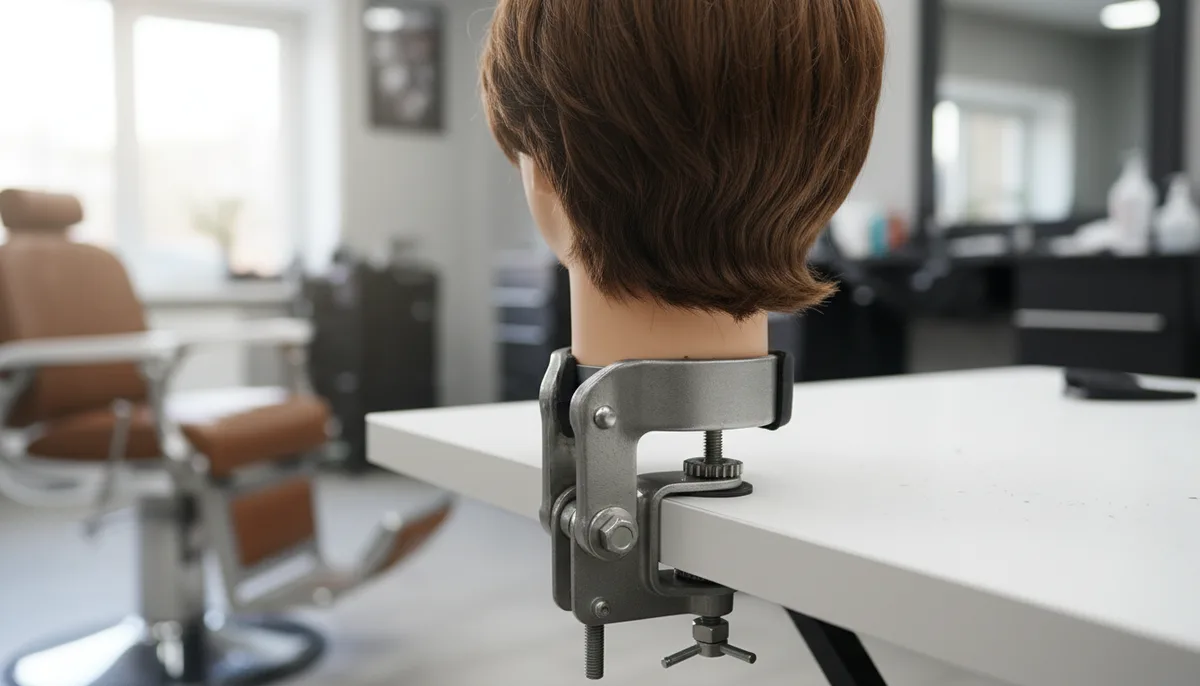
Check the mount type before buying if a stand is already on the desk. The 12-inch training head with clamp stand is an example of a listing built around the mount first: a clamp stand and five clips ship in the box, with the 22-inch head circumference that standard clamps grip.
Keeping a human hair head usable
Human hair heads last through months of daily drills when the upkeep stays simple. Wash with a gentle shampoo after color or heavy product work, blot rather than wring, and dry on low heat. Store the head on its clamp or stand, away from direct sun. For a second head dedicated to curly-texture work, the curly human hair training head with clamp follows the same routine, and its listing lists cutting, coloring, braiding and heat styling among its uses.
Drills to run in the first week
Once the head is mounted, the first week should be zones and guard work, not full haircuts. Divide the head into sections, run guard progressions on each zone, and only then chase a full taper. The zones-of-the-head breakdown in the video below is a good model for structuring that first week, and it pairs with the fade drills in the how to cut a fade at home guide.
What barber schools issue, and the gift angle
Barber schools usually issue mannequins for floor work, and suppliers such as Pivot Point sell pro-grade barbering mannequins through school channels, so check what a program provides before buying a first head. Where the program does not supply one, or for the student on a gift list, a human hair head with a beard is the pick that keeps giving through the whole program, and the gifts for barber school students guide pairs it with the rest of a starter kit.
FAQ
Is a human hair mannequin head worth it for barber school?
For clipper work, fades and color practice, yes: human hair gives the resistance and finish a real head gives, so the hours transfer. Synthetic heads make sense as a cheap spare for braiding drills and set styles, not as the main practice head.
Can a training head be colored or bleached?
On 100% human hair heads, the listings generally say the hair takes color, bleach and heat. Blends such as an 80% human hair mix behave differently, so read the listing before planning color drills and follow the product’s own instructions.
What head circumference fits a standard clamp?
Most student training heads list a 21 to 22 inch circumference, which is the size standard table clamps and neck blocks are built to grip. Anything inside that range mounts the same way.
How long does a training head last?
With washing and low-heat drying between sessions, a human hair head carries months of daily drills. Heavy color or bleach work shortens its usable life, which is one reason students keep a second, cheaper head for color experiments.
What should a barber student practice first?
Zones and guard progressions before full haircuts, then tapers, then beard work if the head carries one. The drills section above has the short version.
Verdict: which head to buy
Start with the Czrleaty 12-inch head if the goal is one head that covers cuts, fades, color and lineup work from day one. Add a dedicated beard head like the 14-inch curly beard head once beard drills become part of the weekly routine, and let the tripod kit head carry a shared study-group setup. Keep a cheaper curly or synthetic head for braiding stations, and the practice hours will compound fast.
Specs in this guide come from the current Amazon listings for each product. The Pivot Point barbering mannequin page and the firsthairstyle guide to mannequin heads for barber practice were consulted for context on what schools issue and what the market offers. Availability changes, so confirm a listing is live before ordering.


