
TrustedBarber is reader-supported. If you buy through links on this page, we may earn a commission from Amazon at no extra cost to you.
You got home, looked in the mirror under honest light, and the haircut is wrong. The panic response is a one-star review and six weeks of hats. The professional response is a sequence, and the career stylist behind TheSalonGuy laid it out from the other side of the chair: what to do in the first days, what to say, and what you can actually fix yourself. His advice is worth having whether the problem is a length mismatch, an uneven piece, or a blend that fell apart.
Call the shop first, not the review site
His first instruction is the one most people skip: call and speak to the person who did your hair, or the owner or manager, and say what is wrong plainly, that it is not laying properly, that it does not look right, and ask them to take a look at it. Shops would rather have the conversation than the surprise review, and there is a practical reason: owners sometimes eat the cost of a fix, which means the issue gets resolved instead of just vented.
He is equally clear about the flip side, from a career of seeing thousands of clients: there are two sides to every story. A small number of clients are so particular that no cut can satisfy them, and the tell he describes is the person who says they have been to nineteen stylists this month and none of them could get it right. If that is not you, none of this applies, and the call is worth making.
He is equally clear about the flip side, from a career of seeing thousands of clients: there are two sides to every story. A small number of clients are so particular that no cut can satisfy them, and the tell he describes is the person who says they have been to nineteen stylists this month and none of them could get it right. If that is not you, none of this applies, and the call is worth making.
What not to do: stew in silence, decide never to go back, and then unload a six-page Yelp review out of embarrassment. He names that pattern directly and asks people not to do it, for the obvious reason that the stylist never got the chance to fix the problem the review punishes them for.
The timing of that call matters more than people expect. Within a day or two, a fix is a normal part of the service; a week later, after you have been washing and styling it your own way, the conversation gets awkward and the fix gets smaller. The practical window is early, specific, and calm: what is wrong, where, and what you pictured instead. Specific beats angry in every barbershop on earth, and it is also what makes the correction easy for the person holding the shears.
How most bad haircuts actually happen
The root cause he points to is communication, and his example is painfully common. The client says just trim the top, half an inch, and means something very different by that than the stylist hears. Then the result comes out shorter or longer than the client imagined, and the blame lands on the professional who was doing what they were asked. That gap, between what was said and what was pictured, produces a huge share of the “bad haircuts” walking around.
The practical lesson cuts both ways: when you book, be specific about the outcome, not just the amount to remove, and when you are in the chair, say what you are picturing in plain terms. Our guide to guard sizes and the taper vs fade breakdown both exist because the vocabulary gap is that common.
The three kinds of wrong
Before the self-rescue section, it pays to sort bad haircuts into the buckets that actually behave differently, because the right response is not the same for each.
Wrong length. The cut came out shorter or longer than you pictured. There is nothing to fix at home beyond symmetry; this is the bucket where the phone call earns its keep, and if the call does not work, it is a pure grow-out with clean edges.
Wrong shape or blend. The lengths are roughly right but the transition is broken: a ledge where it should be soft, weight where there should be air. Product and a light texturizing pass can genuinely improve this one, because the problem is distribution, not total length.
Wrong lines. The neckline is ragged, the hairline wandered, the sideburns do not match. Entirely fixable at home, and the fastest win of the three, because edge work is visible immediately and the technique is in our neckline guide.
Diagnose which bucket you are in before anything else, because a fix from the wrong bucket, trimming length to solve a shape problem, is how a bad haircut becomes a worse one.
Diagnose it yourself with your hands
If the cut is past saving by a phone call, or you would rather handle it yourself, his method starts before any tool touches your head: use your hands. Make your hands into claws, rake them through your hair section by section, and feel for what is off. His line is worth quoting: the hair will talk to you. Run your fingers through, feel where a section sits longer than its neighbors, and the problem zone announces itself, whether it is the back where you cannot see or the sides where the blend died.
This is also the moment to be honest about what kind of problem it is. A wrong length everywhere is a grow-out or a re-cut conversation. One uneven piece, a heavy section, a ragged edge: those are fixable at home in minutes. Figure out which one you have before you pick up scissors, because the fix for one will make the other worse.
The rake-through also settles the most common false alarm: the haircut that is actually fine and just styled wrong. Hair that has dried with no product and no direction can read as a botched cut until you push it around with your hands and product. Only after you have raked through, found the specific offender, and confirmed it is still wrong with product in should you reach for a tool. Plenty of panicked first-night diagnoses dissolve at the mirror once the hair is actually being styled.
The small tweaks that fix it
The genuinely fixable cases, in his telling, are small. Hold a suspicious section up between your fingers and compare it against the section next to it: if one piece is visibly longer, trim that one piece to match, and the whole haircut can look right again. Sometimes it really is that simple, a single stray piece throwing off the read of the entire cut. Work in tiny increments, because hair you remove today does not come back on a schedule you choose.
Resist the instinct to fix everything in one session. His framing is that you are looking for tweaks, plural but small, that make the cut presentable while it grows out, not a re-cut. That mindset also keeps you from the classic DIY disaster: trying to even things out until the “fix” becomes the problem. If the damage is structural, our guides on cutting your own hair with clippers and fading at home cover the disciplined version for next time.
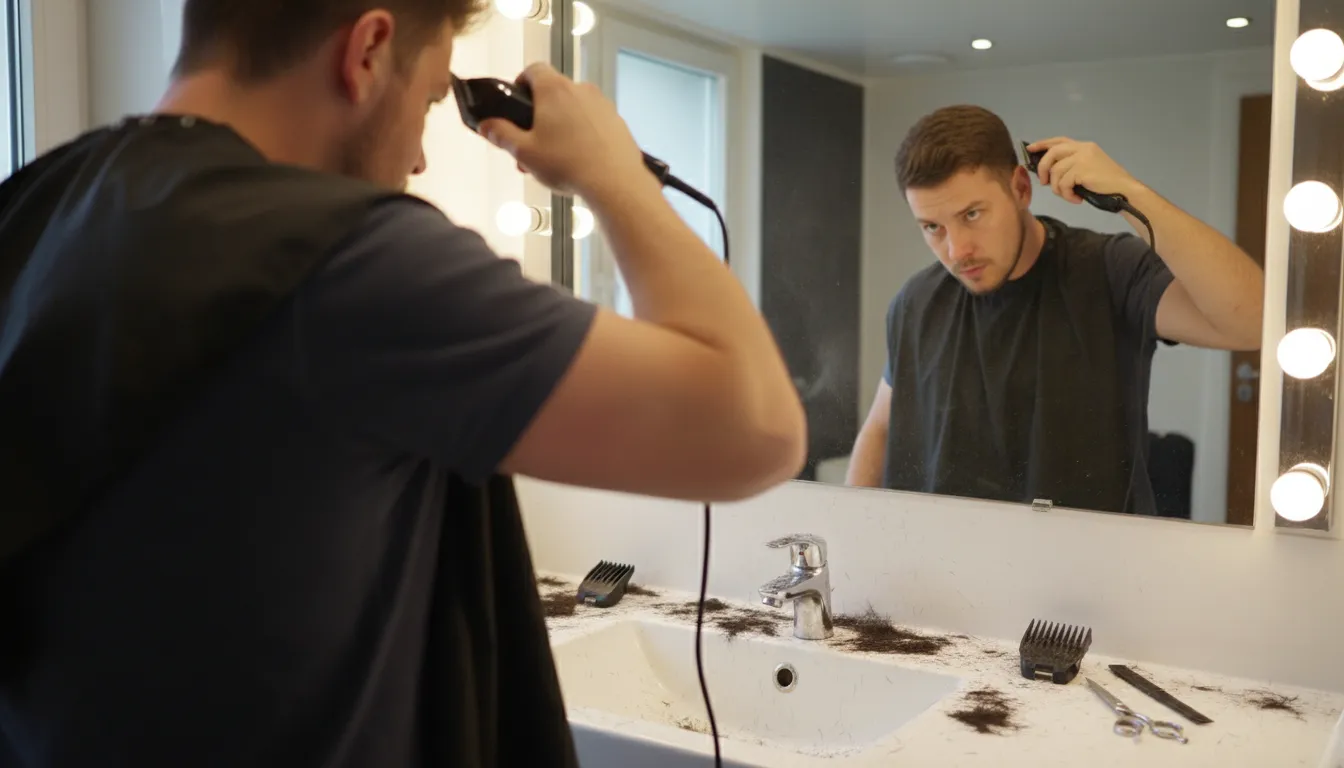
Where the tools do come in is the edge work. A bad haircut that is otherwise acceptable often fails on its neckline or hairline, because those are the zones that show first and grow out fastest. Cleaning the neckline with a trimmer and squaring the hairline buys you days of looking maintained, and it is the safest trim on the head: the lines are visible, the reference points are known, and the technique is in our neckline guide and lineup guide. If the problem is bulk rather than length, the moves are in the thinning shears guide, though that one is a harder sell for beginners, because thinning done heavily is very hard to undo.
When to just grow it out
He also gives permission for the third option: decide it is a grow-out, plan the interim, and move on. Not every haircut is worth a rescue mission, and a bad cut that is kept clean and neat at the edges reads far better than a bad cut that has been hacked at by its owner. The pieces worth knowing for that interim: keeping the neckline clean between haircuts so the grow-out looks deliberate, and using product to redirect attention while length returns. The haircut cadence guide gives you the timeline for when it will be behind you.
Planning the grow-out beats suffering through it. Work out roughly when the length will be back in your comfort zone, book the next appointment for shortly after that rather than as soon as possible, and pick a transitional style that works with what you have. A bad cut headed somewhere deliberate is just a phase; a bad cut left to drift is six weeks of bad photos. The middle step that changes the experience most is the honest one: tell your next barber what went wrong last time. They will check the problem area first, and you will get a better cut for it.
The restyle that buys you a week
Between the phone call and the grow-out sits the option people underuse: restyle the cut on purpose. A bad haircut judged under shop lighting and salon product often behaves completely differently once you style it your own way, dry it in a different direction, and put a matte product through it. Spend ten minutes deliberately styling it the way you actually wear it, and you may find the cut is 70 percent fine with the remaining 30 percent hidden. That discovery matters, because it changes the conversation with the shop from “this is ruined” to “this piece here is wrong,” which is a much easier fix for them to make, and a much easier conversation for you to have.
The restyle is also the honest test for the DIY path. If the cut still bothers you with product in and your styling on it, the problem is real. If it cleans up, the problem was the styling, and your money is better spent on product than on a correction appointment.
Three tools for the fix-it-yourself route
If you are going to work on a bad haircut at home, do it with proper tools. These three cover the diagnosis, the trim, and the styling that carries the grow-out, and all three are sold on Amazon.
Wahl 9818A Stainless Steel Lithium-Ion trimmer: the rescue kit
The one tool that handles a bad-haircut intervention properly is a beard-and-detail trimmer with real attachments, and the Wahl 9818A Stainless Steel Lithium-Ion Plus is the long-running pick: stainless ground blades, a battery that holds a charge for months, and a guide comb set that lets you take an even amount off rather than guessing with scissors. For trimming the one long piece to match its neighbor, it is exactly the right instrument.
Check the Wahl 9818A Trimmer on Amazon
Slick Gorilla Texturising Powder: the cover-up that works while you wait
Most bad haircuts look worse than they are because the hair is lying in the wrong directions. The Slick Gorilla Texturising Powder roughs the hair up into separated pieces and breaks the flat, wrong shape that makes a cut look chopped. It is the fastest way to make a mediocre haircut look intentional, and it rinses out with water so it never becomes part of the problem.
Check the Slick Gorilla Texture Powder on Amazon
Baxter of California Clay Pomade: structure for the grow-out
For the longer grow-out, you want a product that holds a shape without announcing itself. The Baxter of California Clay Pomade is the matte, strong-hold clay that keeps hair where you put it through a full day, which is the difference between a grow-out that looks planned and one that looks neglected. A dime amount worked through dry hair, reshaped once midday if needed.
Check the Baxter Clay Pomade on Amazon
FAQ
Should I go back to the same barber?
Yes, first, and by phone rather than a review. Owners sometimes absorb the cost of a fix, and the stylist who cut it is best placed to correct it. The exception is the pattern the stylist himself warns about: if you have been unhappy with everyone lately, the problem may be the brief, not the barber.
Can I fix a bad haircut myself?
The small ones, yes: one uneven piece, a heavy section, a stray edge. Diagnose with your fingers first, trim tiny amounts with a proper trimmer, and stop when it reads presentable. A wrong overall length or a broken blend is not a DIY fix.
How long does a bad haircut take to grow out?
Depends on the miss, but most noticeable length problems resolve inside one full haircut cycle, and keeping the neckline and edges clean during that window makes the interim look deliberate rather than neglected.
What is the fastest way to make it look better today?
Product and a blow dryer. A matte clay or texturizing powder breaks the wrong shape and re-directs the hair, which changes how the cut reads more than any trim you can safely make on day one.
Is it rude to ask for a fix?
No, and the professional view is the opposite: a shop that hears about the problem gets the chance to fix it and keep the client. What sours the relationship is the silent review months later, not the same-week phone call.
Related reading: the best clippers for home use, thinning shears technique, and hairline lineup basics.