TrustedBarber is reader-supported. If you buy through links on this page, we may earn a commission from Amazon at no extra cost to you.
Low, mid and high get used as three words for the same haircut, and that looseness is why fade requests go wrong at the chair. Danito Bless Hands’ video sorting the three heights has been watched over 160,000 times, and the reason it resonates is that he fixes the vocabulary with landmarks instead of adjectives. Every fade in his system is defined by where the bald guideline starts, and the rest of the build, the guard ladder, the lineup zone, the finished silhouette, follows from that one placement. Watch how each height changes what he does, and the fade menu stops being three vague options.
The three bald lines that define the fade
He points to each starting line on the head in turn. The low fade starts the bald guideline at the bottom of the sideburn. The mid fade starts it at the corner of the eyebrow. The high fade starts it at the top of the c-cup, the curved patch of hair that wraps around the ear, because with a high fade you have no c-cup at all.
That is the whole classification, and it is worth repeating the payoff: one reference point, chosen before any guard goes on, determines which of the three fades you are building. Get the starting line right and the guard work below has a target. Get it wrong and no amount of good blending rescues the request, because the height was wrong before the first pass.
Low starts at the bottom of the sideburn, mid at the eyebrow corner, high at the top of the c-cup.
The c-cup rule
The c-cup is the meter the whole video reads. With the low fade you keep the full c-cup. The mid fade leaves about half a c-cup. The high fade leaves none, only the side boxes above the ear.
That framing converts a style preference into a quantity a barber can verify. A client who says “not too high” is describing a full or half c-cup, which is a measurable outcome, and the lineup zone at the end of each fade exists to confirm exactly that quantity before the client leaves the chair. Our burst fade guide uses the same reference-point logic for the fade that wraps around the ear.
Full c-cup for low, half for mid, none for high. That is the whole height decision.
The low fade, start to finish
The low fade starts at the bottom of the sideburn, and his first guideline goes up an inch. He does that on every fade, which is why the three builds share their rhythm. On the low fade, his last guideline ends right at the corner of the c-cup, and he sets that line with the number two guard. That is how he knows where to end the fade; after that, it is clipper over comb the rest of the way up.
The two-guard ceiling on a low fade is worth noticing, because it shows the height affecting the tools: the low fade spends more of its climb below the skin-tight range, so a guarded guideline can carry it higher before freehand work takes over. Our clipper over comb technique guide covers that finish work in detail, since it is the shared last step of all three heights.
Every fade opens the same way: no guard, up an inch.
The mid fade
For the mid fade he resets the reference and states the contrast directly: if he were doing a low fade he would start at the bottom of the sideburn, but since this is the mid fade he is starting at the corner of the eyebrow. The fading process is the same as every other fade: up an inch with the no guard. With only half a c-cup left, he keeps that remaining patch a little darker, then runs one guard closed for a half inch, one guard open for another half inch, and sets the last guideline with the two guard open, going up an inch.
Where the mid fade ends is the detail people misremember. A low fade would end at the top of the c-cup, but the mid fade ends halfway up the corner boxes. That is a substantial band of height above the ear, and it is exactly why the mid fade reads as the middle option: the hair is gone from the lower half of the c-cup zone but still present through the boxes. In his framing of client demand, the mid is the safest of the three heights, the one that suits most heads and most workplaces, because it clears the ear without stripping the silhouette.
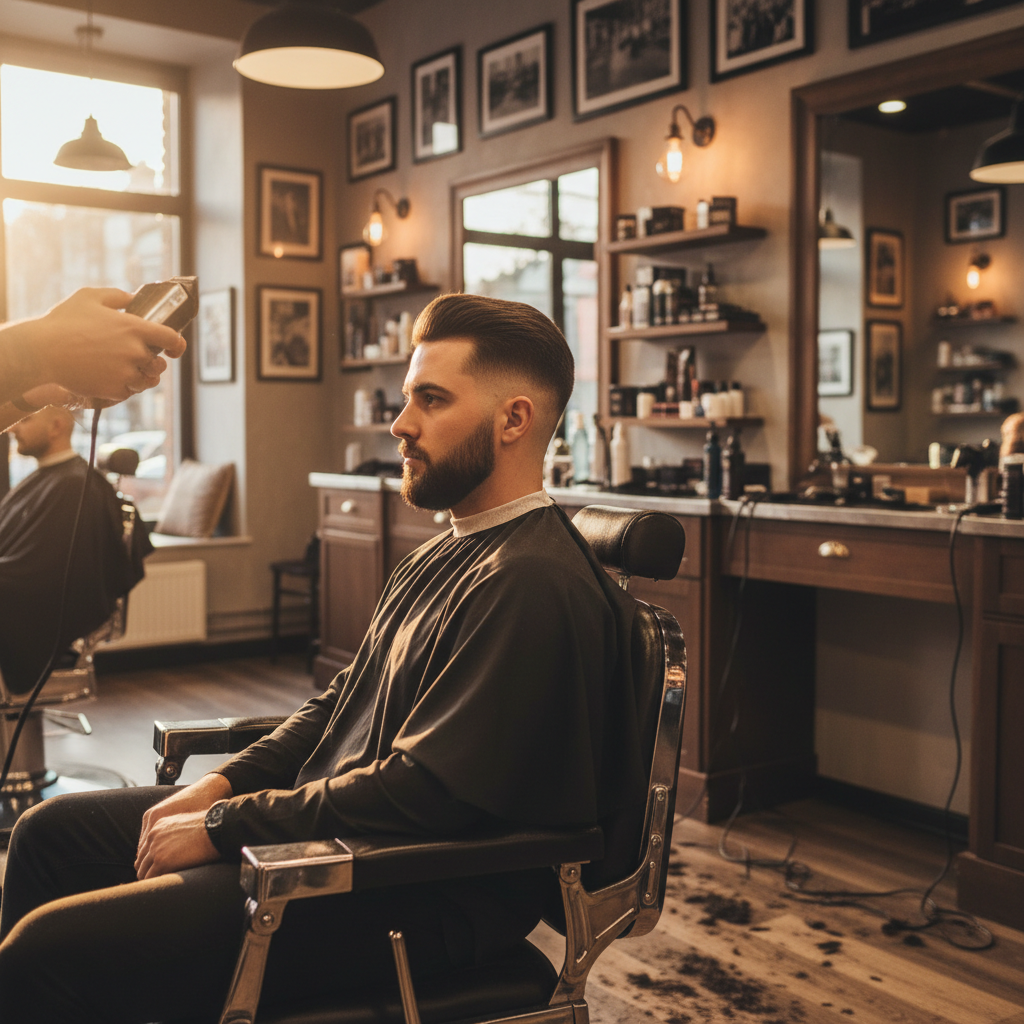 ” alt=”Barber working a fade with a professional adjustable-blade clipper” class=”wp-image-6476″ style=”width:640px;height:auto” />
Same method, moved up: the mid fade starts at the corner of the eyebrow.
The high fade
The high fade moves the bald line to the top of the c-cup, and the consequence is structural: no c-cup for this fade, only the side boxes. The climb starts the same way, no guard open going up an inch, but the blend up to the one guard changes tools and technique. To fade up to the one guard he uses the zero guard halfway closed, then comes back with the zero guard completely closed.
The finishing boundary carries the one rule that keeps a high fade from becoming a mistake: it ends at the top of the box, and you make sure it stays below the parietal ridge. That ridge is where the head’s curvature turns, and a bald line pushed over it reads wrong from every angle, because the fade starts climbing the crown instead of ending at the side’s edge. The ridge is the ceiling of the high fade, in exactly the way the c-cup is the meter of the lower two.
High fade keeps only the side boxes, no c-cup at all.
The guard ladder, fade by fade
Because the video narrates every guard change, the three ladders can be written out exactly as he runs them, which turns the “same steps” principle into something you can hand to a beginner. On the low fade: no guard, up an inch for the first guideline; the last guideline is the two guard, closed set, ending at the corner of the c-cup; then clipper over comb takes it the rest of the way. On the mid fade: no guard open, up an inch; one guard closed for a half inch; one guard open for another half inch; the two guard open, up an inch, ends halfway up the corner boxes, with the surviving half c-cup kept a little darker through the climb.
The high fade is where the ladder tightens, because there is no c-cup absorbing the transition. After the no guard runs its inch, the step up to the one guard is done with the zero guard halfway closed, then a second pass with the zero guard completely closed. Notice what that sequence is doing: on a low fade, the c-cup’s density hides small steps, so wider jumps read fine. On a high fade, the bald line sits against bare skin at the top of the ear, so every step between bald and guarded has to be split into half-closed and fully closed passes to avoid a visible ledge. Same ladder, tighter rungs, because the height removed the hair that was hiding the steps.
He also shows the three results back to back at the end of the video, and that comparison is the fastest training tool in it: the same head discipline run at three heights, with the c-cup shrinking from full to half to gone and the bald line climbing from sideburn to eyebrow corner to ear top. Anyone arguing about what “a real mid fade” looks like can settle it by pointing at the middle head in that lineup.
The guard ladder is identical on all three fades. Only the endpoints move.
Why the fading steps stay the same
The quiet insight of the video is that the height changes the endpoints, not the method. He says it while building the mid fade, and repeats it across all three: the fading process is the same with all fades, the same first guideline an inch up, the same progression through the guards, the same two-guard finish. Low, mid, high, the steps are the same.
That is why the three fades are learnable as one skill rather than three. Once the inch-up opener, the closed-to-open guard progression and the freehand finish are drilled, the only decision the three heights add is where the bald line starts and where the last guideline ends. Our at-home fade guide teaches that shared method step by step, and our guard sizes explainer covers the numbers behind each rung.
The height changes the endpoints, not the method.
The lineup zone for each height
Each height lines up a different amount of hair, and Danito ties the lineup directly to the height so the finish confirms the cut. The low fade has to line up the whole c-cup, because everything was kept low and there is more hair right there, a full c-cup to line up, and doing it is how you make sure you actually did a low fade. The mid fade lines up only half the c-cup, since that is all the hair the height left. The high fade has no c-cup at all, so it is just lining up the boxes.
The lineup is therefore not decoration; it is verification. If the finished lineup exposes a full c-cup, that haircut is a low fade regardless of what was intended, and the mismatch gets resolved before the cape comes off. For the lining work itself, our line-shaping guide covers the edge discipline the boxes and c-cup both need.
Line up exactly as much hair as the height left: the finish confirms the cut.
Choosing the height for the client
With the mechanics clear, the choice becomes a conversation about three outcomes. The low fade keeps the most hair and the most conservative silhouette, everything anchored low with a full c-cup to shape. The mid fade splits the difference and ends halfway up the corner boxes, which reads neat from every angle without committing to a skin-tight side. The high fade strips to the boxes and stops below the parietal ridge, maximum contrast for the top, and the most demanding haircut to maintain as it grows out, because the bald line reappears fastest at that height.
A practical shorthand for the chair: ask the client to picture their ear. Hair wrapping fully around the top of the ear is the low, half coverage is the mid, bare ear with hair only above the temple is the high. Then match the request to the bald line that produces it.
Height also sets the maintenance conversation, and it is worth having before the cut rather than after. The higher the bald line, the less hair stands between the guideline and bare skin, so the crisp edge shows its grow-out sooner and the touch-up window is shorter. A low fade grows out into softness; a high fade grows out into a visible ring. Clients who cut every six weeks are better served by the mid, while clients who come in every two weeks can wear the high comfortably. Framing it that way turns the height choice from an aesthetic argument into a schedule the client can actually keep.
Low keeps the hair, high makes the statement, mid splits the difference.
The tools for the build
The main clipper
The inch-up opener and the guard progression all run on a blending clipper. The Wahl Professional 5 Star Magic Clip Cordless carries the stagger-tooth blade that made it the standard for exactly this work: smooth feeding through the open-closed transitions the ladder needs, with more than 100 minutes of cordless runtime for a full day of fades.
The detailer
The lineup work, whole c-cup, half c-cup or just the boxes, needs a trimmer with a fine blade and the T-wide geometry built for edges. The Wahl Professional 5 Star Cordless Detailer is that tool, with the extended blade for lineups that the verification pass at the end of each fade depends on.
For home users
If you are cutting your own fades, a color-coded guard set keeps the closed-to-open ladder honest without counting clicks. The Wahl Color Pro Cordless runs the same guard logic on a home-friendly clipper, and our best clippers for fades roundup compares the full field if you want to shop it properly.
FAQ
What actually separates a low, mid and high fade? One thing: where the bald guideline starts. Bottom of the sideburn is the low, the corner of the eyebrow is the mid, and the top of the c-cup is the high. Everything else, the guard ladder and the finish, follows from that placement.
How much c-cup should each fade leave? A full c-cup for the low, about half a c-cup for the mid, and none for the high, which leaves only the side boxes. The lineup pass at the end confirms it: whole c-cup lined up means low, half means mid, boxes only means high.
Where should a high fade stop? At the top of the box, below the parietal ridge. Push the bald line over the ridge and the fade starts climbing the crown, which reads wrong from every angle. The ridge is the ceiling of the high fade.
Are the fading steps different for each height? No. Danito repeats it across all three builds: the first guideline goes up an inch, the progression runs no guard to one to two, and the finish is clipper over comb, the same on every fade. Only the starting line and the last guideline move.