
As an Amazon Associate, TrustedBarber earns from qualifying purchases.
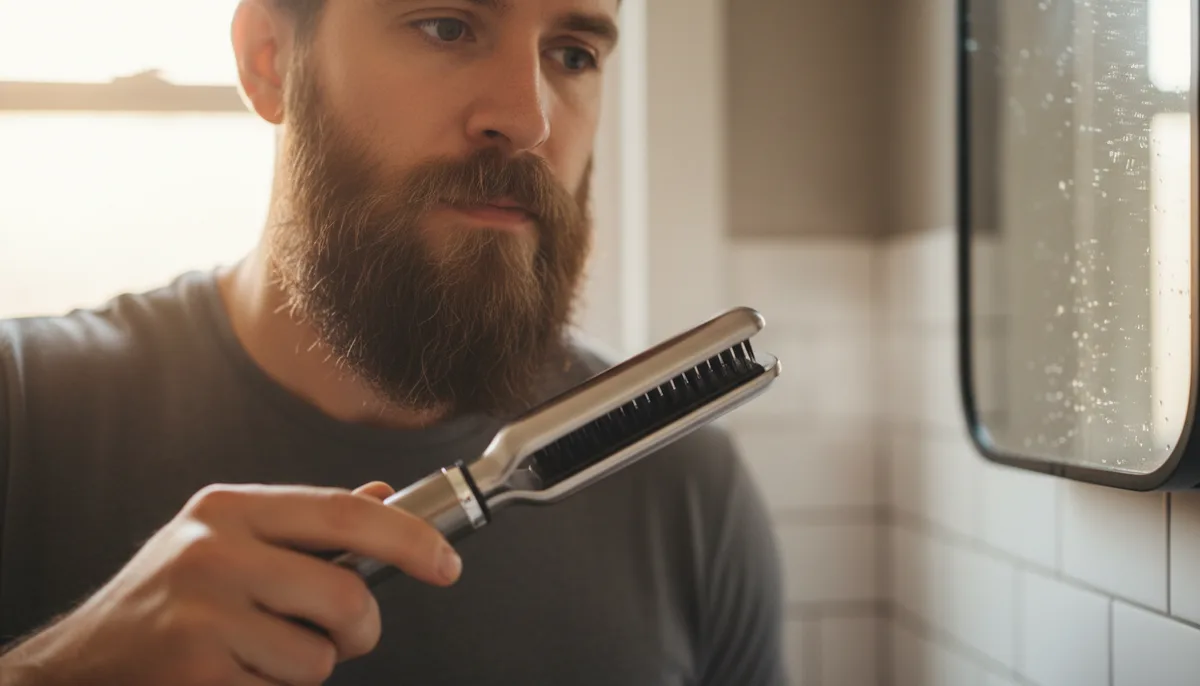
A beard straightener is the fastest fix for a beard that behaves like a broom: it grows out wavy, bends sideways by lunchtime, and refuses every balm you own. A heated brush does in five minutes what a blow dryer and a round brush struggle to do at all, and it does it without the heat blasting your face. The Arkam Premium heated beard brush is the pick for most guys because its temperature range and bristle setup cover the widest range of beards.
Below we break down how these brushes work, what separates a good one from a novelty, and five models we would actually keep on the shelf, from a stocking-stuffer kit to a pro-grade tool. If you are new to the technique first, our how to use a beard straightener guide walks through the pass itself, and everything there applies to every brush on this list.
Quick answer
Best overall: the Arkam Premium hits the temperature and bristle balance most beards need.
For long, thick beards: the Tame The Wild Pro runs twelve heat settings and a wide head.
Coarse, wiry growth: the Wild Willies hot comb style straightener grips better than soft bristles.
Straightening plus a care routine: the XIKEZAN beard straightener kit with oil, balm and comb covers the styling and the aftercare in one box.
Check the Arkam Beard Straightener Price on Amazon
Check the Tame The Wild Pro Price on Amazon
Check the Wild Willies Straightener Price on Amazon
Check the Aberlite EDC Price on Amazon
Check the XIKEZAN Beard Straightener Kit Price on Amazon
In this guide
Why beards curl in the first place
Beard hair is rounder, coarser and drier than scalp hair, and the follicle angle changes across the face. That is why one cheek can wave while the other stays flat, and why a beard often kinks worse after a shower, when the hairs swell and dry in whatever direction the towel left them. Genetics sets most of it. You are not fixing the follicle, you are temporarily resetting the hydrogen bonds inside each strand, which is exactly what a blow dryer does to scalp hair.
Heat is the tool that does the resetting. Warm the hair past a threshold, stretch it under light tension, and cool it in the new shape, and the strand holds that shape until moisture, sweat or sleep re-kinks it. That is also why a straightened beard does not last through a humid day or a pillow without backup: a light balm after the pass keeps the shape, and the Honest Amish beard oil keeps the hair itself from drying out under repeated heat.
Two things matter more than raw wattage. First, heat needs contact: a brush presses warm bristles against the hair, so the heat transfers into the strand instead of bouncing off the surface. Second, tension needs a second hand or a dual-action comb, because a straightened wave snaps back if the strand cools while still curled. The tools below all combine those two jobs in different ways, which is what actually separates them.
What separates a good heated brush from a novelty
Temperature range is the first spec to check. Fine, short beards style at the low end of the dial, while coarse shoulder-length beards need real heat to hold a shape. A brush that only offers one or two low settings will frustrate anyone with dense growth, and a brush that only blasts high risks cooking the hairline. Look for a range that steps in small increments and actually lets you settle on the lowest setting that works for your hair.
Bristle design is second. Soft nylon bristles glide and polish but slide off coarse hair; stiffer bristles or a heated comb tooth grip and pull the wave out under tension. The best designs pair a row of bristles with comb teeth so you can choose grip or glide as you work. An anti-scald guard matters more than most listings admit, because the brush runs against the skin of your neck and jaw, and the guard is what keeps a long pass from turning into a burn line.
Practical details finish the list. A swivel cord beats a stiff cable every time at the sink, a cordless model earns its keep on travel days, and auto shut-off is worth having on any tool that heats up and lives next to a bathroom sink. None of these decide the style. They decide whether you will still use the tool in March, which is when the cheap novelty brushes end up in the drawer.
The five beard straighteners worth buying
Arkam Premium heated beard brush: the pick for most beards
The Arkam Premium is the tool we would buy first, because it lands in the middle of every spec that matters. The temperature dial steps across a wide enough range to handle both fine stubble-adjacent growth and a coarse two-incher, the anti-scald feature keeps the barrel safe against the jaw, and the head pairs bristles with a dual-action comb so you can switch between gripping and smoothing without changing tools.
It also behaves like a tool a barber would keep on the station rather than a gadget: fast heat-up, a cord with real reach, and a shape that fits the hand for the upward strokes a beard pass needs. If you have never owned a straightener before, start here and learn the technique on it; the step-by-step guide covers the first pass.
Check the Arkam Beard Straightener Price on Amazon
Tame The Wild Pro: for long and thick beards
The Tame The Wild Pro earns its spot for one reason: twelve temperature settings on a one-piece heated brush built for dense growth. Long beards are the worst case for a straightener, because the wave has more length to reassert itself and the heat has to reach the middle of the knot, not just the surface. The wider setting range means you can climb from a safe low setting upward until the hair actually holds, instead of fighting one fixed temperature.
The ionic generator is more than marketing here: charged bristles cut the static that makes a long beard look like it is floating after a pass. If your beard is past the chin, this is the model on the list built for you, and the stiffer bristle row pulls tension through the whole strand rather than styling the top inch.
Check the Tame The Wild Pro Price on Amazon
Wild Willies heated comb: for coarse and wiry growth
The Wild Willies brush and hot comb is the pick when soft-bristle brushes slide right off your beard. Coarse, wiry hair needs grip, and the tourmaline ceramic plate and comb-tooth design pulls a stubborn wave straight under tension instead of polishing over it. Three temperature settings keep it simple, and the ceramic surface distributes heat more evenly than bare metal, which matters on repeated passes over the same patch.
It is also the closest in feel to the hot combs barbers have used for decades, which is exactly why it suits coarse textures. The trade is finesse: on fine beards the comb side can over-grip and pull hairs, so this is a tool for people who know their hair fights back.
Check the Wild Willies Straightener Price on Amazon
Aberlite EDC: the premium compact pick
The Aberlite EDC is the one we would pack for travel or keep at the office. It is a compact professional straightening brush with the heat range and build quality of the full-size tools, in a body that fits a dopp kit. The bristle field is tighter, which suits medium and short beards, and the fast heat-up is tuned for quick touch-ups rather than full styling sessions.
On a long beard it works better as a maintenance tool than a primary, because the small head covers a lot of territory slowly. For everyone whose beard is under three inches and whose straightening happens in hotel bathrooms, this is the right tool at a premium tier.
Check the Aberlite EDC Price on Amazon
XIKEZAN straightener kit with oil, balm and comb: the gift pick
The XIKEZAN beard straightener kit with beard oil, balm and comb solves the other half of the problem, which is that a straightened beard needs care the same day. The kit pairs a heated brush with a leave-in oil, a styling balm and a grooming comb, so the gift or the starter setup covers the pass and the aftercare in one box. The straightener itself is a solid mid-range unit with the anti-scald guard and the dual-action comb head most first-time users need.
As a gift it works because nobody has to guess sizes or shades: a beard that grows out wavy plus the kit that fixes and holds it is a complete answer. As a starter kit it teaches the right habit, which is style, then seal, then comb. If you are buying for the holiday season, this is the pick on the list built for it.
Check the XIKEZAN Beard Straightener Kit Price on Amazon
How to straighten a beard without frying it
Step one: wash, dry and comb the beard out completely. Heat on damp hair boils the moisture inside the strand and causes the frizz and split ends you were trying to avoid. Towel dry, hit it with a blow dryer on low if you have the time, and comb through so every strand is loose and going in one direction before the brush ever touches it.
Step two: start at the lowest heat that visibly works. Set the dial low, run one section, and only climb if the wave snaps back. Every beard has a setting where the shape holds without the hair feeling hot to your lip; find that setting and stay there. Higher heat does not make the shape last longer, it just damages the hair faster.
Step three: work against the growth in short downward passes. Start under the chin and brush upward against the grain to lift and stretch the hair, then follow with downward passes to lay it into the shape. Keep the brush moving; parking a hot brush on one patch is how heat damage happens. A pass should take a second or two, not a hold.
Step four: seal the shape while it is warm. A tiny amount of balm or a light oil applied right after the pass, while the hair is still settling, locks the shape in. Overdoing product re-kinks the beard faster than using none at all, so start with less than you think you need and comb it through. If the beard fights the shape by afternoon, the brush versus comb guide covers the finishing tools that hold a style without heat.
Mistakes that undo the shape by lunchtime
The biggest mistake is straightening a dirty or product-heavy beard. Old oil, sweat and yesterday’s balm resist heat and re-kink the moment they warm up, so the pass looks great in the mirror and collapses by lunch. Wash or at least rinse the beard before a straightening session, and keep the heavy styling products out of the hair until after the heat is done.
The second mistake is chasing a pin-straight result. A beard styled glass-flat looks unnatural and re-kinks faster, because the hair wants its curl back and has nowhere to go but out. Aim for controlled, uniform softness: the wave gone, the direction set, and a little natural texture left in the body. That shape survives the day and looks like a beard instead of a wig.
Third, straightening every day when every other day would do. Heat styling is a reset, not a permanent fix, and repeated daily passes dry the hair and roughen the cuticle until the beard feels like straw. Build the routine around wash days, seal with oil after each pass, and let the beard growth timeline guide set expectations for the length you are styling in the first place.
Watch the heated brush versus the blow dryer
Barber Matty Conrad compares the two ways to straighten a beard on camera, and the difference in result is worth seeing before you buy anything. The heated brush wins on control and repeatable passes; the blow dryer wins on volume. Watch how little pressure he uses, because pressing hard is the most common beginner error.
FAQ
Is a beard straightener bad for your beard? Not at sane settings. Heat is the same mechanism a blow dryer uses, and damage comes from held heat, not moving heat. Keep the brush moving, use the lowest setting that holds the shape, and seal with oil after the pass.
How long does a straightened beard last? A few hours to a full day depending on humidity and hair texture. Coarse, wiry beards hold shape longer than fine ones, and a light balm after the pass roughly doubles the hold. Sleep will undo it either way.
Can I use a hair straightener on my beard? You can, carefully, but a flat iron clamps hair between two hot plates, which is easy to overdo on short, curved beard hair. A heated brush wraps the heat in bristles and keeps the plate off the skin, which is why the beard-specific tools above are the safer default.
Do beard straighteners work on short beards? They work from roughly half an inch of growth, which is when there is enough length to hold a shape. Below that the wave barely shows and a brush or balm handles what styling is needed.
Brush or comb straightener: which is better? Brushes suit fine to medium hair and polish as they style; comb-tooth models grip coarse hair better. Several of the tools above combine both, which is why they top this list.
The bottom line
Start with the Arkam Premium if you are buying for yourself: it covers the widest range of beards and behaves like a tool you will still use next year. For a long, dense beard the Tame The Wild Pro is the one built for it.
For wiry growth, the Wild Willies comb grips where soft bristles slide off, and the XIKEZAN beard straightener kit with the oil, balm and comb is the pick when the purchase is a gift.
The Aberlite EDC covers travel and short-beard touch-ups at a premium tier.
Whichever you pick, learn the pass before you judge the tool: dry hair, low heat, constant motion, and a seal of product after. And if you are ordering close to a date you need it, a Prime free trial covers the shipping. Done right, a heated brush is the five-minute step that makes a grown-out beard look deliberate, and there is no balm that fakes it.