Disclosure: this article contains Amazon affiliate links. As an Amazon Associate we earn from qualifying purchases, at no extra cost to you. It does not change what we recommend.
Cutting your own hair with clippers is a real option if you like a short, simple cut. We watched two tutorials that go about it in different ways: The One Minute Barber, a barber in his 18th year behind the chair, and Clarks Condensed, a DIY creator who has cut his own hair for about 12 years. One method is fast and foolproof, the other is slower and gives you more control, and this guide walks through both so you can pick the one that matches your patience.
A note on the sources: The One Minute Barber tags a pair of scissors and a styling spray in his description, and Clarks Condensed is a DIY channel rather than a barber. Both bring real experience to the demo, one from the chair and one from a decade of cutting his own head, and every product mentioned below is checked against its own Amazon product page.
In this article
The One-Guard Method
The One Minute Barber says he is in his 18th year as a barber and wanted to describe the easiest way to do it. His method uses a number three guard on the whole head. The idea is to follow the curve of the head. Go straight up the side, and do not curve over onto the top. At the back, he warns about the bone ridge at the back of the head and says to go straight up there too, so the head keeps its natural shape.
For the top, he says to comb the hair in the direction it lies and run the clipper with the grain, from the back of the head toward the front. He says this thins the density but does not take off the length. If you want to keep your fringe, lift the clipper a little as you reach it.
Source: How to Cut Your Own Hair with Clippers, The One Minute Barber.
Quick take
One guard, all over. Go straight up the sides without rounding over onto the top, and use two mirrors for the back.
The Step-Down Method
The Clarks Condensed method is slower and more forgiving. He starts with a number 8 guard, which he says is about one inch or 25 millimeters, and goes over the whole head. Then he steps down to a 6, a 4 and so on, ending near a 2 on the sides depending on how thick your hair is. He says passing over the head with each guard is a habit that catches hairs he missed with the longer guard.
He says to aim for a V shape at the edges so the blend has no hard lines, and to tilt the clipper away from the head if you want a gentler blend. He also says he cuts his hair clean, washed that morning and with no product, and that he uses a trash bag as a cape.
Source: How to Cut Your Own Hair with Clippers – For Men!, Clarks Condensed.
Good to know
The step-down method takes longer but gives you more chances to blend. You can stop at any guard and still have a finished cut.
Which Method Fits You
Pick by how much control you want and how much time you will give it. The one-guard method is a fifteen-minute job: one guard, one direction of travel, and the head’s own curve does the shaping for you. It is the right first cut if you have never clipped your own hair, because there is almost nothing to blend and nothing to get badly wrong.
The step-down method costs more time but buys you a shaped cut. Starting at a number 8 and working down means you can stop one guard higher than planned and still look finished, and each pass teaches you where the lines sit on your own head. If you already know your guard numbers and want a tapered edge rather than a uniform buzz, this is the method that grows with you.
Hair type matters here too. Thick, coarse hair hides guard transitions easily, so the one-guard method looks clean on it. Fine or thinning hair shows every step, so the slower fade-through-the-guards approach is the safer bet to avoid visible shelves.
Mirrors and Setup
- Both use a mirror. The One Minute Barber holds a big hand mirror in front and stands close to two mirrors for the back.
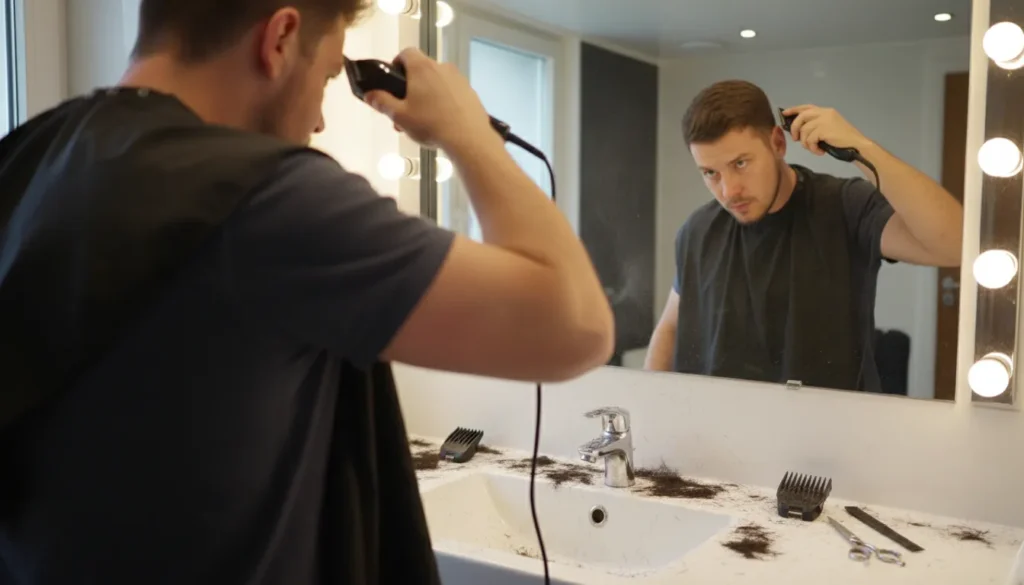
- Clarks Condensed cuts in the bathroom and puts a trash bag down to catch hair. He also says to be careful with an electrical device near water.
- The One Minute Barber says to expect a “bush haircut”, not a professional cut. His aim is acceptable and easy.
- Cut dry. Both work on dry hair, which shows the true length and lets the guards glide instead of snagging.
- Drape a towel or an old shirt over your shoulders before you start; the collar is where clippings collect.
Neckline and Ears
The One Minute Barber says to be careful at the neck. Where the neck hair goes from dense to sparse, there is a solid line, and you should not clip past it into the scalp hair. You only want to take the loose fluff. Around the ears, he says to draw around the ear with the corner of the clipper and not go too high.
Clarks Condensed says the number lines are easiest to see when you go short, so be most careful around the edges and the neck, and follow the ear and neckline when you blend, not a line parallel to the floor.
Common Mistakes to Avoid
- Starting too short. You can always take more off, never put it back. Begin one guard longer than you think you want.
- Rounding over the crown. Both barbers warn about the curve at the back of the head. Follow straight up until the clipper leaves the hair, then move to the next strip.
- Skipping the second mirror. The back is where self-cuts go wrong. Check it after every section, not at the end.
- Pressing the clipper into the scalp. Let the guard do the work. Pressure digs the blade closer and leaves uneven patches.
- Ignoring the lever. If your clipper has a taper lever, closed adds length and open cuts closer; use it to soften transitions without changing guards.
What to Buy and Keep Clean
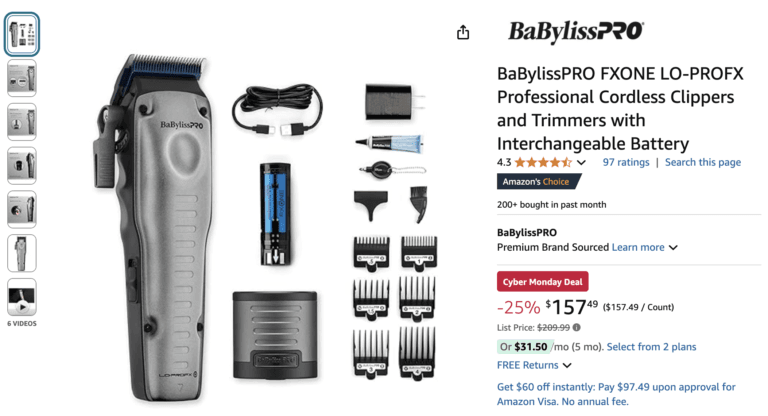
You do not need much: a clipper with guards, a mirror and a bag. One clipper covers both methods: the Wahl 5 Star Magic Clip Cordless ($139.99 on Amazon, 4.5 stars across 23,422 ratings, read October 14, 2026). Its stagger-tooth blade pulls through longer top hair without snagging, the included eight guards cover the whole step-down ladder from a number 8 to a 1, and the taper lever softens the edge at the neckline the way Clarks Condensed describes. The 100-plus minute battery outlasts several cuts per charge.
For help choosing between other options, see our best hair clippers for home use and the Wahl Elite Pro vs Color Pro comparison. Clarks Condensed lubes his clipper with mineral oil, but he is unsure what the maker recommends, so check your clipper’s manual and our clipper blade care guide first. Oiling before every cut keeps the blade cool and the length true.
If you want to check guard numbers, see our guide to clipper guard sizes.
FAQ
How long does a self-cut take? The one-guard method runs about fifteen minutes once you have done it a few times. The step-down method takes closer to forty-five, mostly because each guard gets a full pass over the head.
What guard should a beginner start on? A number 4 or 5 all over. It is long enough that a mistake is invisible from across the room, and after two or three cuts you can step down confidently.
Can I give myself a fade? Not on the back of your own head, not well. Both barbers keep their self-cuts to uniform lengths and soft blends; a true skin fade needs eyes on the back of the head and a mirror setup most bathrooms cannot deliver.
Start with the one-guard method to learn your head, then move to the step-down ladder when you want shape. Keep the guards one number longer than you think for the first few cuts, and the whole thing stays low-risk.
Pick this if…
You want a short all-over cut with no fuss: try the one-guard method. You want more control and do not mind going slow: try the step-down method.