As an Amazon Associate, TrustedBarber earns from qualifying purchases.
Hair fibers are the fastest confidence purchase in grooming, and also the most misused. Shaken on wrong, they look like pepper, migrate by noon, and stain a collar. Shaken on right, they read as real hair from two feet away in daylight, which is the only test that matters. The difference is not the brand on the jar; it is technique. The Toppik Hair Building Fibers jar is where most people start, and it is the right place.
Top picks
Check Price on the Toppik Hair Building Fibers 12g
Check Price on the Toppik Spray Applicator
Check Price on the Toppik Hair Building Fibers 27.5g
In this guide
What fibers actually are
Every major fiber product, from the Toppik Hair Building Fibers down to the drugstore shelf, works the same basic way: micro-thin fibers (keratin in Toppik’s case, plant-based in some others) that carry a static charge and cling to existing hair shafts the way a balloon clings to a wall. They do not grow hair, treat anything, or attach to bare skin. They thicken what is there by making each strand look fatter and filling the spaces between strands.
That mechanism explains both the magic and the limits. Because fibers need existing hair to cling to, a fully bald crown is a fiber-free zone. But a thinning crown with visible scalp between hairs, a receded temple with fine fuzz, or a scar line inside a hairline is exactly the surface they were made for, and the whole market for a jar of keratin fibers.
The static cling also explains the wind question everyone asks. Untreated, fibers shift in rain and heavy sweat, which is why the fixing step in section five is not optional. Treated with a holding spray built for fibers, they hold up better through a normal day than untreated fibers do.
Where they work and where they never will
The honest map is short. Fibers perform on diffuse thinning, a widening part, a thinning crown, and temple recession where stubble-length hairs remain. They fail on slick bald skin, on hair shorter than about a quarter inch at the target zone, and on hair so oily the strands cannot hold a charge. That last one catches people off guard: apply fibers to freshly conditioned, product-heavy hair and they slide off, because residue neutralizes the static the whole system depends on.
They also fail on the wrong expectation. A fiber job on advanced thinning looks like less thinning from across the room, not like a full head of hair. The goal is a plausible version of your head with the scalp dimmed, not an eighteen-year-old hairline. Chase perfect and you build a fiber crust that photographs worse than the thinning did.
One more place they genuinely do not belong: over skin that is already irritated or flaking. Treat that first, and our dandruff shampoo guide covers the shampoo side of it. Fibers on top of flaking make both problems more visible.
Color and bottle size, the two buying decisions
Color decides whether the result reads as hair or as dust. The rule that works: go one shade darker than you think you are while your roots are still dark, and step lighter as gray takes over more of your head. A medium brown user with salt-and-pepper edges should split the difference by mixing, because a two-tone blend is what natural density looks like. Every brand maps its shades differently, so match against the crown in daylight, not against the marketing photo on the product listing.
Bottle size is a pure math decision. A Toppik Hair Building Fibers twelve-gram bottle lasts a daily user roughly a month; the Toppik 27.5g bottle costs noticeably less per gram than the small jar and, at the same rate, lasts a little over two months. Buy the small one first to confirm your shade, then commit to the large. Do not economize on freshness: fibers are hygroscopic, and a jar left open in a steamy bathroom clumps into exactly the blotchiness the product exists to hide.
Brand differences are real but modest. BOLDIFY Hair Fibers are vegan and plant-based rather than keratin, which matters if you want to avoid animal-derived ingredients. Toppik uses keratin and sells nine shades, which makes a close match easier.
Check Price on the Toppik Hair Building Fibers 27.5g
Application, step by step
- Dry hair, styled first. Shampooed the day before is ideal. Toppik’s directions have your styling product in and fully dry before the fibers go on.
- Style first, fibers second. Fibers lock your hair where it sits. Style the hair into the shape you want before a single fiber lands.
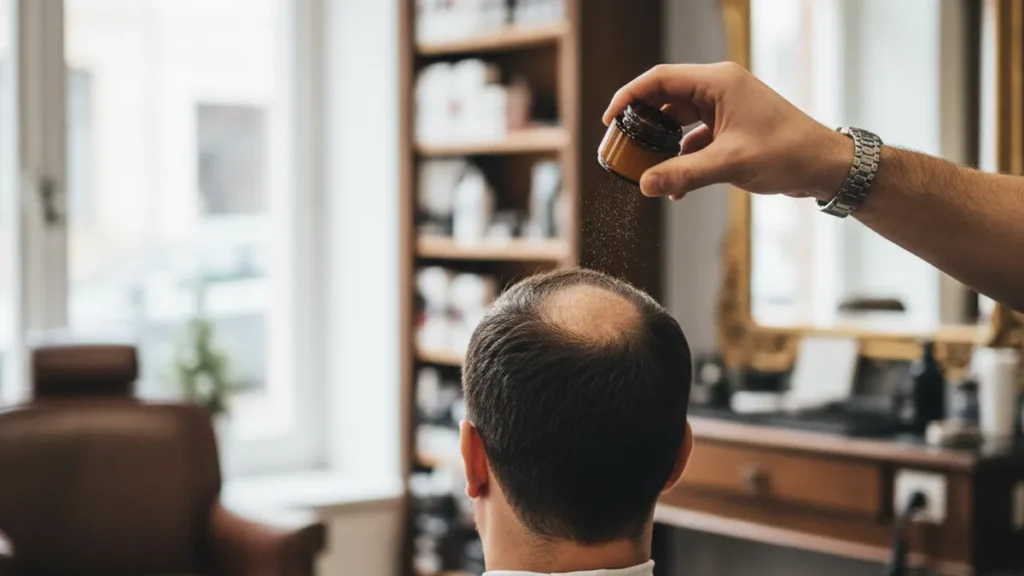
- Tap, never pour. Hold the jar an inch from the scalp over the thinning zone and tap the side. Ten light taps beat one heavy dump every time.
- Work front to crown. Thinning zones read worse when overdone up front. Start lighter than feels right at the hairline.
- Then pat and press. A flat palm pressed over the area melds fibers into the hair and knocks off the loose ones that would otherwise end up on your collar.
The Toppik Hair Fiber Spray Applicator exists because aiming at your own crown in a mirror is the weakest step in that chain. It screws onto the jar and puts the shake pattern exactly where you point it, which turns the crown application from a guess into a dot. For hairline and temple work, the jar alone is fine. For the crown, it is the difference between a DIY result and a barbered one, and it costs less than most tubes of pomade.
Under-application is the beginner error, over-application is the regular’s error. If the target area looks darker than the surrounding hair, or you can see texture sitting on top of strands, you have crossed the line. A second light pass the next day is the correct fix for a sparse first attempt; there is no fix for a heavy one except a wash, and the Toppik Hair Fiber Spray Applicator is the cheapest insurance against getting there.
Check Price on the Toppik Hair Fiber Spray Applicator
Making them hold through the day
After application comes the step most people skip and then blame the product for. A holding spray built for fibers, misted from six inches and left to dry for a minute, helps them hold through wind, light rain and sweat. Straight hair sprays loaded with alcohol work in a pinch but can make fibers look stiff, so use the product made for the job. Kits such as the Hair Illusion Combo Kit bundle fibers with a spray applicator and a water-resistant spray in one box.
Sleep is the real stress test. Without the spray, expect a good part of the job gone by morning. Re-tap a light layer in the morning.
Removal deserves its own line because wrong removal is what convinces people fibers “damage” hair. They rinse out completely with any shampoo. What damages hair is scrubbing dry fibers off with a brush, which drags out real strands along with the fake ones. Water first, always.
Check Price on the Hair Illusion Fibers Combo Kit
Fibers vs texture powder vs doing nothing
Texture powders, which we broke down against dry shampoo in our texture powder vs dry shampoo, add grit and lift to hair you already have. They suit the guy whose hair is fine all over but present, and they wash out like any styling product. Fibers are the heavier-duty sibling: they add mass and color and target specific zones. If your problem is flat hair, buy a powder. If your problem is visible scalp, fibers are the answer.
The third option deserves a fair hearing because barbers bring it up honestly in the chair: for advancing recession, a shorter cut beats any cosmetic. A tight crop with squared edges makes thinning read as a choice, which is why so many guys land on the early hair-loss barber advice route after a year of fiber experiments. The two approaches are not rivals. Plenty of regulars run a short, low-maintenance cut plus fibers at the crown, a low-cost combination that covers both problems.
Tap light, aim true, lock it in. Three habits that turn a fiber jar from a gimmick into the fastest upgrade in your cabinet.
FAQ
Will fibers come off on a date or in the rain? Not with the hold step. A water-resistant setting spray takes a drizzle and a handshake; an umbrella takes anything. What they do not survive is rubbing, so a hat comes off carefully or the crown needs a touch-up after.
Are they safe to use every day? Yes, for most people. The fibers sit on the hair shaft and rinse out with shampoo. The only caution is a sensitive scalp reacting to fragrance in some brands; a fragrance-free option or a different formula, such as the plant-based BOLDIFY Hair Fibers, is the simple answer there.
Do they work on a shaved head? No, and do not let a video convince you otherwise. No hair means nothing to cling to. The Toppik Hair Building Fibers works from roughly stubble-length up, and below that the honest answer is the short-cut route from section six.
Video credit: Tyler Claxton, “How to use toppik hair building fibers” on YouTube.