TrustedBarber is reader-supported. If you buy through links on this page, we may earn a commission from Amazon at no extra cost to you.
A pompadour is a long, swept-back top over short sides, and the top is the part you cannot rush. This guide compares three tutorials: a home guard cut from Wahl, a self haircut from Alex Kouras, and a scissor-led method from Hair In Motion Education. You will see how much length you need, how to cut the sides, and how to finish the top.
What you need before you start
A pompadour is a haircut with a long, voluminous top that sweeps up and back, set against shorter sides. The first question is length. Matt Ranaudo, in a how-to video from Wahl, says you need at least three inches on top to achieve the look. If you are starting with less, wait. Hair In Motion Education, a hairdressing channel, builds its mid-length version on a similar idea: the longest point is held at the front so it can sit back over the middle of the head.
“You’re going to need at least three inches on top to achieve this look.”
– Matt Ranaudo, Wahl
There are two broad ways to cut it. One is a clipper-led home cut with guards, which is what Wahl and Alex Kouras show. The other is a scissor-led salon method, which Hair In Motion walks through. Both end up in the same place. The sides are short, the top keeps its length, and the front is the longest point.
Sectioning the top
Hair In Motion starts with a simple box section on top. It is wider at the front, where the hairline can recede, and narrower toward the back where the head protrudes. A horizontal panel at the apex separates the crown from the top. In total there are only two zones to work with.
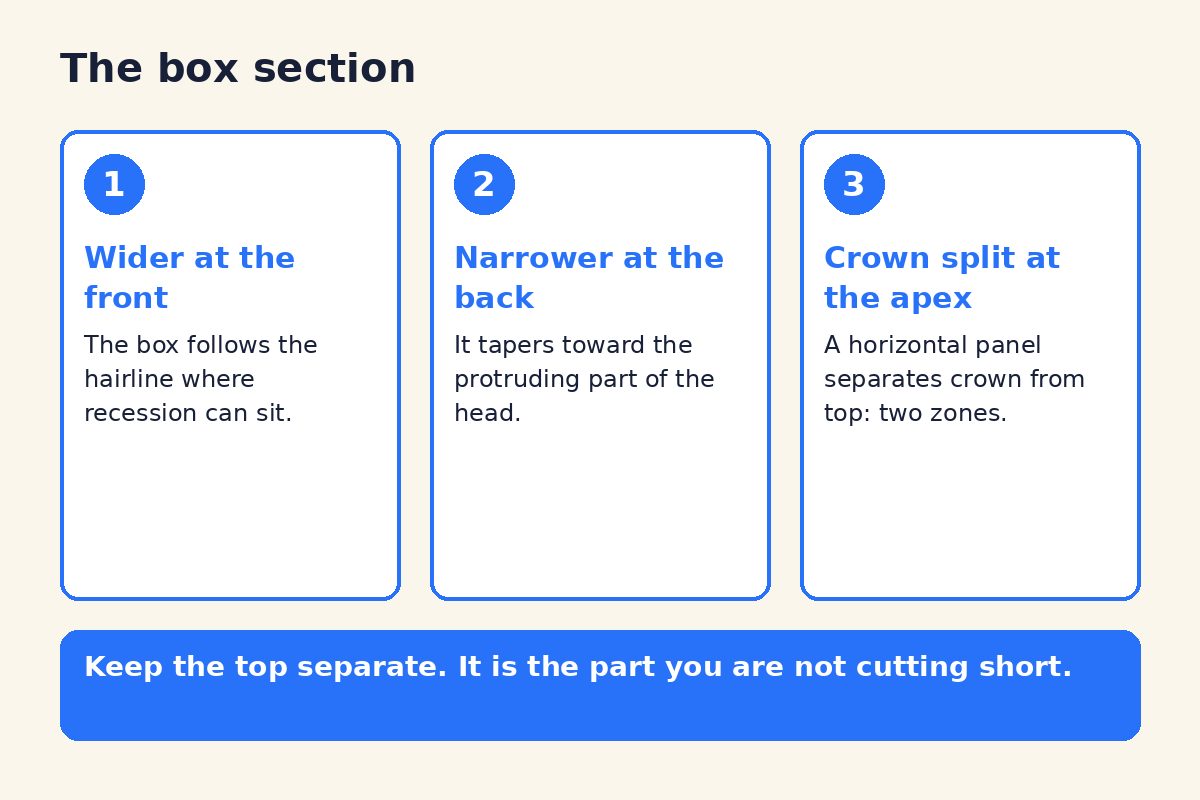
“We’re going to section away the top of the head in a very simple box section, which works wider at the front where the recession is and more narrow towards the back.”
– Hair In Motion Education
Ranaudo’s version is quicker. He damps the hair with a spray bottle, combs out tangles and makes sure the blades are oiled. Then he splits the head into four sections that he cuts one at a time, with the top section last because it holds the longest hair.
- Damp the hair and comb out the tangles first
- Oil your clipper blades before you start
- Keep the top separate. It is the part you are not cutting short
The sides: guards or graduation
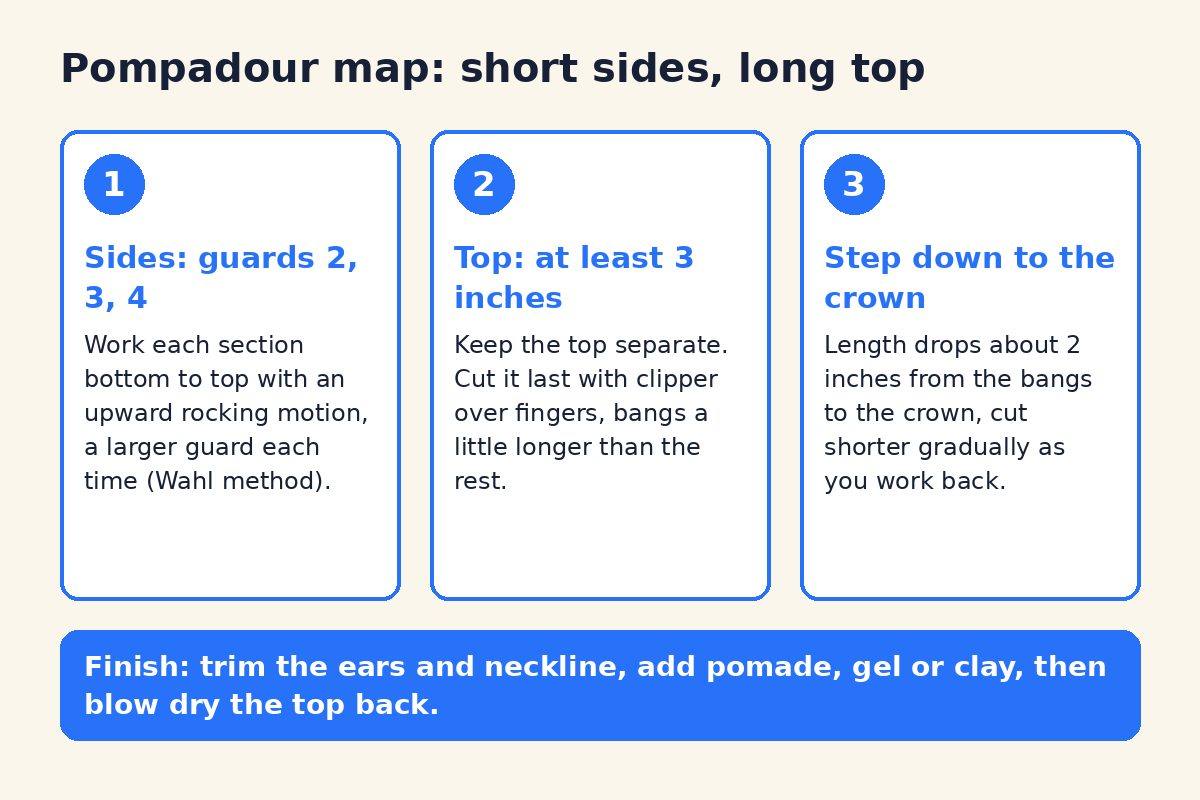
The Wahl guard route. Ranaudo attaches a number 2 guard to a Wahl clipper and starts at the bottom of section 1, working up with an upward rocking motion. Then he moves to a number 3 guard and the same motion for section 2. Section 3 gets a number 4. All three passes work from the bottom up, using the rocking motion so the guard blends as it climbs. Our guard sizes chart explains what each number leaves.
“You’re going to attach a #2 guard to your clipper and, starting at the bottom of section 1, work your way up using an upwards rocking motion.”
– Matt Ranaudo, Wahl
The Kouras guideline route. Kouras shows a mid fade version he calls a modern slickback pompadour. He starts with a trimmer and no guard to cut the bald guideline, a line that slants slightly down toward the back of the head. Then he opens the clipper lever, goes up about three quarters of an inch with no guard, repeats with a number 1 guard and then a number 2, each about three quarters of an inch higher. After the guidelines are in, he softens each one in turn, using the lever halfway and then closed with a flick out. His own tip is to listen to the clipper, and to stretch the skin with your free hand to lengthen the zone you are flicking. He finishes the fade with thinning shears point cut in reverse.
The Hair In Motion scissor route. Hair In Motion’s method cuts diagonal sections that run longer at the top and shorter toward the bottom. Each section is over-directed into the next one. Over-directing means pulling it toward the next section to leave more length and weight toward the curve of the head. The aim is a classic graduated shape that is shorter at the front and longer and heavier toward the crown. The video warns against over-directing too much below the occipital bone, the bump at the back of the skull. After the graduation, it cross-checks the horizontal shape with a wide-tooth comb. There should be no corners of weight, only a slight point in the center where the hair is longest.
Cutting the top
Ranaudo cuts the top last. Section 4 is the longest hair on the head, and he uses the clipper-over-fingers technique. He starts with the bangs and cuts them so they stay a little longer than the rest, because once cut they should fold back over easily. He keeps using the same technique while working back and cuts progressively shorter. The difference in length between the bangs and the crown should be about two inches.
Hair In Motion cuts the top as a complete square shape, which keeps the length at the front. The most common mistake, the video says, is rounding off the front without noticing. To avoid it, focus on the root and where you pull the hair up. Toward the back of the head, the square starts rounding off. Then the stylist texturizes by point cutting with classic scissors, mainly through the top and sides, and uses a feather razor on the mid-length to remove density at the nape.
“We’re working longer at the top of the section and shorter towards the bottom.”
– Hair In Motion Education
Kouras, cutting his own hair, adds a few practical finishing moves. Where the top overhangs the faded sides, he pulls sections straight out from the head and cuts at 90 degrees to blend it in. Before the line up, he holds back his hair with a headband.
Cleanup and styling
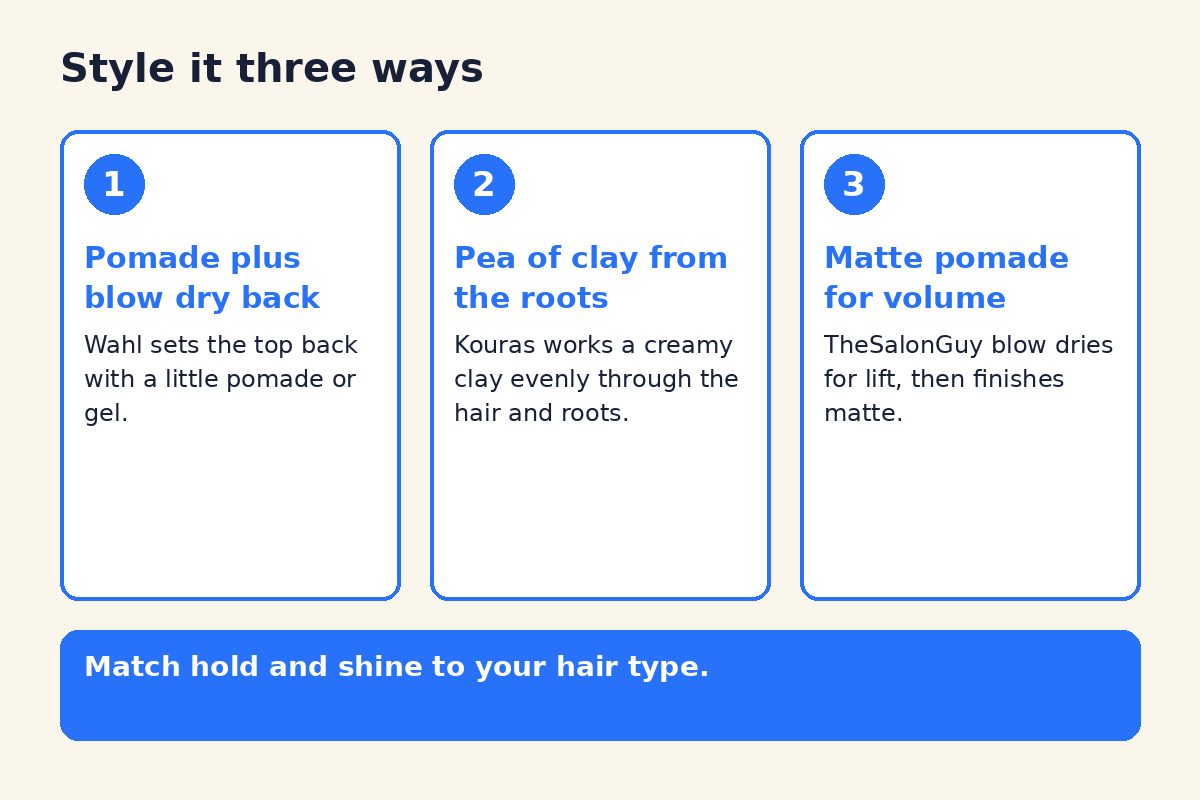
Ranaudo cleans up around the ears and neckline with a trimmer, or with the clipper if you do not own one. Then he applies a little pomade or gel to the top and blow dries the hair back to set it in place.
Kouras styles his with a clay. He takes a pea-sized amount, rubs it between his palms until it turns creamy, and works it evenly through the hair, especially the roots. Then he adds a little more to finish the shape. TheSalonGuy, who shows a shorter, disconnected version of the pompadour, finishes his with a matte pomade and a blow dry to get volume. He also warns that very short sides need redoing every week or two once they grow back.
“I take about a pea-sized amount of product, lightly rub it between my palms until it turns creamy, and then work it evenly throughout my hair, making sure I reach the roots.”
– Alex Kouras
Not sure which product fits? Our pomade vs clay vs wax guide breaks down hold and shine.
Tools for the job
The cuts above use guards, a trimmer, a cutting comb, shears and a styling product. Here are the ones that already appear in our other guides.
The Wahl 1-8 color-coded guide set covers the whole numbers used in the Wahl video above (the half and 1.5 guards are sold separately).
Check the Wahl 1-8 guide set on Amazon
The Wahl Detailer Li is a precision trimmer for the ear and neckline cleanup.
Check the Wahl Detailer Li on Amazon
The Bardeau 8.75-inch carbon cutting comb handles sectioning and lifting.
Check the Bardeau carbon comb on Amazon
The Sirabe 10-piece shears set includes cutting and thinning shears for the scissor work and the texturizing.
Check the Sirabe shears set on Amazon
For styling, Baxter of California Clay Pomade is a matte, high hold option, and Suavecito Original Pomade is a classic shiny pomade.
Sectioning clips keep the boxed-off top out of the way while you work the sides.
Check sectioning clips on Amazon
Uppercut Deluxe Matte Clay is another matte option in the style Kouras describes (the clay in his video is his own brand).
Check Uppercut Matte Clay on Amazon
Check Baxter Clay Pomade on Amazon
Check Suavecito Original Pomade on Amazon
Watch the full tutorials
Wahl’s pompadour at home, a short walk through the guards and the clipper-over-fingers top. This is a brand video from Wahl, so it uses their clippers:
Video credit: Wahl|WahlHomeProduct on YouTube
Alex Kouras’s slickback pompadour self haircut, with the guideline spacing and the lever sequence narrated. He also promotes his own hair brand and a course in the video:
Video credit: Alex Kouras on YouTube
Hair In Motion Education’s mid-length pompadour, scissor-led:
Video credit: Hair In Motion Education on YouTube
FAQ
How long does hair need to be for a pompadour?
Ranaudo says at least three inches on top. The bangs are cut a little longer than the rest, and the length steps down by about two inches by the crown.
Can you cut a pompadour yourself?
Wahl and Kouras both show home versions, and Kouras’s video is a self haircut. TheSalonGuy notes that a very short disconnected pompadour is difficult to do on yourself because of the angles and precision, even though going guard to guard is easier.
How do you style a pompadour?
Pomade or gel and a blow dry back (Wahl), a pea-sized amount of clay worked from the roots (Kouras), or a matte pomade with a blow dry for volume (TheSalonGuy).