
TrustedBarber is reader-supported. If you buy through links on this page, we may earn a commission from Amazon at no extra cost to you.
- The one rule behind every guard number
- The complete clipper guard size chart
- What each guard haircut actually looks like
- Why half guards exist (and why barbers love the #1.5)
- Brand differences: Wahl, Andis, BaByliss, and the Oster catch
- The taper lever: the half-size you already own
- Universal vs brand-specific guards
- Guards for a fade: the standard recipe
- The guard sets worth owning
- FAQ
Every haircut number, from a #1 buzz to a #4 crew cut, comes down to one system, and once you see it the whole chart becomes obvious. This page is the reference for that system: every standard guard in inches and millimeters, what each length actually looks like on the head, the half sizes barbers blend with, the one big brand that breaks the pattern, and how the numbers stack up in a fade. Save it, screenshot the chart, hand it to whoever is cutting your hair.
The one rule behind every guard number
Clipper guard numbers follow the eighths of an inch. A #1 guard leaves one eighth of an inch of hair, a #2 leaves two eighths (a quarter inch), a #3 leaves three eighths, and so on up to a #8, which leaves a full inch. The number is not a size code that brands invent differently; it is a fraction. Wahl states this directly in its guide comb explainer, and the numbered sets from Wahl, Andis and BaByliss PRO follow the same convention, which is why a #2 in one barbershop comes out the same as a #2 in another.
Two things sit outside the rule. First, the zero: a bare blade with no guard cuts shorter than any guard, and a #0 guard is its own length, usually about 1.5 mm of stubble. Second, some machines fine-tune between numbers with a taper lever, which we cover further down. Learn the eighths rule and those two exceptions, and you can decode any guard conversation at the barbershop or in the mirror at home.
The complete clipper guard size chart
This is the standard U.S. numbering used by Wahl, Andis and BaByliss PRO. Lengths are the amount of hair left on the head after the pass.
| Guard | Inches | MM | What it leaves |
|---|---|---|---|
| Bare blade (no guard) | under 1/32″ | 0.8 or less | Skin-tight stubble; the base of a skin fade |
| #0 (some sets label this #0.5) | 1/16″ | 1.5 | Freshest stubble length; Andis’s smallest magnetic guard |
| #1 | 1/8″ | 3 | Short buzz cut; still very tight |
| #1.5 | 3/16″ | 4.5 | Blend step between #1 and #2 |
| #2 | 1/4″ | 6 | The classic short buzz |
| #3 | 3/8″ | 9 to 10 | Longer buzz; top of most fade work |
| #4 | 1/2″ | 13 | Crew cut territory |
| #5 | 5/8″ | 16 | Long crew; start of grown-out looks |
| #6 | 3/4″ | 19 | Grown-out buzz; often blended with scissors |
| #7 | 7/8″ | 22 | Blending length for longer tops |
| #8 | 1″ | 25 | One inch; the longest guard in standard sets |
| #10 | 1-1/4″ | 32 | Extended sets only |
| #12 | 1-1/2″ | 38 | Extended sets only |
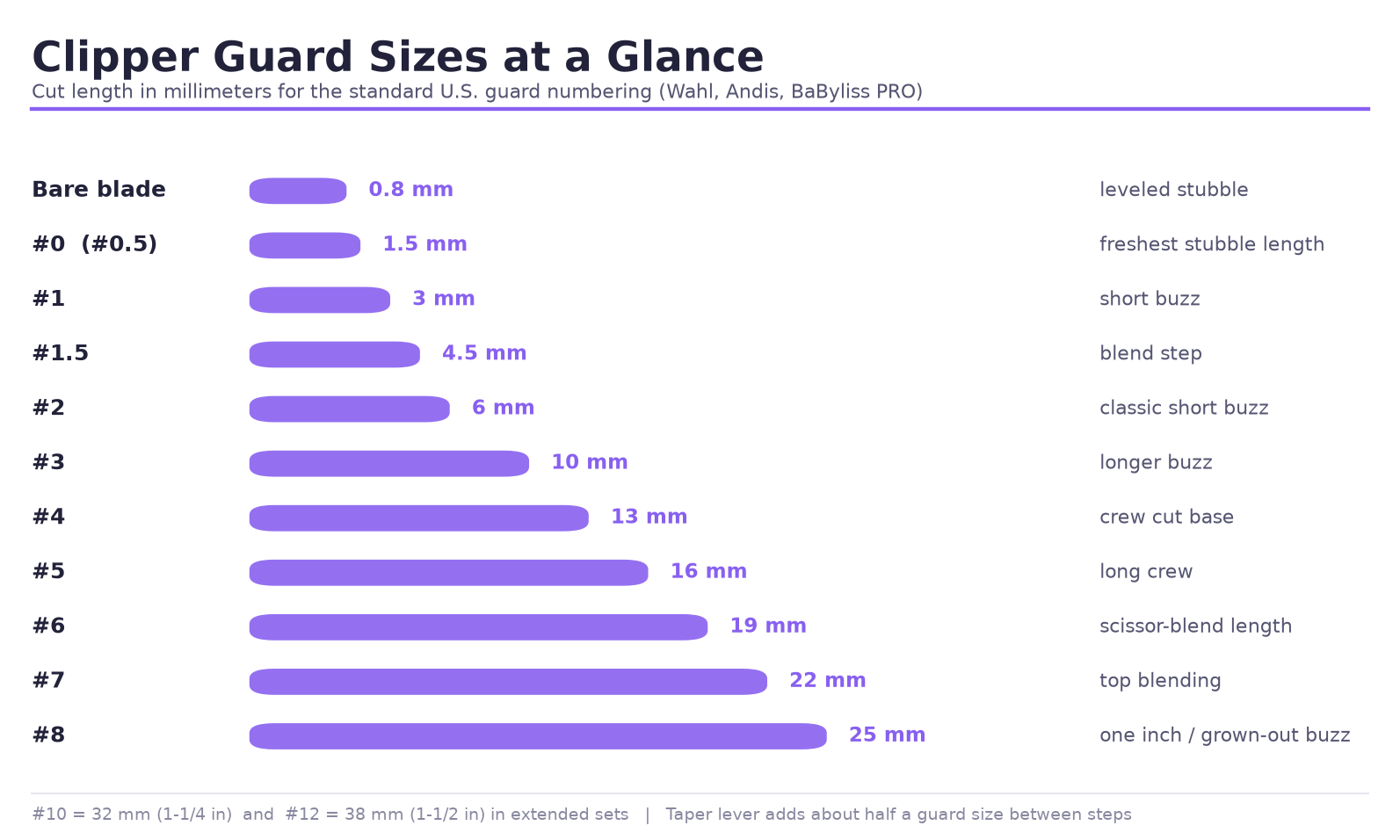
Numbers past #8, like the #10 and #12, exist in extended guard kits that some brands sell separately. Most home users will never need them: at 32 to 38 mm you are into scissor-and-comb territory, and a barber would blend that length with shears rather than push a plastic comb through it.
What each guard haircut actually looks like
The numbers mean nothing until they are on a head, so here is the chart translated into the haircuts people actually ask for.
Skin, bald and zero: a bare blade or a dedicated balding clipper is the tightest a clipper gets, but it is not bald. A clipper leaves a shadow of stubble; true bald comes from a foil shaver or a razor. Wahl’s 5 Star Balding clipper exists precisely because a standard clipper blade is not designed to finish at zero, and barbers use it to take a skin fade’s lowest section down to shadowless.
#1 (3 mm): the short buzz. Enough hair to keep the head from shining, tight enough to read as almost shaved from a distance. It is also the workhorse of the lower half of a fade.
#2 (6 mm): the classic short buzz, and the single most requested guard length in barbershops. Short enough to be maintenance-free, long enough to show hair color and texture. When a client says "just a two all over," this is the number.
#3 (9-10 mm): the longer buzz, and the usual ceiling for clipper work on the sides of a fade. A #3-on-the-sides cut is the grown-up, blend-friendly version of the #2 buzz.
#4 (13 mm): crew cut and brush cut territory. Half an inch stands up on its own on most hair types, so barbers pair a #4 on top with tapering sides for the classic military-adjacent cut.
#5 through #8 (16-25 mm): these live on top rather than on the sides. A #8 all over is a grown-out buzz that a lot of guys grow into instead of choosing; more often barbers use these guards to set a top length that scissors then texturize into. If you are cutting at home, a #6 to #8 all over is the most forgiving place to start, because mistakes are invisible at these lengths.
Why half guards exist (and why barbers love the #1.5)
Half sizes like #0.5, #1.5 and #2.5 split the gap between two whole numbers, and they earn their place in a kit for one reason: fades. Jumping from a #1 straight to a #2 leaves a 3 mm step that reads as a line on most hair. The #1.5 at 4.5 mm turns that jump into two smaller steps, which is why professional guard sets and barber kits keep growing half sizes. Wahl’s half guards are so common in fade work that the brand sells them in dedicated packs, and Andis fans fill the same gap with the dual-magnet sets we link below.
Naming differs by brand at the short end, and it is worth knowing before you buy: the same 1.5 mm length is labeled #0 in Andis’s magnetic system and #0.5 (or #½) in Wahl’s. Equal length, different number. Book of Barbering’s guard guide flags exactly this trap, and it catches people who buy a second brand’s guards expecting the numbers to carry over.
Brand differences: Wahl, Andis, BaByliss, and the Oster catch
Wahl, Andis and BaByliss PRO all follow the eighths convention, so a #3 means 3/8" across all three. The differences are in the mounting and the small sizes: Wahl guards clip on and are widely standardized across the brand’s full-size clippers, while Andis’s magnetic combs snap onto the Master and Fade Master family with dual rare-earth magnets. The magnets are the most secure attachment in the business, but they are brand-specific: a Wahl guard does not seat on an Andis Master and vice versa.
The Oster catch: on Oster clippers like the Classic 76, the numbers refer to detachable blades, not combs, and the blade scale runs shorter than the guard scale. An Oster #1 blade cuts about 2.4 mm, noticeably tighter than a Wahl #1 guard at 3 mm, so asking for "a one" in a shop running Oster 76s gets you a shorter cut than the chart above suggests. Oster’s own product listings for the Classic 76 ship it with #000 and #1 blades, and the brand’s longer combs are labeled in inches instead of numbers. The fix for the confusion is the same one barbers use: quote the length in inches or millimeters, not the number.
| Oster blade | Length | MM |
|---|---|---|
| 00000 | 1/125″ | 0.2 |
| 0000 | 1/100″ | 0.25 |
| 000 | 1/50″ | 0.5 |
| 00 | 1/25″ | 1.0 |
| 0 | 3/64″ | 1.2 |
| 1 | 3/32″ | 2.4 |
| 1A | 1/8″ | 3.2 |
| 2 | 1/4″ | 6.0 |
| 3.5 | 3/8″ | 10.0 |
The taper lever: the half-size you already own
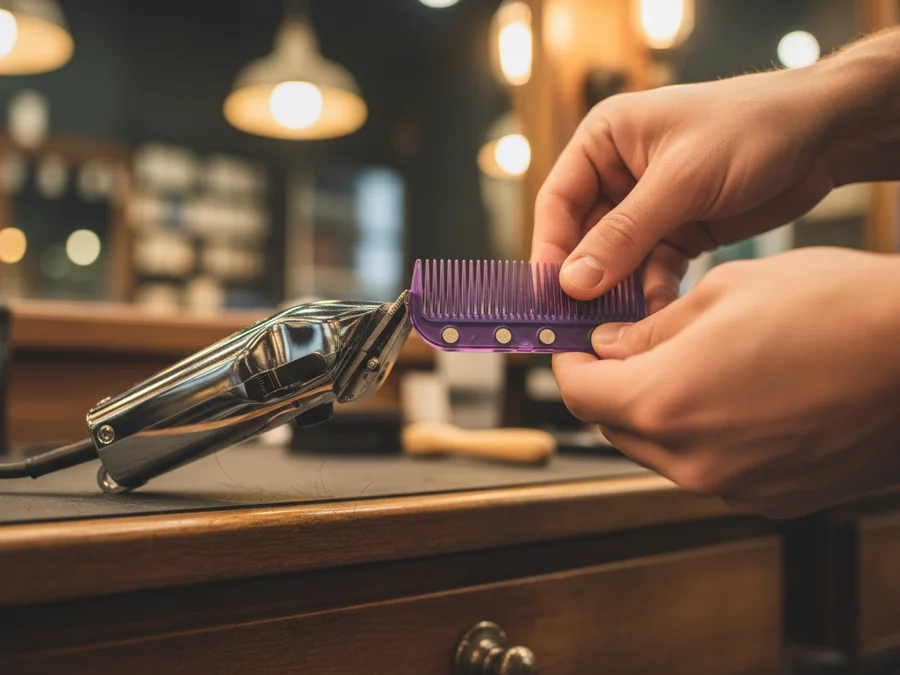
If your clipper has a small handle on the side, that is the taper lever, and it is a bonus guard built into the machine. On an adjustable-blade clipper, the lever shifts the blade gap between roughly 0.8 mm closed and about 2.4 mm open. In practice it widens any guard’s range by about half a size: a #1 with the lever open cuts closer to a #1.5, which is how barbers fine-tune blends without swapping combs mid-fade. Flicking the lever between guards is the difference between a fade with a visible line and one that graduates cleanly, and it is the first thing to reach for before you go hunting for more plastic combs.
Universal vs brand-specific guards
Two guard types fill shop drawers. Brand-specific guards, like Wahl’s color-coded clip-on set and Andis’s magnetic combs, lock onto their own machines positively and are what professionals run all day. Universal guards, most famously the Speed-O-Guide combs that predate both brands’ systems, stretch over a range of clipper blades with a spring fit. They are handy for a drawer of mixed machines, but the trade is security: a universal comb can pop loose mid-pass where a magnet or clip will not. The practical advice barbers give matches the physics: match the guard to the machine, and only lean on universal combs for odd jobs.
Guards for a fade: the standard recipe
Fades are just the guard chart read bottom to top, and the recipe is stable across shops. A classic mid fade runs: skin or bare blade at the bottom, #1 above it, #1.5 to blend, #2, then #3, finishing with a scissor or guard blend on top. Each pass overlaps the one below it by an inch or two so the gradient stays smooth. A low fade keeps the same ladder starting lower and a high fade pushes the bare-blade line up toward the crown, but the guard steps stay identical, which is why learning three or four numbers covers nearly every fade request.
If you are decoding the request rather than performing it, the same chart is the vocabulary. Our guide to telling your barber what you want pairs each of these numbers with the words that get the cut you pictured, and our breakdown of tapers versus fades explains where the skin line sits in each. Cutting at home? Our clipper tutorials for cutting your own hair walk the ladder step by step, and the comb-over fade and faux hawk guides show how pros stack these numbers into finished styles.
The guard sets worth owning
Most clippers ship with a partial set, and the fastest upgrade is the missing numbers. These are the sets that fill out the chart, all verified available on Amazon.
Wahl Professional 1-8 color-coded cutting guides (model 03170-400). The standard fill-in set for full-size Wahl clippers: eight colored guards from 1/8" to 1" with an organizer tray. The color coding is not decoration; barbers memorize guard colors and grab by color mid-fade.
Wahl 10-piece color-coded guide comb set. Same clip-on system with two extra sizes in the box, including the small half sizes that fade work leans on. It fits most standard-width Wahl clippers, from home kits like the 9243 through the Magic Clip line.
Andis 01410 Master dual-magnet small comb set. The Andis answer: five magnetic combs covering #0 (1.5 mm) through #4 (13 mm) for the Master, Fade Master and compatible ML-family clippers. This is the set that lives beside most Master clippers in working shops.
Andis 01415 Master dual-magnet large comb set. The upper half of the Andis scale: four combs at 5/8", 3/4", 7/8" and 1", pairing with the small set for full coverage with one attachment system.
Oster Classic 76. If you are choosing a machine around the blade system instead, the 76 is the detachable-blade standard: single-speed universal motor, swap-in blades that change faster than any comb, and the chart above applies to its blade numbers. It ships with #000 and #1 blades.
Wahl 5 Star Magic Clip (cordless). The most common adjustable-blade clipper in the country, and the machine all of this chart is written around: an open lever, a stack of guards, and every fade recipe above runs on it natively.
FAQ
What length is a #2 guard?
A #2 leaves 6 mm, a quarter inch, of hair. It is the standard short buzz length.
Is a #0 the same as no guard?
No. No guard means the bare blade, which cuts under 1 mm depending on the machine and lever. A #0 guard leaves about 1.5 mm of stubble. Andis labels that length #0 and Wahl labels it #0.5 on its half-size sets.
Are Wahl and Andis guards interchangeable?
No. The cutting lengths agree across brands, but the mounting does not: Wahl guards clip on, Andis combs seat on dual magnets, and the blade shapes differ. Buy guards made for your machine.
What guard do barbers use for a skin fade?
The bottom of a skin fade is a bare blade or a balding clipper, then the ladder climbs #1, #1.5, #2 and up. The guards you need for a full fade kit are #0 through #3 plus the blending half sizes.
Why is my Oster #1 shorter than a Wahl #1?
Oster numbers describe detachable blades, which run on a different scale: an Oster #1 blade cuts about 2.4 mm versus 3 mm for a Wahl #1 guard. Quote lengths in inches or millimeters when machines differ.
What is the longest clipper guard?
Standard sets stop at #8, a full inch. Extended kits add #10 (32 mm) and #12 (38 mm), though most barbers switch to scissors and a comb before that point.
Sources: guard lengths follow Wahl USA’s published guide-comb chart and the specifications Andis publishes for its 01410 and 01415 magnetic comb sets; the Oster blade scale follows the blade reference chart used across Andis and Oster detachable-blade documentation.