As an Amazon Associate, TrustedBarber earns from qualifying purchases.
A cowlick can split your fringe, lift the crown or send the part in a direction you did not choose. The useful question is where it sits. Hairline styling and crown cutting need different decisions, and going shorter is not the answer for every head. Here is how hair professionals approach the cut, the part and the blow-dry.
What a cowlick actually is
Sam Villa’s styling guide defines a cowlick as hair growing in a different direction from the rest and resisting being combed flat. For a haircut consultation, point to the section that lifts or separates, then show how it behaves when it dries. That gives your barber a visible pattern to work with rather than a vague request to make it disappear.
What professionals recommend
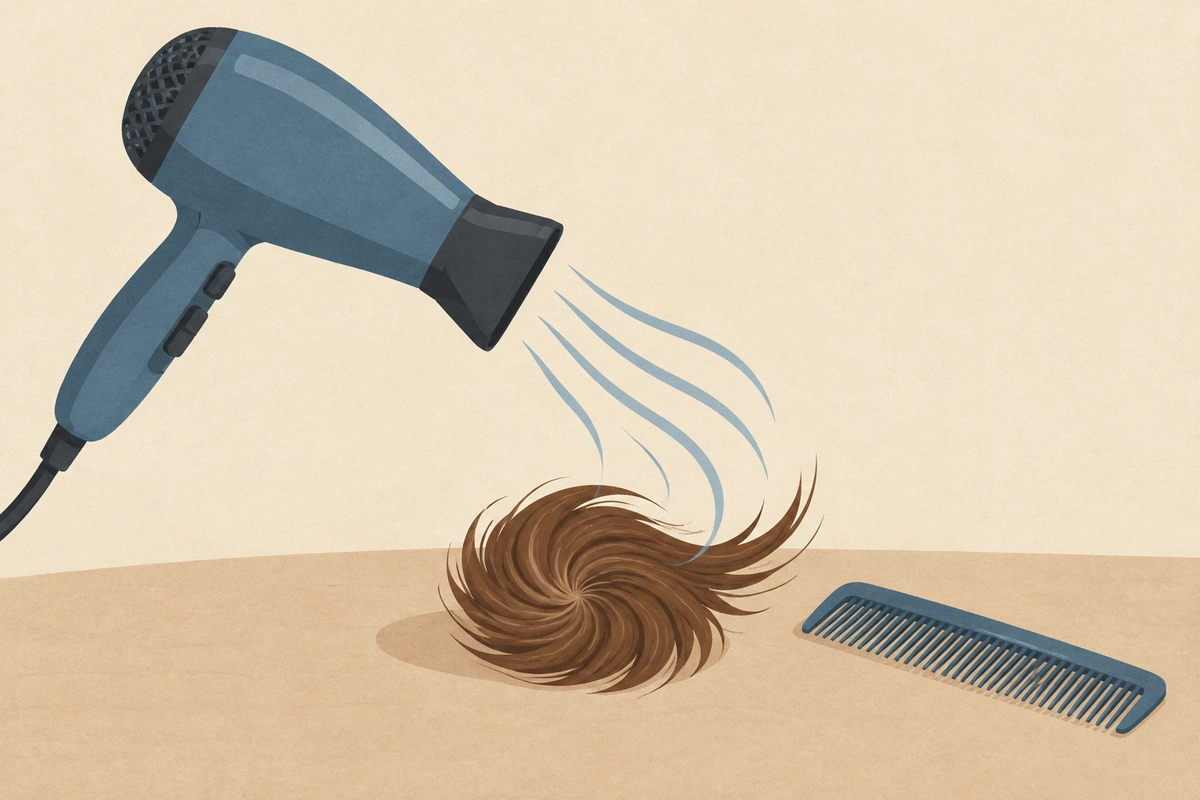
The Associated Hair Professionals’ cowlick guidance for stylists starts with reading the whole hairline, because less obvious cowlicks often hide beyond the one you know about. Its styling advice: if a cowlick is unruly, blow dry it in the opposite direction right away, because hair left to dry on its own sets into its natural pattern and becomes much harder to redirect. The same author notes this works especially well when the hair is longer and the cowlick sits at the hairline. On length, the same guidance says leaving hair slightly longer lets the weight of the hair calm the cowlick.
The same AHP article offers two more routes when length alone is not the answer. If you wear your hair super short, it points out that many current styles simply buzz the section off. If your hair has some curl, its advice runs the other way: accentuate the cowlick and work with the curls rather than fight the pattern, since, as the author puts it, sometimes the battle against a natural growth pattern is not worth the anguish.
“The good news is that with a bit of diligence and a good product, you can usually manage a cowlick.”
Associated Hair Professionals
On the cutting side, a second AHP article presents two approaches: cutting the section short, which it notes often works on layered curly hair, or the approach Redken artist Becka Bradshaw recommends; keep the section longer and texturize it so the growth pattern softens and blends. Her cutting direction: slide cut through the section in the direction of the growth to take the “pop” out so it lays flatter. For styling, the same article suggests a fine-tooth comb moved side to side, focused opposite the cowlick’s growth direction, to redirect the roots. For stubborn volume, the same article adds that a flat iron can flatten the section, and securing it with a clip while it cools works even better.
American Salon’s cowlick tutorial adds three working habits from Andrew Carruthers, education director for Sam Villa. First, cut the hair dry, because that shows the cowlick in its natural state. Second, blow-drying technique does the daily management; including applying product to soften and hold, and wrap drying the section. Third, around the whorl itself, use a blending shear designed for minimal hair removal, which creates soft, loose texture instead of a hard edge that can pop back up.
Hairline or crown: start in the right place
For a fringe that splits: Sam Villa’s written blow-drying method uses a fine-tooth comb close to the roots. Work one way with the dryer following the comb, then reverse the direction to create an X pattern. The guide specifies the dryer’s lowest speed setting. Finish by bringing the fringe forward and spreading it out, rather than leaving it pulled to one side.
For short hair that lifts around the crown: Andrew Carruthers’s short-hair lesson uses a comb instead of a brush and an X-pattern blow-dry. It also shows a hand-and-dryer approach to creating crown texture. That is a styling option to discuss alongside the longer-or-shorter cutting choices above, not an instruction to flatten every crown into the same shape.
For the next appointment: ask your barber to demonstrate the finish on your own hair. AHP says teaching the client to work with the pattern is part of the job. Ask which section to dry first, where to put the part and which length to preserve. That is more useful than copying a guard number from a haircut with a different growth pattern.
Where to part it
One barbering take reframes the cowlick as a guide rather than an obstacle. Fellow Barber‘s senior barber Soren’s advice is to part with the crown whorl, not against it: if the whorl runs clockwise (left to right), the hair lays nicer parted on the left, and if it runs counterclockwise, part it on the right. The check is simple; run your hands through your hair and see where it wants to fall; and since most people never look at the back of their own head, this is exactly the read your barber can do for you. Even front-hairline cowlicks, he notes, tend to fall in line when the part follows the back whorl.
Parting against the whorl is where the familiar trouble starts, per the same interview: the hair around the cowlick sticks up, the part will not stay put and falls into your face, and the cut can read uneven or puffy because the hair never fully lays down. If you insist on parting against it anyway, his method is a blow dryer and a small amount of a strong-hold product rather than a large amount of a weaker one.
His cut guidance mirrors the AHP length logic from the other side. Either take the crown short enough that no length is left to stick up; accepting that the cowlick returns as it grows out, so the cut needs regular upkeep; or keep enough length for the hair’s weight to hold the pattern down. The cut he warns against is high and tight on the back and sides with a longer top, which strands the crown at a mid length with no weight to control it.
What to tell your barber
Point the whorl out before the clippers come on. AHP’s first instruction to professionals is to read the client’s hairline for exactly this, and its cutting guidance above gives your barber the two routes; shorter, or longer and texturized. For the rest of that conversation, how to tell your barber what you want covers the vocabulary.
“First, I recommend that you try to read the client’s hairline a bit. Look closely throughout the scalp as at times there may be other cowlicks that are not as apparent.”
Associated Hair Professionals
What people report doing (anecdotes)
These are individual routines, not verified instructions; results vary by hair and whorl:
- One r/Hair member described a damp-cloth reset: “I usually moisten a clean wash cloth and press it over my cowlick. Does a great job on second day hair.”
- Several members report that leaving more length over the whorl lets the hair’s own weight hold it down; “Let it grow longer is the answer,” as one r/Pomade member put it, while an r/AskMen member reported that after a certain length, your hair will lay down on its own. That matches the professional guidance above.
- Others report training the section with a blow dryer while the hair is damp: “Spraying my hair with water and then blow drying in the direction I want my hair to lay has helped a lot,” wrote one r/Pomade member, and an r/Haircare member described how their hairdresser redirects theirs with a round brush and blow dryer. Again consistent with AHP’s advice to professionals.
“Let it grow longer is the answer.”
Also worth a look
The AHP guidance above pairs diligence with “a good product” for managing a cowlick, so two of the site’s verified picks:
A water-based, medium-shine pomade per its listing.
Billed by its listing as an all-day strong hold, high volume paste with a matte finish.
Our styling products guide compares more options across hold and finish.
Watch the credited styling demonstrations
Sam Villa Hair Tutorials shows two different problems: a short cut with strong growth patterns and a fringe with a cowlick. Choose the lesson that matches the section you are trying to style.
Video credit: How To Blow Dry Short Hair With Strong Growth Patterns, Sam Villa Hair Tutorials.
Video credit: How To Blow Dry Bangs With a Cowlick, Sam Villa Hair Tutorials.
FAQ
Is there one haircut that fixes every cowlick? No. AHP describes both shorter and longer approaches, and its advice changes with the hair pattern and desired style. Ask your barber to show how the section will sit at the length you want.
Should I cut a cowlick shorter or leave it longer? Professionals take both routes. AHP notes cutting short often works on layered curly hair, while Redken artist Becka Bradshaw recommends keeping the section longer and texturizing it to blend. Your barber can judge which fits your hair.
Will the damp-cloth routine work for me? It is one member’s report, not a verified method; results will depend on your hair and whorl.