Disclosure: this article contains Amazon affiliate links. As an Amazon Associate we earn from qualifying purchases, at no extra cost to you. It does not change what we recommend.
A mustache trims in minutes, and most of those minutes go wrong the same way: too much off the lip line, lopsided ends, and a stache that bleeds into the beard with no shape of its own. Two guides from the Live Bearded channel, one a pro walkthrough and one from a man who has worn a handlebar for ten years, agree on the whole fix. Style it first, take less than you think, and use one trick almost nobody does to make the mustache sit on top of the beard.
A note on the source: Live Bearded is a beard care brand that sells mustache wax, and both videos recommend wax as part of the routine. The trimming method itself, where to cut, in what order, and how little to take, is what we pulled from them, and it needs nothing more than a comb, a trimmer, and small scissors.
In this article
Style First, Trim Second
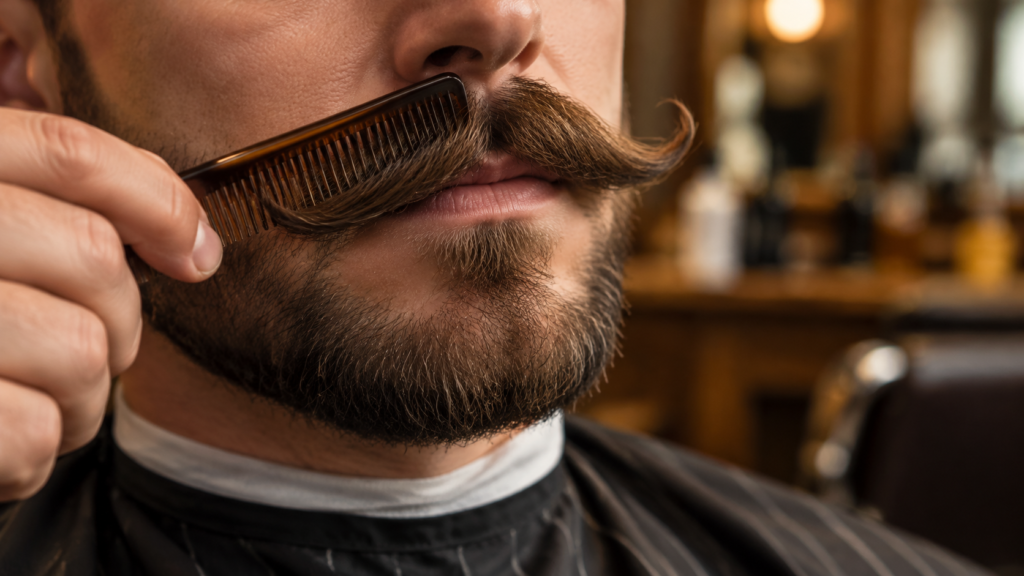
The pro guide opens with a step most people skip: before any trimming starts, style your mustache the way you actually wear it. Work a little mustache wax through from the middle outward, rolling toward the outsides almost like snapping your fingers, so the hairs train away and up. The point is not to glue the stache to your lip. “The whole idea behind mustache wax is not to glue your mustache to your lip, you really just want to move the hairs and shape it,” the Live Bearded pro tutorial explains.
The reason is simple: you want to see the mustache as it sits on a normal day before you decide what comes off. Trim it unstyled and you will cut hairs that were never in your way, and miss the ones that are. With the wax in, only the hairs that genuinely need trimming stick out as candidates.
The Lip Line: Your Nose Is the Guide
Both videos land on the same measuring tool, and it is attached to your face. Start in the middle with a trimmer and work outward, clearing just enough so hair stays off the lip. “The width of the tip of your nose is usually a pretty good guide,” the pro tutorial says, and the ten-year handlebar wearer repeats it almost word for word: he trims above the upper lip “about the width of my nose” and cleans around the nostrils so nothing grows in.
The warning that comes with it matters more than the guide: do not take that line too far out. The hairs at the outer edges are what give a mustache its thickness and, on a handlebar, its whole shape. Clear the middle, leave the edges. And the running theme of both videos applies here hardest: less is more, small passes, and as the wearer puts it, “measure twice, cut once.”
The Ends: Blunt, Not Chased
For the ends, both guides switch from trimmer to scissors, small precise ones, not kitchen shears. The pro’s target is a straight, blunt cut across the tips. Evening the ends down to one length is what makes the tips of the mustache look fuller; ragged ends at different lengths are why so many mustaches look thin when they are not.
The discipline is in knowing when to stop. “Don’t play this back and forth game where you take it down and this side goes a little shorter,” the pro tutorial warns, because the chase ends with more length off than you ever planned. Use the eye test, get them close, twist the waxed ends together to check, and walk away. The wearer’s version: feel the ends out with your hands and only trim if they actually need it.
The Separation Trick
The pro video saves its best move for last, and calls out that most beardsmen have never heard of it: define the separation between mustache and beard. If your stache seems to pour straight into your beard with no shape of its own, this is why, and it is fixable in about a minute.
Pull the mustache hairs, the ones actually growing on the lip, up and away toward the side of your mouth. The hairs left behind on the cheek are beard hairs, and those are what you trim down, taking just the tips. With those shortened, the mustache sits on top of the beard instead of blending into it, and the shape suddenly reads. “That’s what’s going to allow these hairs to sit on top and really give you that separation,” the tutorial says, and the wearer confirms he does the same thing every trim. Take it slow here: you are snipping millimeters, not clearing a cheek line.
Tools for a Clean Trim
The whole routine runs on three things: a comb, a lip-line trimmer, and small scissors. For the scissors, the Tweezerman moustache scissors are the size and precision the ends and the separation trick call for. A fine-tooth carbon cutting comb handles the daily comb-out both guides start with. For the lip line and nostril cleanup, a tight detail trimmer like the Wahl 5 Star Cordless Detailer Li does controlled work in a small space. If you wear a handlebar or any styled shape, a tin of mustache wax rounds out the kit, since styling first is step one of the whole method.
FAQ
How often should I trim? The lip line and nostril area go fastest, usually weekly. The ends and the separation work can wait two to three weeks, since taking them too often is exactly how mustaches lose their thickness.
Can I use kitchen scissors? Both guides say precision scissors, and it is not snobbery. Big household shears cannot isolate single hairs under your nose, and the ends step depends on a controlled straight cut a few hairs wide.
Does the separation trick work on a short mustache? Yes, and it matters more. A short stache has no length to create shape on its own, so the shortened beard hairs beneath are what give it an outline at all.
First time growing a handlebar and it is unruly? Normal, says the man who has worn one for ten years. New growth points every direction, like parting your hair a new way. Wax it daily, trim only the lip line for the first couple of months, and it gets easier as the hairs train.
Style it, clear the lip to nose width, blunt the ends with scissors, and cut the beard hairs back so the stache sits on top. Small passes, and stop one pass before you think you should.