As an Amazon Associate, TrustedBarber earns from qualifying purchases.
Prep, angle, and pressure decide a safety razor shave. The steps below follow the published instructions of two razor makers, Rockwell and MUHLE, with the source linked at each step. Community experiences are included at the end, labeled as anecdotes. The technique is the same on any double-edge razor, from the Merkur 34C to the MÜHLE R89.
Choose the mechanism before the extras. The two linked options below are different razor choices; neither changes the handling rules in the maker’s instructions. Compare the exact kit and blade-loading method.
- Prep, per the makers
- Open comb or closed comb
- The angle: what the makers specify
- The stroke
- Refinements from the same guides
- Tricky areas: chin, upper lip and neck
- Choosing blades
- When to change the blade
- Changing the blade safely
- After the shave
- Common safety razor mistakes
- What long-time users add (anecdotes)
- Also worth a look
- Watch a credited demonstration
- FAQ
Prep, per the makers
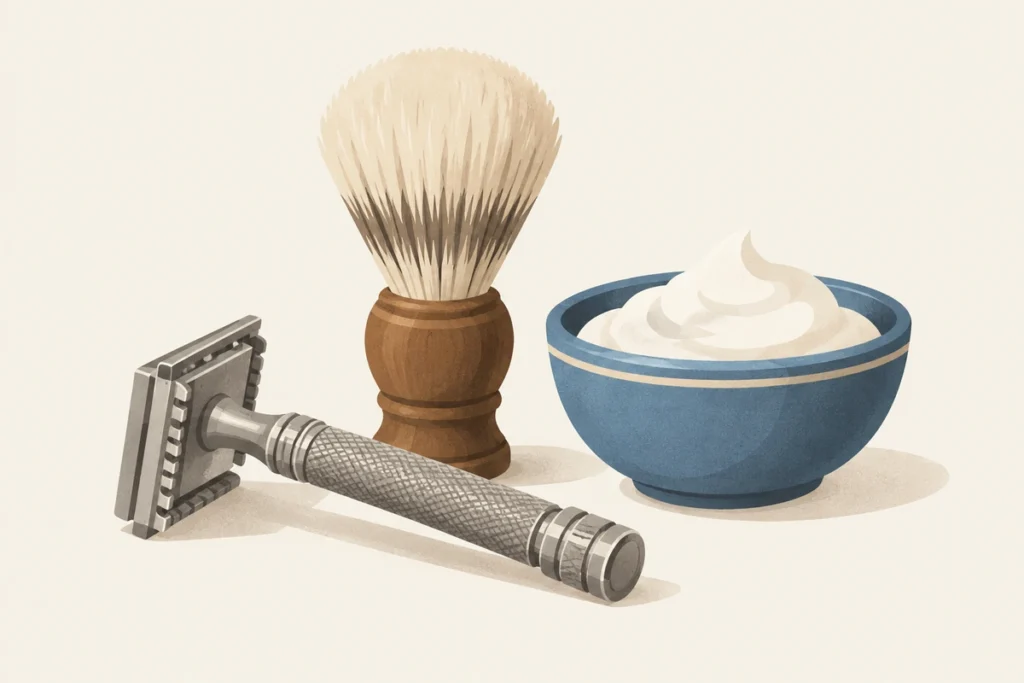
Rockwell’s step-by-step guide starts with preparing the skin with hot water and a good lather. Its prep specifics: shave right after a hot shower if you can, because the goal is to hydrate the skin and soften the whisker, and build the lather with a pre-soaked brush and shaving cream. MUHLE’s safety razor guide is more specific about why and how long: soaping softens the hair and helps the blade glide, and you apply the soap or cream with a brush in circular motions for two and a half to three minutes. If you need the brush side of that kit, our shaving brushes and bowls picks cover the options.
“Apply the shaving soap or cream with the brush in a circular motion. You should take two and a half to three minutes.”
MUHLE, safety razor guide
Any shaving cream or soap that builds a slick lather will do. Proraso says its Proraso Refreshing Shaving Cream works with safety razors and needs only a dime-size amount on a brush or in your hands. A boar brush such as the Omega 10049 Pure Bristle shaving brush is a common pairing for the brush-and-bowl lather MUHLE describes.
Rockwell explains its adjustable setting by the number visible on the bottom of the assembled razor. That number is not the same thing as the handle angle described below. Check the assembled setting before you start, then apply the technique for your own razor. A different head design or adjustment system needs its own instructions; a number from one maker is not a universal aggressiveness scale.
Open comb or closed comb: the head changes the shave
Before angle and pressure, the razor head itself sets how much blade meets the skin. MUHLE’s guide to razor heads explains the two basic designs. An open comb, like MUHLE’s R41, has teeth that resemble a rake, and the blade protrudes further. MUHLE calls that shave very effective for thick beards but less gentle, with a higher risk of injury.
A closed comb has a smooth, wavy safety bar instead of teeth, and the blade is less exposed. MUHLE recommends a closed comb for beginners and men with sensitive skin and names its MÜHLE R89 closed-comb razor as one of the softest it makes. The Merkur 34C is also a closed-comb design: Merkur lists it as a two-piece, straight-cut razor made in Solingen, Germany, weighing 2.75 oz.
The technique in this guide works on both designs. A closed comb simply leaves more room for small mistakes in angle while you learn.
The angle: what the makers specify
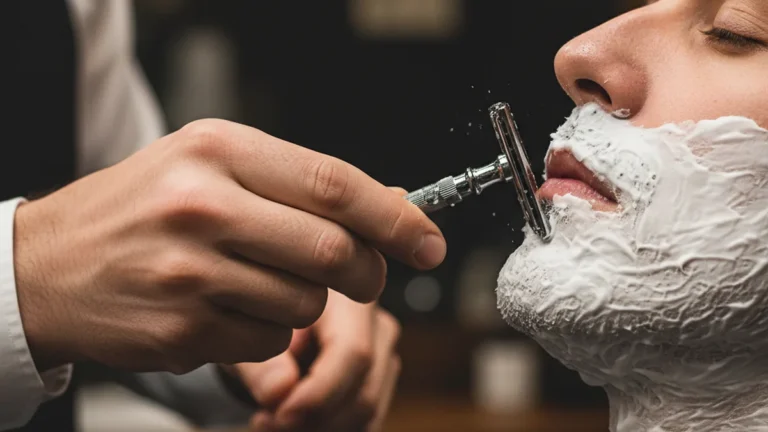
Rockwell’s instruction is precise about what the angle means: in a safety razor, the blade sits at 90 degrees to the handle, so you hold the razor’s handle at 30 to 45 degrees to your skin to expose the blade correctly.
MUHLE’s guide gives a single figure: set the razor at an angle of about 30 degrees to the skin. MUHLE does not define the reference for that number further, so this guide presents both makers’ instructions as written rather than merging them into one.
If you own an adjustable Rockwell razor, the company’s support guide suggests starting on the mildest setting (R1) and adjusting later to suit your skin and hair. That setting system is specific to Rockwell’s adjustable models.

The stroke
Three instructions from the same Rockwell guide define the stroke: shave along the grain, with virtually no pressure, pulling the skin taut and using short, straight strokes. MUHLE also says to shave in the direction of growth without pressure and to pull the skin taut on the chin and neck. Both put light handling ahead of pushing the razor through the shave.
“Shave along the grain with virtually no pressure.”
Rockwell Razors, safety razor guide
Refinements from the same guides
Rockwell’s guide defines “short” strokes precisely: one to three centimeters. It also covers what to do as the razor clogs: flip the razor over and keep going, because a double edge razor has two sides, then rinse it clean with cold water.
Two practical habits come from the same guide. If you catch yourself pressing, hold the razor by the tip of the handle, which counteracts the tendency to apply pressure. And if the 30 to 45 degree angle feels uncertain, Rockwell’s own suggestion is to practice on your arm before trying it on your face.
Rockwell describes an optional second pass with a fresh layer of lather first. Keep that lather step separate from the decision to shave again: another pass is an option in its guide, not a requirement to finish the routine. Follow the instructions for the razor you are using rather than assuming a second pass needs a different direction.
Tricky areas: chin, upper lip and neck
The same three rules carry the whole face, but a few spots need extra care. MUHLE singles out the chin and neck as the places to pull the skin taut. Stretching the skin flattens it, so the blade meets a smooth surface rather than a fold.
- Chin: curved and often where the grain changes direction. Use the shortest strokes here, at the 1 to 3 cm Rockwell describes, and re-check the angle as you go around the curve.
- Upper lip: a small, curved area under the nose. Keep the strokes very short and go with the grain.
- Neck: hair here often grows in several directions. Feel the grain with your fingers before you start, and shave each patch in its own growth direction.
The American Academy of Dermatology also recommends rinsing the razor after each swipe. On a double-edge razor that is easy: use one edge, flip to the other, then rinse.
Choosing blades: start with a few brands
Blades are where double-edge shavers disagree most, and the community advice quoted below boils down to trying several. MUHLE adds one useful rule: the sharper the blade, the lower the risk of cutting yourself, because a blunt blade makes you push or pull harder. A dull blade is a reason to change it, not to press more.
Buying a few packs is the simplest way to compare. Feather double-edge blades and Astra Platinum double-edge blades are two widely sold brands.
Derby Extra double-edge blades are another, and all three fit standard double-edge razors. Give each brand several shaves before you judge it, and keep the angle and pressure the same so the blade is the only thing that changes.
Check Astra Platinum Blades Price
When to change the blade
Rockwell’s support guide says its own blades last most users between 4 and 7 shaves, depending on hair density, and names tugging or pulling as the replacement signal. That figure is Rockwell’s statement about Rockwell blades, not a universal blade lifecycle. For razors in general, the American Academy of Dermatology suggests changing your blade after five to seven shaves to minimize irritation. The same guide suggests a blade safe, a small tin for storing spent blades. Check your local disposal rules before deciding where a filled container belongs.
Changing the blade safely
Rockwell’s blade-replacement guide covers the handling, because a spent blade is still sharp. Its method for its own razors: hold the head with a towel at the side tabs, twist the handle off, lift the numbered base plate, and pick the blade off the top cap by its side tabs (the unsharpened ends), never by the exposed edges. On twist-to-open butterfly models, the same tab grip applies after you twist the knob and the doors open. When you reassemble, the guide warns against over-tightening the head, which can wear the handle’s threading over time.
On a removable-head Rockwell, the handle, numbered base plate and top cap are separate pieces in the maker’s replacement sequence. Keep track of those pieces as you open the head. The numbered plate comes off before you lift the blade from the cap; it is not an instruction to pull a blade through a partly assembled head. With a butterfly opening, use the knob to open the doors first. Match the opening method to the razor in front of you.
Disposal is the other half. Wrapping a used blade in tissue is a bad idea, per the same guide; a blade safe is the route it recommends, and the tin takes any brand’s double edge blades, not just Rockwell’s. Rockwell bills the filled tin as fully recyclable, but household recycling rules for sealed blade containers vary by municipality, so check your local program’s acceptance before it goes in the bin.
The handling sequence matters more than the style of handle. Rockwell separates its removable-head design from butterfly opening, but keeps the same rule for touching the blade: use the unsharpened tabs. Identify how your own head opens before loosening anything, and keep the sharp edges out of your grip. A blade that no longer shaves well still needs the same careful handling as a fresh one.
After the shave
Rockwell closes its technique guide with a cold-water rinse and aftershave balm. A balm such as the Proraso After Shave Balm (Oatmeal and Green Tea) from Proraso’s Sensitive Skin line fits that step; use it as its label directs.
Then look after the razor. The American Academy of Dermatology recommends letting it dry completely between shaves and storing it somewhere dry, not in the shower or on a wet sink. On a two-piece razor such as the Merkur 34C, rinse the head after the shave and let it air-dry. If your skin stays sore, red or bumpy after shaving, see a dermatologist.
Common safety razor mistakes
- Pressing. Rockwell’s guide says the weight of the razor is enough and that pressing leads to nicks; hold the handle near the end if you catch yourself pushing.
- Holding it like a cartridge razor. The blade sits at 90 degrees to the handle, so the handle has to drop to 30 to 45 degrees, per Rockwell.
- Going against the grain first. Rockwell calls shaving against the grain one of the leading causes of irritation; start with the grain.
- Shaving on dry or thin lather. Re-lather before any second pass, as both makers’ guides assume.
- Keeping a dull blade. MUHLE notes a blunt blade makes you press harder, which raises the risk of cuts.
- Leaving the razor wet. The AAD advises drying and storing it out of the shower.
What long-time users add (anecdotes)
Individual community reports, not instructions. One r/shaving answer to a beginner matched Rockwell’s steps from experience: “Correct 30 degree angle required with safety razors. Let the weight of the razor head do the work. No pressure required from you.” And in an r/shaving thread of tips for new safety-razor users, member u/RaggedClaws’s advice was to “get a selection of blades to discover which one is best for you.”
Also worth a look
A fixed-head double-edge razor with a heavy-duty short handle, for anyone who would rather skip adjustable settings entirely. Merkur lists it as a closed-comb, two-piece design.
Ships with five Swedish steel blades and a case, so a first razor and first blades arrive together. See the Vikings Blade Chieftain safety razor listing for the current kit.
Our best safety razors under $50 picks compare more options.
Watch a credited demonstration
Geofatboy’s adjustable-razor video offers visual product-family context alongside the written maker instructions above. Adjustment mechanisms differ, so do not transfer a setting or assembly sequence to another razor without checking its manual.
Video credit: Learn About Adjustable Razors, geofatboy.
FAQ
How many passes should I do? Rockwell describes a with-the-grain shave and says to apply fresh lather if you choose another pass. Keep the direction and handling matched to the instructions for your razor, and treat another pass as optional rather than a required finish.
What angle should a safety razor be held at? Per Rockwell, the handle at 30 to 45 degrees to your skin, because the blade sits at 90 degrees to the handle. MUHLE specifies about 30 degrees between razor and skin.
How much pressure should I use? Per Rockwell, virtually none; pull the skin taut and use short, straight strokes along the grain.
How often should I change the blade? Rockwell says its blades last most users 4 to 7 shaves, and to change when you feel tugging or pulling. That is one maker’s figure for its own blades.
Should a beginner use an open or closed comb razor? MUHLE recommends a closed comb, such as its R89, for beginners and sensitive skin, because the blade is less exposed than on an open comb.
Which blades should I start with? There is no single answer; long-time users suggest trying several brands. MUHLE’s rule of thumb is that a sharp blade is safer than a dull one, because a dull blade makes you press harder.
Do I need a shaving brush? No. Rockwell and MUHLE both describe brush lathering, but Proraso says its cream can be lathered in your hands as well.
Is a safety razor better than a cartridge? That depends on what you value; this guide covers the technique, not the verdict.