
As an Amazon Associate, TrustedBarber earns from qualifying purchases.
The t-blade vs standard blade question comes down to what you cut. A T-blade, like the one on the Andis T-Outliner, is the wide, flat, square-ended blade barbers use for lineups, sharp edges and crisp outlines. A standard blade is the narrower, slightly rounded cutting edge built for general beard trimming and detail work, where you follow curves rather than draw straight lines. We compared cutting geometry, use cases and current prices, checked on November 2, 2026. The short answer is this: if you want lineups that look shop-fresh, a T-blade wins; if you trim a beard more often than you edge it, a standard blade is the better daily driver.
If you are still sorting out which tool does which job at all, start with our clippers vs trimmers vs shavers breakdown, then come back here to pick the blade.
In this guide
What a T-blade actually is
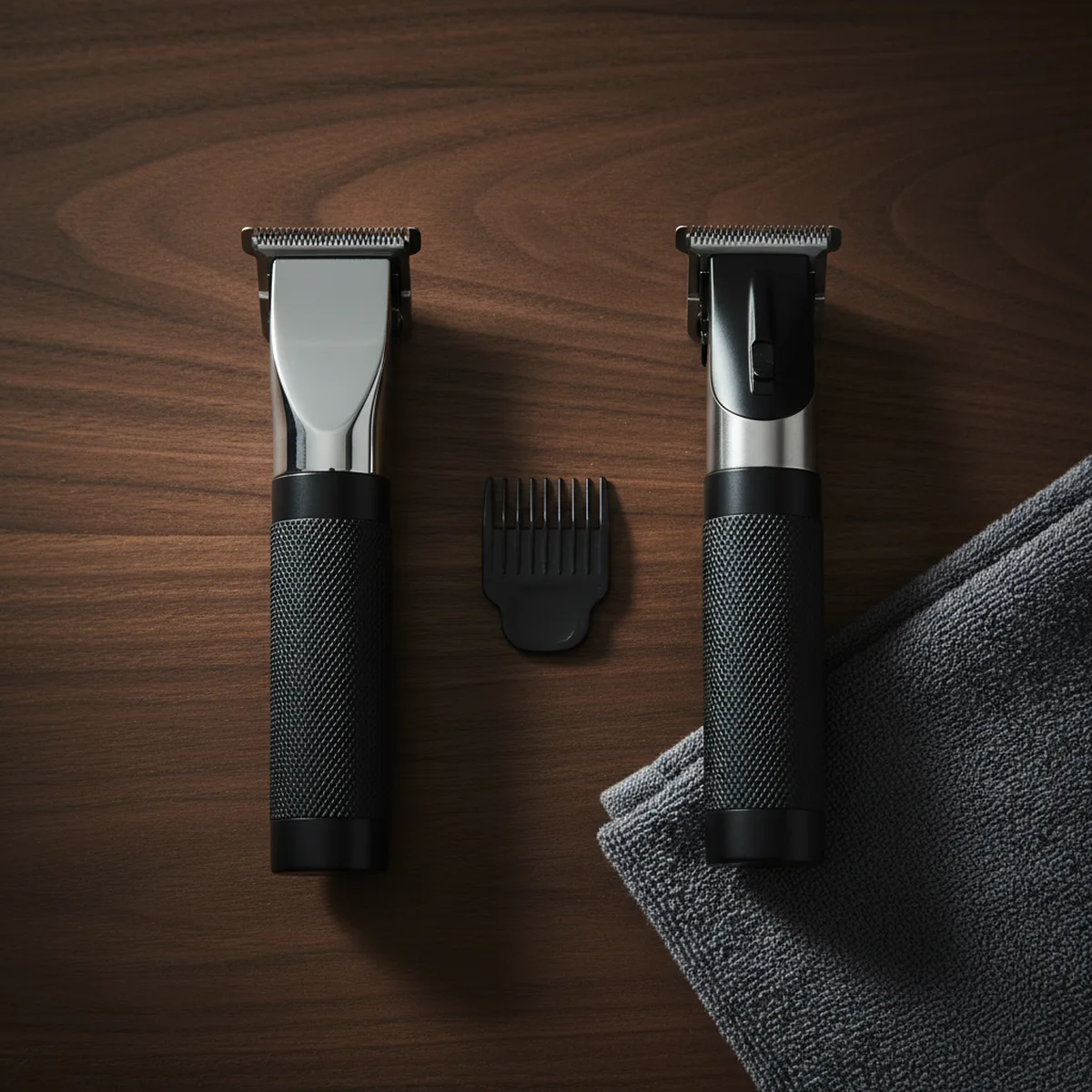
Look at the trimmer from the front and the blade forms a T: a long horizontal cutting edge with a narrow stem below it. That wide edge is the whole point. It covers more hairline in one pass, which is how a crisp lineup stays even from corner to corner without wobble. The squared corners reach into the sharp angles of a flat-top hairline, sideburn points and the hard corner at the temple.
The trade-off is forgiveness. A wide blade will follow a curved jaw the way a ruler draws a circle: poorly. Push a T-blade along a curve and one corner digs in, which is why beginners sometimes leave little gouges at the jaw when they edge with one.
What a standard blade is
A standard trimmer blade is narrower, with slightly rounded or curved cutting teeth. It was designed for the way most people actually groom: trimming beard length, cleaning up cheeks, tidying around the ears and mustache. The narrow head gets into tight spots under the nose and along the chin strap without taking out more hair than you asked for.
What it does not do is draw a hard line. For the razor-sharp perimeter of a line-up, the standard blade leaves a softer edge that reads as tidy rather than crisp. Many all-in-one trimmers ship with exactly this kind of blade, and interchangeable guard systems ride on it for length control.
The six trimmers worth your money
Best T-blade overall: Andis T-Outliner
The Andis T-Outliner T-blade trimmer is the classic the whole category gets judged against. Its carbon-steel T-blade is sold with what Andis calls its bump-free blade design, built to edge close while staying comfortable on sensitive hairlines. It is corded, with an 8-foot cord and a rotary motor, so it never sags mid-lineup, and the blade can be zero-gapped for the ultra-close cuts barbers need.
Roughly $55 to $70. If you want one T-blade trimmer that will still be relevant in ten years, this is it.
Best adjustable T-blade: Wahl Detailer
The Wahl Detailer adjustable T-blade trimmer puts an adjustable T-blade and a rotary motor with full-size clipper power into a compact body that fits in the palm, so you can set the cutting depth rather than fight a fixed gap. The rotary motor keeps speed steady through coarse hair, and the wide blade makes quick work of long hairlines. It is the tool Wahl built specifically for detail work, and the name is not decoration.
Roughly $80 to $95. Choose it over the Andis if you want adjustment range and a slightly wider edge.
Best premium T-blade: BaBylissPRO FX+
The BaBylissPRO FX+ T-blade trimmer is the shop-grade option, with an exposed T-blade, all-metal housing and a 4-hour lithium runtime. Cordless freedom matters in edging because you angle the trimmer constantly, and nothing snags a cable at the worst moment like an off-center pass. The high-speed motor and precise blade make it the cleanest-cutting T-blade on this list.
Roughly $170 to $200. It is priced for professionals, and it behaves like one.
Best budget T-blade: Supreme Trimmer T-Shaper
The Supreme Trimmer T-Shaper trimmer brings zero-gap edging for well under $40. It runs cord or cordless, about 90 minutes per charge, with a compact body that suits detail work, and the T-blade takes a proper zero-gap setting for crisp hairlines. It will not match the motor stamina of the pro picks on a full day of clients, but for a home user who edges weekly, it covers the job.
Roughly $30 to $40. The right way to find out whether you reach for a T-blade weekly before spending triple digits.
Check Supreme Trimmer T-Shaper Price
Best standard blade overall: Wahl Lithium All-in-One
The Wahl lithium all-in-one standard blade trimmer is the standard-blade daily driver. It trims beard length with guards, details around the ears and nose with its narrow heads, and its lithium battery runs up to 3.5 hours per charge, which covers weeks of ordinary grooming. This is the shape most people picture when they think trimmer, and for beard-first grooming it is the better tool than any T-blade.
Roughly $40 to $50. It replaces a drawer of single-purpose grooming gadgets.
Best of both blades: Wahl Stainless Steel Lithium 2.0+
The Wahl Stainless Steel Lithium 2.0+ trimmer covers both sides of this debate in one kit. Its main head is a wide T-blade for beard and mustache work, and it adds a narrow precision detailer head, a rotary nose and ear head and a foil shaver, all on a stainless-steel body that feels like a barber tool rather than a bathroom gadget. Wahl lists up to 3.5 hours of run time per charge, so charging becomes an occasional thought.
Roughly $65 to $90. Worth it if your grooming rotates between beard, body and detail work every week.
Check Wahl Stainless Steel Lithium Price
Which blade fits your hairline
Straight hairlines and flat-top shapes want a T-blade, because crisp geometry is the job. Curved hairlines, growing-out beards and soft natural edges want a standard blade, which follows the face instead of fighting it. Coarse, fast-growing hair around the hairline usually justifies a T-blade even if you rarely get lineups, simply because the wider edge cleans up a week of growth in one pass.
Plenty of barbers carry both and pick per client. Home users should buy for the job they do most. If that job is shaving a beard down and tidying it, standard wins. If it is keeping a fresh lineup between barber visits, T-blade wins.
Getting clean lines with either blade
Stretch the skin flat before any pass, with either blade; loose skin is what turns a straight intention into a wavy line. With a T-blade, move the tool in short, overlapping strokes and lead with the blade heel, not the corners. With a standard blade, follow the grain on cleanup passes and let guards set the length so you never eyeball it freehand. Both blades cut best on dry hair, when the true line is visible.
Do not chase a sharper line with more pressure. If the edge stops reading crisp, the blade is dull or dirty, not the technique.
Blade care for both types
Both blade styles live or die on oil and cleaning. Brush hair out after every use, put a drop of oil on the blade before each session, and keep the gap adjustment untouched once set unless you know exactly what you are changing. Carbon steel edges like the Andis resist wear but corrode if stored damp; dry them after wet shaves and keep them out of steamy cabinets. Replace blades when pulls start; on trimmers that usually means once a year for daily users.
FAQ
Can a standard blade do lineups?
It can tidy an edge, but it cannot draw the razor-crisp perimeter a T-blade makes. The narrow, rounded geometry follows curves instead of cutting flat lines, which is the whole difference between the two.
Is a T-blade bad for sensitive skin?
No, not inherently. Modern T-blades like the Andis T-Outliner use tooth designs that lift hair before cutting. Comfort has more to do with light pressure and a sharp, clean blade than with the blade shape.
What does zero-gap mean?
It means the two blade teeth are adjusted to sit as close as possible without touching, so the trimmer cuts flush. Edgers zero-gap their blades for the closest line; stock settings leave a small safety gap.
Do I need both a T-blade and a standard trimmer?
If you keep a sharp lineup and also grow a beard, yes, the two jobs pull in different directions. If you do one or the other, buy the matching tool first and add the second only when the gap annoys you.
Corded or cordless for edging?
Corded delivers constant power for the long, steady strokes a lineup needs, while cordless wins on maneuverability. Pro picks exist in both styles above; match your tolerance for cables to your patience for charging.
How long do trimmer blades last?
Daily users replace or re-sharpen about once a year; weekly home users often go two to three years. When the blade starts pulling instead of cutting, it is done.
Our verdict: for lineups, get the Andis T-Outliner; for beard-first grooming, the Wahl Lithium All-in-One is the better daily trimmer.
The blade decides the shape of everything you cut with a trimmer, so pick it for the job you actually do. For most barbershop looks, the right sideburn shape starts with the edge a T-blade draws; for everything else, the standard blade quietly does the daily work.