As an Amazon Associate, TrustedBarber earns from qualifying purchases.
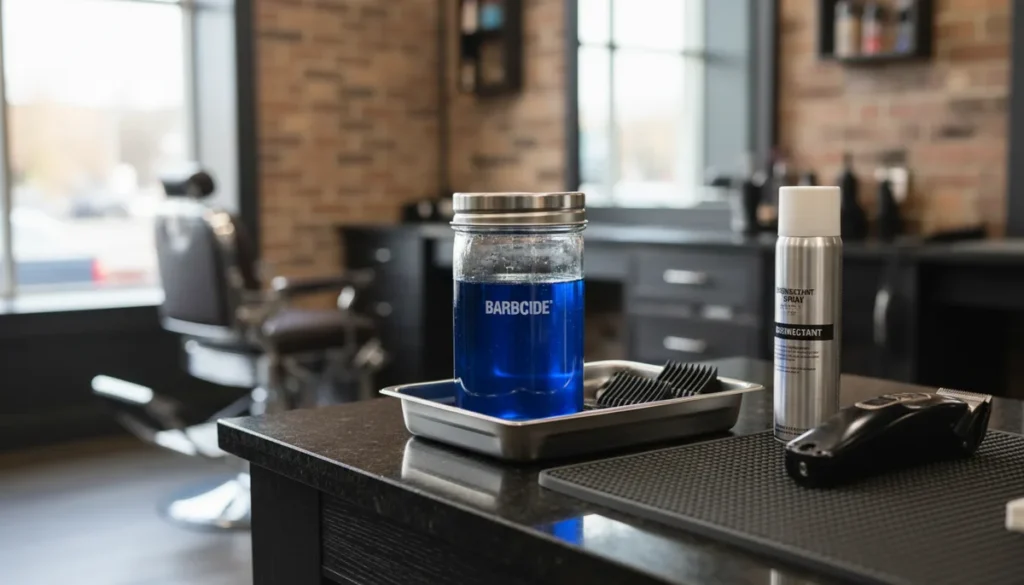
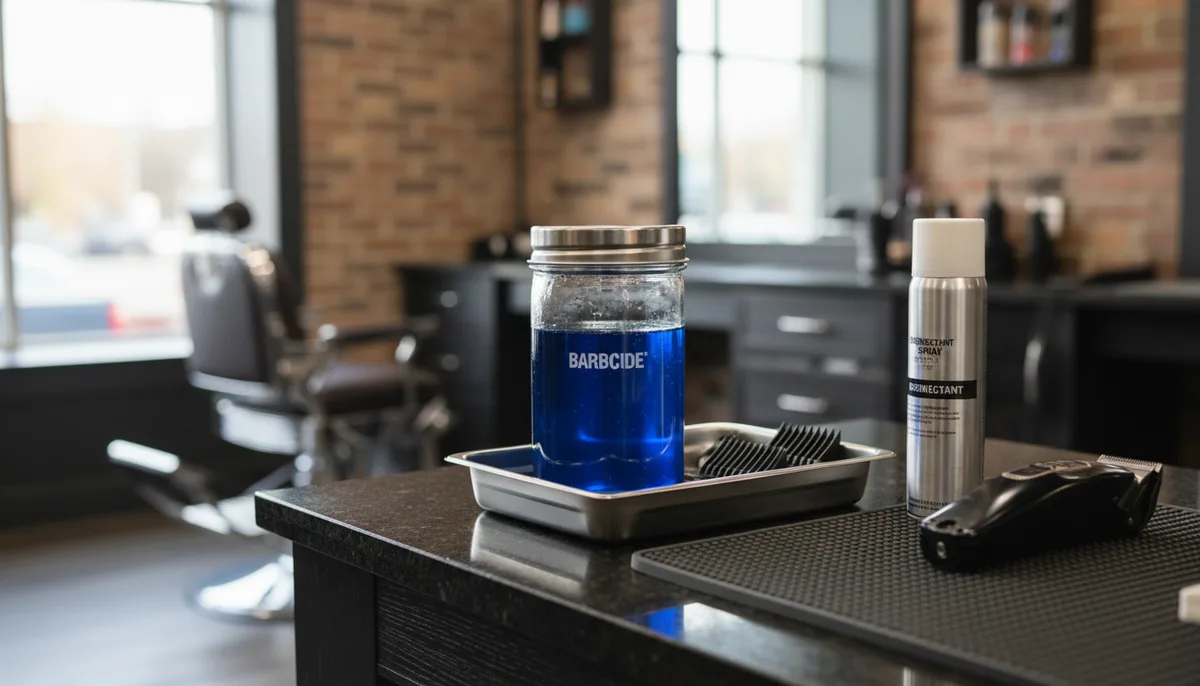
The blue jar on every barber station does more work than anything else on the counter, and it is the one product that legally has to keep doing it. Health codes in most states treat clippers, shears and headgear as reusable tools that must be cleaned and disinfected between every client, and the Barbicide concentrate half-gallon two-pack is the jug most schools and shops reach for when they set that routine up. A best barber disinfectant pick is not about smell or branding. It is about what the label is registered to kill, how long contact takes, and whether the bottle fits the way a working chair actually moves through a day.
This guide compares the four disinfectants worth buying in 2026: the classic Barbicide concentrate for soak stations, a fast Clippercide spray for between-client tool wipes, a ready-to-use Barbicide spray for stations without a soak jar, and Andis Cool Care Plus for clipper blades that need cooling and disinfecting in one pass. We look at what each is built to kill, how it is used, and where each one fits a working day.
Quick answer
The soak-station standard: the Barbicide concentrate half-gallon two-pack, the classic blue jar mix most shops and barber schools run.
The between-client spray: Clippercide, a one-step aerosol for spraying combs, guards and tools between services.
The no-jar option: Barbicide ready-to-use spray, the same Barbicide kill power without mixing, for wipe-down stations.
The blade saver: Andis Cool Care Plus, which cools, cleans, lubricates and disinfects clipper blades in one spray.
In this guide
What makes a disinfectant shop-grade
A disinfectant is not a cleaner, and the difference is the part boards care about. A cleaner removes hair, oil and product residue. A disinfectant kills pathogens after the cleaning step, and the products that can legally claim it carry an EPA registration on the label. In most states, barbers are required to use an EPA-registered disinfectant on reusable tools between every client, and inspectors will ask what you are using and whether it is mixed correctly. An unregistered spray that smells strong does not count.
The second number that matters is contact time. Every registered disinfectant lists how long a surface has to stay wet, or how long a tool has to stay submerged, for the kill claim to hold. Ten minutes of full submersion is the classic contact time for hospital-grade soak formulas, while faster sprays work in the time it takes to wipe a blade down. The trap is simple: a tool that is rinsed or dried before the contact time ends has not been disinfected, no matter what bottle it touched.
The third thing a working shop needs is turnover. A jar that must be changed daily, or more often under heavy use, becomes a real cost line, which is why concentrate formats appeal to high-volume shops. A concentrate mixed fresh each morning costs far less per fill than ready-to-use bottles, and the same jug lasts months in a two-chair shop.
Spray, concentrate and wipes: which does what
Concentrate is the soak format. You mix it with water in a wet disinfecting jar or tray, fully immerse clean, debris-free tools for the label contact time, and rinse or air-dry before the tool touches a client. It is the cheapest per fill and the format most state boards picture when they inspect a station. It does not clean for you: hair and product residue have to come off first, or the disinfectant works on debris instead of the tool.
Sprays cover the rest of the day. An aerosol like Clippercide handles the tools that cannot sit in a jar, and the wipe-down moments between services: clipper bodies, guards, shears, clippers with batteries, and anything with a motor or electrical contact. Ready-to-use sprays also suit shops without a soak station: they cover the wipe-down side, stations and surfaces, while the jar keeps the full-submersion work. They cost more per ounce than concentrate but nothing to mix, and nothing to forget.
Wipes sit in the same role as sprays, trading lower cost per surface for speed at the counter. Barbicide wipes are the low-effort version: pull, wipe, done, which is why they live next to the register for quick station resets. Most shops end up running two formats at once: a soak jar for metal tools, and one spray or wipe for everything that cannot be submerged.
The picks
1. Barbicide Concentrate: the soak-station standard
This is the bottle most people picture when they picture a barbershop. Barbicide concentrate comes in a half-gallon jug, and this two-pack is enough concentrate to keep a wet jar going through months of daily changes. Mixed to the label ratio, it is the classic blue solution barber schools teach, the one state inspectors expect to see, and the reference point every other disinfectant in the category is measured against.
What it does well is volume. A concentrate fill costs a fraction of what a ready-to-use bottle costs per jar, and the two-pack means a busy shop is not reordering every few weeks. The routine is established: clean tools of hair and debris first, fully submerge them for the label contact time, then rinse and dry before the next client. The one discipline it demands is housekeeping: the jar needs a daily change under normal use, and the mix needs to be made fresh, not topped off from yesterday.
Where it is the wrong fit: shops that never want a wet station, or tools that cannot be submerged. For those, one of the sprays below does the job.
See the Barbicide concentrate two-pack
2. Clippercide: the between-client workhorse
Sprays carry the middle of the day, when a client just left and the next one is already in the chair. Clippercide is the one-step aerosol most shops keep at every station: a short burst on the blades, guards and combs, a wipe, and the tool is back in service. It is the format that actually survives a busy Saturday, because it asks nothing of the barber except a can that stays where the tools live.
It earns its spot on clippers specifically, where a soak jar is not an option. The spray hits the blade teeth and the body the way state checklists describe, and because it is an aerosol it gets into the guard gaps a cloth misses. Cans are affordable enough to keep one per station, which is the real difference between a disinfectant habit and a disinfectant intention.
The limits are the usual spray limits: it is not a cleaner for caked-on debris, and a ten-second spray is not a substitute for the full soak routine at the end of the day. It is the between-services layer, not the whole protocol.
3. Barbicide Ready-to-Use: the no-mix backup
Not every station wants a jar. Barbicide ready-to-use spray puts the brand shops already trust into a spray bottle that needs no mixing and no measuring, built for wiping down non-porous surfaces between clients: stations, chairs, counters and tool surfaces. It is the same Barbicide name on a wipe-down format, and for a shop that uses Barbicide in the jar, the spray keeps the routine consistent across both formats.
The trade is cost per ounce: you pay for the convenience, and a heavy day of spray wipes goes through a bottle faster than a concentrate jug would ever move. That is the reason this pick is the backup rather than the main line. Where it shines is the station whose daily disinfecting is wipe-down work, and shops where the jar is someone else’s job and consistency matters more than the last nickel of cost.
See Barbicide ready-to-use spray
4. Andis Cool Care Plus: the blade saver
Clipper blades have a problem no jar solves: they run hot. Andis Cool Care Plus is the five-in-one can built for exactly that, cooling the blade, cleaning, lubricating, rust-preventing and disinfecting in a single spray. It is the fastest way to bring a hot blade back to workable between fades, and it is the disinfectant layer that keeps clipper maintenance from feeling like a separate chore.
The spray goes on while the clipper runs for a second or two, clears hair and debris out of the teeth, and leaves the blade cooler and lubricated. For a shop that runs multiple clipper passes all day, the cooling alone justifies the can; the disinfecting claim is what makes it board-compliant instead of just a lubricant. It is a maintenance product first, which is why it belongs next to the clippers rather than on the general tool shelf.
One boundary worth knowing: a blade spray covers clipper blades and their immediate surroundings, not the whole shop. Shears, razors and combs still go through the jar or a general spray, so this is an add to the routine, not a replacement.
Mixing and contact times: doing it right
Two numbers decide whether a soak station actually disinfects. The first is the mix ratio: Barbicide concentrate is mixed with water, not used neat, and the label ratio is the one to follow every time. Stronger is not better, and a too-strong mix wastes product and can be hard on tools. The second is contact time: fully submerged tools need the full label time, which for the classic hospital-grade formulas means ten minutes, not the two minutes a client gap allows.
That is why the routine splits. Full immersion for shears, razor blades and metal combs happens at natural gaps: after a service, during cleanup, at close. Quick sprays carry the in-between. Everything is cleaned of hair first, since debris shields pathogens from the disinfectant, and tools come out rinsed and dried before they touch a client again.
Housekeeping rules finish the system. Wet jars get changed daily and whenever the solution turns visibly dirty, spray cans get a home on the station rather than a drawer, and wipes get dated or rotated so an opened pack is not quietly drying out. A board inspector can tell within a minute whether those habits exist.
The mistakes that fail inspections
Using alcohol alone is the classic one. Alcohol evaporates too fast to hold contact time on most surfaces, and most state boards list it as a cleaner rather than an approved disinfectant for tools. It reads like disinfection and does not satisfy the requirement.
The second is topping off a jar instead of changing it. A diluted, debris-loaded mix is not the solution the label describes, and the daily change exists because the kill claim depends on a fresh mix at the right strength. Third is skipping the cleaning step: disinfectant on hair-clipped blades kills almost nothing behind the debris. Fourth is the oldest, half contact time, which is exactly what the label contact time exists to prevent.
The last one is documentation. Many states require proof of what is being used, sometimes a posted SDS sheet or a log. The shop that can show the bottle, the mix schedule and the change routine passes; the shop with the same products and no habits does not.
FAQ
How often should barber tools be disinfected?
Reusable tools are disinfected between every client in most states, and again at the end of the day. Combs, brushes and guards used during a service count as reusable tools, so they go through the same cycle, not just the shears.
Is Barbicide the only approved disinfectant?
No. Barbicide is the most recognized because barber schools teach it, but any EPA-registered disinfectant with a claim against the pathogens a board requires meets the standard. Check your state board’s listed requirements and the product label.
Can I use disinfectant wipes on clippers?
Yes, for the clipper body, guards and contact surfaces, as long as the wipe is an EPA-registered disinfectant and the surface stays wet for the label contact time. The blades themselves are better served by a blade spray like Cool Care Plus, which cools and lubricates while it disinfects.
What is the difference between cleaning, disinfecting and sterilizing?
Cleaning removes debris. Disinfecting kills pathogens on the surface within the label contact time. Sterilizing eliminates all microbial life and is a different, higher-level process used for tools that cut skin, most often in a sterilizer unit, and only where a state board requires it.
How long does mixed Barbicide last?
Under normal shop use, the label calls for a fresh mix every day, and sooner when the solution is visibly soiled. Do not top off a day-old mix; dump, rinse, and mix fresh.
The bottom line
A compliant station needs both halves of the system: a soak format for metal tools and a fast format for everything else. Start with Barbicide concentrate in the jar, add a spray at the stations without a jar, and keep a blade spray by the clippers. Two formats, done consistently, are what pass an inspection.