As an Amazon Associate, TrustedBarber earns from qualifying purchases.
If you want to know how to become a barber in Missouri, the short answer is 1,000 hours of barber school (spread over at least six months) or 2,000 hours as a registered apprentice, then the national written and practical barber exams, which Missouri’s testing vendor Prov runs. Most full-time students at Missouri’s federally aided barber schools finish in about 10 months, and the first big purchase is usually a cordless clipper such as the Wahl Professional 5 Star Cordless Magic Clip.
Quick answer: Missouri barber license
- Hours: 1,000 in a barber school (6 months minimum) or 2,000 as an apprentice
- Exams: NIC barber written + practical, scheduled through Prov; 75 to pass each
- Exam fees: $90 written, $60 practical (paid to Prov)
- State fees: $25 student or apprentice registration, $20 first license, $60 to renew
- Minimum: age 17; a diploma or GED to enroll in a postsecondary barber school
- Time to license: roughly 7–12 months via school, longer as an apprentice
- Board: Missouri Board of Cosmetology and Barber Examiners
Barber school kit picks
- Wahl Professional 5 Star Cordless Magic Clip (about $135–155)
- Andis 04780 T-Outliner (about $60–80)
- Andis 01410 Master Dual Magnet Comb Set (about $30–40)
- Feather Standard Styling Razor Kit (about $50–60)
Prices are typical Amazon ranges and change often.
Missouri barber requirements at a glance
Missouri licenses barbers through the Board of Cosmetology and Barber Examiners, part of the Division of Professional Registration in Jefferson City. The rules live in two places: Chapter 328 of the Missouri statutes (the barber law, especially section 328.080) and Title 20, Division 2085 of the Code of State Regulations, which the Secretary of State publishes chapter by chapter. Everything below comes from those sources unless noted.
| Item | Missouri rule |
|---|---|
| Training | 1,000 hrs school or 2,000 hrs apprenticeship |
| Minimum age | 17 |
| Education | Diploma, GED or equivalent (postsecondary school) |
| Exams | NIC written + practical via Prov |
| First license | $20 after passing |
| Renewal | Every 2 years, by Sept. 30 of odd years |
One quirk stands out: Missouri’s barber law still asks the board to confirm an applicant is free of contagious diseases that could spread in a barbershop, so barber schools submit a medical examination form with each student application. It is a form, not a hurdle, but budget a doctor’s visit for it.
Barber school vs. apprenticeship
Barber school. Under 20 CSR 2085-12.030, Missouri barber schools must provide at least 1,000 hours over no less than six months. The rule splits those hours by subject, and the weighting tells you what the board cares about: 425 hours of haircutting and 325 of hairstyling make up three-quarters of the course, followed by 35 hours of shaving, 30 hours each of permanent waving, chemical relaxing and hair coloring, and 20 hours of sanitation and safe work practices. Students must also get at least one hour of lecture and demonstration every business day except Saturday.
To enroll in a postsecondary barber school, 20 CSR 2085-12.035 requires a high school diploma, a GED, a qualifying home-school program, or proof of earlier enrollment in a federal-aid program that began before July 1, 2012. The school sends your application, medical form, proof of age, two passport photos and the $25 enrollment fee to the board at least two weeks before you start.
Apprenticeship. The apprentice route takes twice the hours, 2,000, completed within five years. Section 328.075 sets the apprentice age at 17 and requires the supervising barber to hold a separate apprentice supervisor license, which means at least two years as a licensed barber plus an eight-hour supervision course. Under 20 CSR 2085-9.010, each supervisor and each shop may train only one apprentice at a time, may not charge the apprentice for instruction or supplies, and the supervisor must be physically present whenever you log credited hours. Apprentices file two or more character references along with the medical form.
Hours do not cross over between the two routes. School hours cannot count toward an apprenticeship, and shop hours cannot count toward school, so pick a path before you start. Board rules also recognize training for only five years, which matters if you plan to pause partway through.
The Missouri barber exams
Missouri uses the national barber exams written by the National-Interstate Council of State Boards of Cosmetology (NIC), and the board contracts with Prov, Inc. to register and test candidates. Prov’s Missouri candidate information bulletin (version dated January 2026) says you first register in the state’s MOPRO licensing system, then schedule with Prov. You need a score of 75 on both the written and the practical exam, per 20 CSR 2085-5.010, and if you fail one part you retake only that part.
The practical is performed on a full-size mannequin; Prov says live models are not accepted and “minikin” or junior heads are not allowed. The bulletin lists the barber practical’s timed sections, including work area and client setup, a 40-minute haircut, a straight-razor shave, a blood exposure procedure, and simulated chemical services such as permanent waving, a relaxer application and a color retouch. You bring every supply yourself, kits must fit under your station (no larger than 30 by 30 inches), and disinfectants must be wipes rather than sprays.
Plan your calendar around the paperwork. Your exam application and fees must reach the test administrator at least 14 days before the date you want, and all hours must be done and the application filed within five years of the board issuing your student or apprentice license. You can apply for a temporary permit at the same time you apply to test, which lets you work under a licensed barber until results come in; it ends if you fail or miss the exam.
Fees
The board’s fees are set in 20 CSR 2085-3.010 (last amended effective November 30, 2024); exam fees go to Prov.
| Fee | Amount |
|---|---|
| Student enrollment | $25 |
| Apprentice registration | $25 |
| Apprentice supervisor application | $75 |
| Written exam (Prov) | $90 |
| Practical exam (Prov) | $60 |
| First barber license | $20 |
| Renewal (2 years) | $60 |
| Reinstatement, delinquent | $90 |
| Reciprocity application | $100 |
For a school graduate, the state and testing costs come to about $195 if you pass both exams the first time ($25 enrollment, $150 in exam fees, $20 license). Tuition, your kit and the medical exam are separate. All board fees are nonrefundable.
Step-by-step: getting licensed in Missouri
- Choose school or apprenticeship and confirm the school or supervisor is licensed by the board.
- Enroll: the school or shop files your application, medical form, proof of age, photos and fee.
- Complete 1,000 school hours (six months minimum) or 2,000 apprentice hours.
- Register in MOPRO, file the exam application, and schedule with Prov at least 14 days ahead.
- Pass the written and practical exams with 75 or better.
- Pay the $20 license fee within two years of passing, or you must retest.
- Post your license at your chair, where the rules require clients to be able to see it.
Renewal
Every Missouri barber license expires on September 30 of each odd-numbered year, whenever you were first licensed, per 20 CSR 2085-5.040. Renewal costs $60, and an application postmarked after September 30 is returned and treated as a reinstatement ($90 plus the renewal fee within two years). The barber renewal rule does not list a continuing-education requirement; check with the board if you hold an instructor or crossover license, which follow separate rules. You can also place your license on inactive status for $30 if you stop cutting in Missouri.
Moving to Missouri with a license
Missouri offers two paths. Under 20 CSR 2085-5.030, a barber licensed in a state with equal or higher requirements, or who has lawfully practiced for at least two years, can be licensed without taking the exam ($100). Separately, Missouri’s universal recognition law, section 324.009, lets someone who has held a current license in another state for at least one year apply for the same license here. If you do not qualify for either, the board will credit hours from a licensed out-of-state school or apprenticeship and tell you exactly what is left before you can sit the Missouri exam.
Cosmetologist to barber (crossover)
Missouri’s crossover rules are generous to licensed hairdressers. Under 20 CSR 2085-13.050, a Missouri Class CH or Class CA cosmetologist in good standing needs only 45 hours of barber training: 5 hours of barber history and 40 hours of shaving. If you have held that cosmetology license for at least a year, you take only the shaving portion of the barber exam; under a year, you take the full written and practical. Estheticians and manicurists get no credit and must complete the full barber program.
Recent changes
The biggest recent change is administrative. The Division of Professional Registration moved licensing to its MOPRO online system, with account registration opening January 14, 2025, and the board now points applicants and renewing barbers there. The board’s fee schedule was also amended effective November 30, 2024. The core barber requirements (1,000 school hours, 2,000 apprentice hours, age 17) sit in section 328.080, last amended in 2018; if a guide quotes a different hour total for Missouri, go by the statute and the board. Prov’s exam bulletin was updated in January 2026, so download the current version before you book.
What Missouri barbers earn
According to the U.S. Bureau of Labor Statistics Occupational Employment and Wage Statistics for May 2025, Missouri had about 580 employed barbers, with a mean wage of $55,900 a year ($26.88 an hour) and a median of $47,880 ($23.02 an hour). That is well above the national figures for barbers (mean $47,070, median $38,210), and it is the fourth-highest barber mean wage among the 36 states with a published May 2025 estimate.
Read those numbers with one caveat. OEWS counts wage-and-salary employees only, so booth renters, shop owners and other self-employed barbers, a large share of the trade, are not in them, and tips may be under-reported. Your own income will depend far more on your chair setup and client book than on the state average.
Barber schools in Missouri
The board licenses every barber school in the state; its licensee search on the board site confirms a school is current. These four are real, operating schools with facts checked on their own sites or the U.S. Department of Education’s College Navigator in October 2026. For a broader look at picking a program, see our guide to finding the right barber school near you.
Academy of Hair Design (Springfield)
Located at 1834 S. Glenstone Ave., this school offers a 1,000-hour barber program with daytime and evening classes, full and part-time. Its barber program page puts the cost at about $15,000, including a tool kit, books, registration and student license fees. College Navigator lists it as eligible for federal aid, with an average completion of 10 months.
Paul Mitchell The School Missouri Columbia
At 1101 Hutchens Drive in Columbia, this campus runs a 1,000-clock-hour barbering program. College Navigator lists 2024–25 tuition and fees of about $14,400 plus about $2,800 for books and supplies, a 10-month average completion, and federal aid eligibility.
Paul Mitchell The School Springfield
This Paul Mitchell campus sits at 3017 S. Kansas Expressway in Springfield and teaches the same 1,000 clock hours of barbering. Per College Navigator, 2024–25 tuition and fees run roughly $11,600, books and supplies about $2,800, completion averages 10 months, and federal aid is available.
Leonard’s Barber College (St. Louis)
Founded by barber Leonard Hall in January 1990, Leonard’s Barber College describes itself as the only place to become a licensed barber within St. Louis city limits. The school does not publish tuition online, so call for current pricing, schedules and payment options.
Barber school kit: what students need
Most Missouri schools sell a kit with enrollment, so check what yours includes before buying extras. Because Prov’s practical requires you to bring every tool and wipe yourself, the list below doubles as exam prep. For a deeper look, see our picks for the best clippers for barber school.
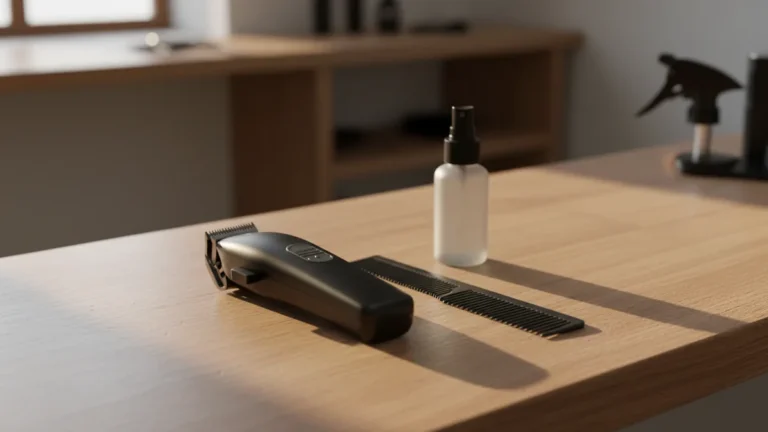
The Wahl Professional 5 Star Cordless Magic Clip is the fade clipper you will see on many school stations. Its adjustable blade and cordless run time suit the 425 hours Missouri’s curriculum spends on haircutting.
Check Wahl Professional 5 Star Cordless Magic Clip Price
For line-ups and outlining, the Andis 04780 T-Outliner is a long-running shop standard. Students use a trimmer like it for the clean necklines and edges that examiners look at closely.
Check Andis 04780 T-Outliner Price
Guards matter on a mannequin test. The Andis 01410 Master Dual Magnet Comb Set fits Andis Master-style clippers and gives you consistent guide lengths for blending.
Check Andis 01410 Master Dual Magnet Comb Set Price
Missouri’s curriculum sets aside 35 hours for shaving, and the practical includes a straight-razor section. The Feather Standard Styling Razor Kit uses replaceable blades, which keeps sanitation simple.
Check Feather Standard Styling Razor Kit Price
Shear-over-comb work needs a dependable pair of scissors. The Equinox Professional Razor Edge Barber Scissors is an affordable choice for students who are still learning which length they prefer.
Check Equinox Professional Razor Edge Barber Scissors Price
Sanitation is its own scored step. A Barbicide Disinfecting Jar (37 oz) keeps combs and guards immersed between clients during school clinic floor work; for the Prov exam itself, remember the bulletin calls for disinfecting wipes.
Check Barbicide Disinfecting Jar (37 oz) Price
A clean cape and neck strips are part of client setup. The Barber Strong The Barber Cape is a popular student cape, and Graham Sanek Neck Strips (12-pack) cover the neckline rule on every service.
Check Barber Strong The Barber Cape Price
How to choose a Missouri barber school
- Confirm the license. Use the board’s licensee search, since only board-licensed schools count toward the 1,000 hours.
- Compare the full cost. Ask whether tuition includes the kit, books and the $25 enrollment fee; Navigator figures list books and supplies separately.
- Ask about schedules. At part-time pace, 1,000 hours can stretch well past a year, and training counts for only five years.
- Check aid. If you need federal grants or loans, confirm the school is listed as aid-eligible on College Navigator.
- Ask about exam prep. Find out how the school prepares students for Prov’s mannequin practical and its supply rules.
FAQ
How long does it take to become a barber in Missouri?
The law sets a minimum of six months for the 1,000 school hours. Missouri’s federally aided barber schools report about 10 months on average, plus time to schedule exams. The 2,000-hour apprenticeship takes longer, and must be finished within five years.
What do I need to get a barber license in Missouri?
You must be 17, complete 1,000 school hours or 2,000 apprentice hours, pass the NIC written and practical exams through Prov with a 75 on each, and pay the $20 license fee. Postsecondary schools require a diploma or GED to enroll.
Can you become a barber in Missouri through an apprenticeship?
Yes. You register as an apprentice ($25) under a licensed apprentice supervisor, who can train only one apprentice at a time and must be present for every credited hour. You need 2,000 hours before testing.
Can a cosmetologist become a barber in Missouri?
Yes. A Missouri Class CH or CA cosmetologist needs 45 hours of barber training (history and shaving). After at least a year licensed, only the shaving portion of the barber exam is required.
Do Missouri barbers need continuing education?
The barber renewal rule lists a $60 fee every two years with a September 30 deadline in odd years, and no continuing-education requirement. Confirm with the board if you hold an instructor or crossover license.
Can a barber make $100,000 a year in Missouri?
The BLS data does not show that for employees: the May 2025 Missouri mean was $55,900. Those figures exclude booth renters and owners, so higher incomes are possible for barbers who build a large client base or run a shop, but there is no official number to cite.
Final take
Missouri is one of the faster states to get licensed: 1,000 hours, a six-month minimum, and a fee total under $200 before tuition. Pick a board-licensed school or a committed apprentice supervisor, register in MOPRO early, and practice the Prov mannequin practical until setup and sanitation are second nature. Start with a dependable clipper like the Wahl Professional 5 Star Cordless Magic Clip, and build the rest of your kit with our barber starter kit guide.
Licensing rules, fees and hours can change. This guide is general information, not legal advice. Always confirm current requirements with your state barber board before you enroll or apply.