
As an Amazon Associate, TrustedBarber earns from qualifying purchases.
Frizz and static arrive together every year around the first week the heater goes on. The air inside dries out, hair loses the small amount of moisture that keeps it lying flat, and every sweater and scarf turns into a charge generator. The result is hair that sticks to the comb, floats off the head, and refuses a hat. The fix is less about buying a miracle product and more about putting moisture and heat control back into the routine, starting with a few drops of Kate Blanc Argan Oil on damp hair every morning.
Quick answer
Winter frizz is dryness and static charge. Fight it by washing less with cooler water, pressing an oil or leave-in into damp hair, using a heat protectant before any blow dryer, drying with downward airflow, and finishing with a light pomade to pin down flyaways. Swap plastic combs for wood or boar bristle to stop the charge at the source.
Top picks
Check Price on the Kate Blanc Argan Oil
In this guide
Why winter turns hair into an antenna
Two separate problems get called frizz in winter. The first is dehydration: hair that loses moisture becomes rough at the cuticle, and a rough cuticle scatters light and stands away from its neighbors, which is what frizz looks like. The second is static: electrons transfer between materials in dry air, hair takes on a charge, and like charges repel, so strands push apart and lift. Dry indoor heating makes both worse, which is why the same hair that behaved in September goes feral by December.
The distinction matters because the fixes differ. Dehydration is fixed with moisture, applied when the hair can absorb it. Static is fixed by reducing charge transfer, which is about materials and airflow as much as products. Most winter routines fail because they treat only one of the two, usually with a heavier cream that helps the frizz and does nothing about the sock-on-the-carpet electricity.
The wash adjustments that matter
Hot water strips faster than cold rinses replace, and in winter every strip counts. Drop the wash temperature to warm, finish with a cool rinse whenever you can tolerate it, and cut wash days where your schedule allows. Men washing daily often find every-other-day alone removes half the frizz, because the natural oil that keeps hair smooth survives to do its job. Our hair washing frequency guide walks through finding your own right number.
Towel habits belong in the same paragraph. A rough terry rub roughs up the cuticle while the hair is at its most vulnerable, wet. Squeeze and press with the towel instead of scrubbing, or use an old cotton t-shirt, which is the barber-standard trick that costs nothing. Wet hair is also when product absorbs best, so the damp state you end up with after pressing is the ideal starting point for the next section.
Moisture on damp hair, not dry
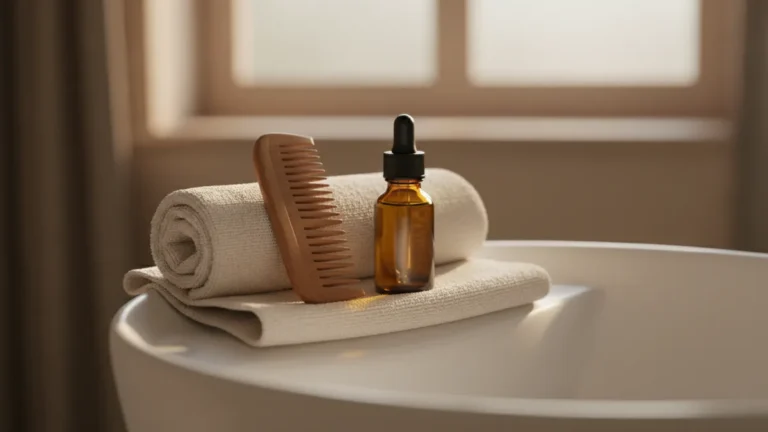
Oils and leave-ins do their real work on damp hair, where they spread evenly and seal water in as it dries. On dry hair the same product mostly coats the surface and can read as greasy without conditioning anything. The practical version: after your cool rinse and towel press, warm two or three drops of Kate Blanc argan oil between your palms and press it through the mid-lengths and ends, then smooth what remains over the surface. Fine hair wants one drop; thick or coarse hair takes three or four.
The same logic drives why curly and wavy hair needs more of this step than straight hair: the natural oil travels down straight strands easily and barely moves down a curl. Our curly hair routine guide covers the fuller version for texture, and our scalp care guide covers the dry-skin side when winter itch moves past the hair itself. For most straight and wavy hair, the oil step plus the next one is the whole routine.
Heat, protectant, and the blow dryer
Heat damage is the frizz gift that keeps giving: dried-out cuticles frizz harder next week. Before any hot tool or hair dryer goes near winter hair, a thermal protectant goes on first. A light one like the CHI 44 Iron Guard Thermal Protection Spray misted over damp hair takes seconds and shields the strand while heat shapes it. Skipping it in summer is a gamble; skipping it in winter, when hair is already dry, is how the damage compounds.
The blow dryer then becomes a styling tool rather than a frizz machine, and the technique is airflow direction. Dry downward, pointing the nozzle along the hair from root to end, so the cuticle lies flat as it dries. Lifting sections and blowing upward creates the volume our hair dryer guide covers for styled looks, but for frizz control the rule is simpler: keep the air moving down the strand and finish with the cool shot to lock the set. A dryer with genuine ionic output helps here, which is why the BaBylissPRO Nano Titanium Portofino stays on barber stations through the winter months.
Tools that stop the static
The material your tools are made of decides half the static battle. Plastic combs and nylon brushes generate and hold charge, which is why the same brush that smooths in July sparks in January. Wood combs, horn combs, and boar bristle brushes do not build the same charge, so they smooth without the lift-off. A boar bristle brush also carries your scalp’s own oil down the hair shaft, which is moisture distribution for free; our boar bristle brush guide covers the picks and how firmness changes the job.
Beyond the tools, the small physical habits pay off. A wool beanie over dry hair is a charge machine, so run damp palms or a drop of oil over the hair before the hat goes on. In the car and at the office, press hair down with your palm instead of raking fingers through it. None of this replaces the moisture step; it just stops undoing it every hour.
Products that pin flyaways down
Once moisture and static are handled, the last step is physical control. A light pomade smoothed over the surface pins down the strands that still want to float; the water-based Suavecito Original Pomade is the easy reworkable choice, and a fingertip-sized amount is plenty for the whole hairline. For texture without flattening, a tiny puff of Slick Gorilla Hair Styling Powder at the roots adds grip that keeps a style in place on a windy day without shine or crunch.
Resist the heavy waxes and thick creams on winter hair. Weight smothers the volume you are trying to keep and builds up faster on dry hair, which then needs a harsher wash to remove, which restarts the cycle. Light layers, applied damp and finished dry, are the winter formula our texture powder and dry shampoo guide covers from the powder side.
FAQ
Why is my hair static only in winter?
Static needs dry air. In summer, humidity lets charge dissipate off hair continuously, so it never builds. Indoor heating drops the humidity far lower than any summer dry spell, which is why the same comb and the same sweater behave completely differently in December.
Does hair oil fix static?
It helps by adding moisture, which dissipates charge, but a dry-oil layer on top of dehydrated hair only masks it for an hour. Oil applied to damp hair fixes the underlying dryness, which is what makes the effect last through the day.
Should I blow dry or air dry in winter?
Blow dry with heat protectant, if the choice is between the two. Air drying in cold, dry indoor air leaves the cuticle open and rough for hours, which reads as frizz. A quick downward blow dry with a cool-shot finish lays the cuticle flat before it can misbehave.
What is the fastest two-minute winter fix?
Damp palms with a single drop of oil, pressed from mid-length to ends, then one pass with a boar bristle or wood brush. It re-moisturizes the surface, kills the standing charge, and pins the worst flyaways, all before the coffee is ready.
The verdict
Winter frizz is a moisture problem wearing a static costume. Wash cooler and less, press oil into damp hair, protect before heat, dry downward, and keep a light pomade in the bag for flyaway emergencies. The CHI 44 Iron Guard Thermal Spray is the cheapest habit with the biggest payoff, because the damage it prevents is the kind that makes every later fix harder.