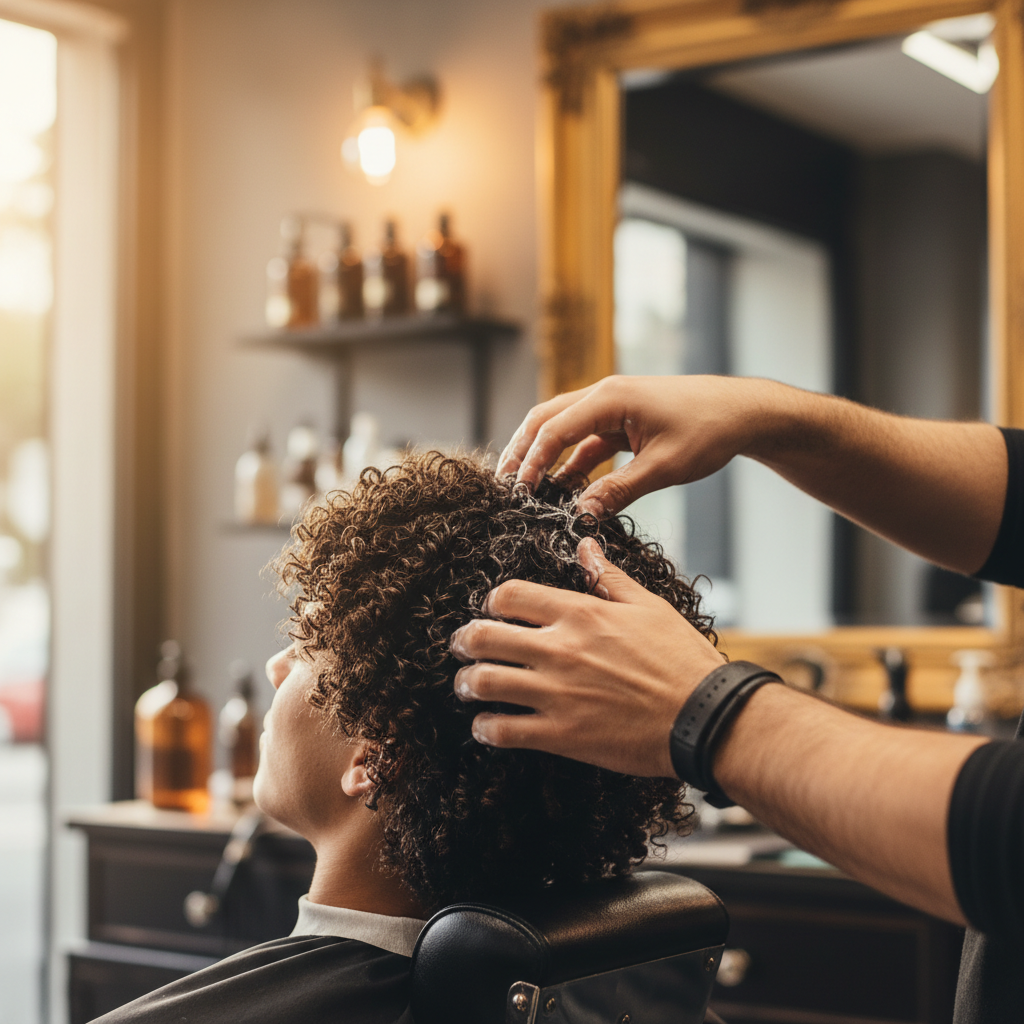
Curly hair does not fail because men do not care about it. It fails because everything men are taught about hair, wash daily, towel dry, comb the product through, brush it neat, is advice written for straight hair, and on curls every one of those steps is actively destructive. Curls are at their best when they are hydrated and left alone, and at their worst when they are stripped, roughed up, and brushed out. The routine that keeps definition is not complicated, but the order matters more than the products, and the order is where most men lose the plot before they even reach for a jar.
This is the full routine, step by step, built around three affordable products that hold up under daily use. For the cutting side of curly hair, the tools and technique live in our clippers for textured and coily hair guide; this piece is about what happens between cuts.
Barber pick
Cantu Coconut Curling Cream. the curl cream barbers recommend first for definition that lasts.
The sulfate-free wash, real conditioning, and product-on-damp-hair sequence here follows the routine the pros at Jesse’s Barbershop walk Trav White through in the video below (watch it here).
Video: Trav White on YouTube
Step one: the wash, and why sulfate-free is not marketing
Sulfates are the aggressive detergents in most supermarket shampoos, the ones that produce the big lather. On straight, oily hair they are fine. On curls they are the single biggest cause of frizz, because curly hair is structurally drier: sebum travels down a straight shaft easily, and down a spiral barely at all, so curly hair is chronically under-moisturized at the ends, and a sulfate wash strips what little oil is there. The result is the puffy, undefined wash-and-dry look men blame on the curl itself.
The fix is a sulfate-free wash, and the workhorse pick is SheaMoisture Curl and Shine Shampoo, a coconut and hibiscus sulfate-free shampoo built for exactly this job. It cleans without stripping, it smells like a barbershop should, and at 4.5 stars across nearly twenty-three thousand reviews it is one of the most-proven curl shampoos on the market at under ten dollars. Wash frequency: two to three times a week for most men, not daily. If your scalp is genuinely oily, wash the scalp area and let the suds rinse through the ends without scrubbing them.
Step two: condition like you mean it
Conditioner is not optional on curls, and it is not a two-second afterthought. It is the step that puts moisture back where the wash and the weather took it out. Apply a generous amount, rake it through with fingers from mid-length to ends, and leave it in for two to three minutes minimum while you finish the rest of your shower. For a final move that separates good curl days from great ones: rinse, then do a fast second pass of conditioner through the ends and rinse in cool water. Cool water drops the cuticle flat, and a flat cuticle is where shine and definition physically live.
The matching conditioner is SheaMoisture Curl and Shine Conditioner, same coconut and hibiscus line, and using the pair together is one of those rare cases where the brand match genuinely matters: the conditioner is formulated to deposit where the shampoo was designed to leave the hair receptive. It carries 4.6 stars across more than twenty-five thousand reviews of its own, so the pairing is not one strong product propping up a weak sibling.
Step three: product goes on soaking-wet hair
This is the step that changes everything for men who have “tried curl products and looked worse.” Curl cream, leave-in, gel, whatever you use, the product needs water to distribute. Applied to dry or damp hair it clumps around some strands and misses others, and you get the stiff, stringy, half-defined result everyone remembers. Applied to hair that is still visibly wet, dripping wet, it distributes evenly, and the curl groups form as the hair dries.
The budget hero for this step is Cantu Coconut Curling Cream, a shea butter curl cream that has become the standard-bearer for defined curls at drugstore money. It is four dollars and change for a twelve-ounce tub, it holds 4.5 stars across nearly thirty-eight thousand reviews, and a scoop the size of a quarter is a full application on short-to-medium curly hair. Work it through with open palms, scrunch upward, and do not comb it out. Combing after application destroys the clumps you just made.
Step four: dry without creating frizz
Every pass of rough terry-cloth towel friction lifts the cuticle and turns definition into frizz. The alternatives, in order of effectiveness:
- Air dry, hands off. The zero-effort gold standard. Scrunch once when you apply product, then do not touch the hair until it is fully dry, because touching during drying breaks the cast and fluffs the curl.
- Microfiber or a cotton t-shirt. A smooth fabric plop (wrap, don’t rub) pulls out water without the friction. Ten minutes wrapped makes a real difference on thick hair.
- Diffuser on low. Cup the curls in the diffuser bowl and hold still; moving the diffuser through the hair creates frizz the same way a towel does.
One more barbershop trick for the first hour: once the hair is about eighty percent dry, clap your palms against the sides of your head gently to break the stiff cast the cream leaves. The cast is doing its job while it dries; after drying it just looks crunchy, and a quick scrunch or clap softens it into natural-looking curl.
The cut matters more than the product
No routine fixes a bad curly cut. Curls show weight lines, uneven lengths, and boxy shapes far more than straight hair does, because each curl springs up differently depending on the length around it. This is why curly hair should be cut dry or soaked-and-defined by a barber who works curls regularly, and why the at-home trim rule is different: trim less, and only the perimeter. The scissor technique in our hair cutting with scissors guide transfers to curls with one modification: cut less than you think per pass, because the curl will spring up shorter than it looks stretched.
Cadence also changes. Curls grow visually “wider” rather than longer, so the shape needs maintenance more often than length-based cuts do, and the general advice in our haircut frequency guide runs about one step more often for curly hair: every three to four weeks for shape, even if length is not the goal.
Weekly extras that actually earn their slot
- A deep condition once a week. Same conditioner, left in ten minutes under a shower cap, on the driest day of your week.
- A scalp wash day. Curls let product and dead skin sit at the scalp; once a week, focus the shampoo on the scalp only.
- A satin or silk pillowcase. Cotton absorbs moisture from hair overnight and roughs up the cuticle; a smooth pillowcase is the cheapest upgrade in the whole routine.
- Water, not product, between days. To revive day-two curls, wet the hands and scrunch; do not pile on more product, which builds up and dulls the curl within days.
If flakes show up at the scalp on curly hair, distinguish dry skin from product buildup before treating; the separation matters, and our barber advice on skin irritation covers why guessing at a scalp issue usually makes it worse.
Where the Curl Comes From, and Why Wavy Hair Can Style Up
The collab video above brings in a stylist, Jesse of Jesse’s Barbershop, and his first contribution is the physics. Curl pattern, the alphanumeric scale you have seen running from 2a to 4c, starts at the follicle, the little nutrient sac the hair shaft grows out of. A follicle that releases hair straight produces straight hair; one that grows it out at an angle produces curl, and the sharper the angle the tighter the pattern. That single fact explains almost everything else in this guide: why the same head can be wavy one week and near-straight the next, why hydration changes definition, and why the cut and the styling technique carry so much of the result.
His second contribution is the ambition bump. His own hair sits between straight, wavy, and curly, yet with the right product, scrunching, and drying technique he finishes a look that reads as fully curly. Men in the 2a to 2c band, who usually give up and treat their hair as straight, are exactly his audience: the curl is in the follicle angle, and technique is what surfaces it. Scrunch the product in, read how the hair responds that day, since heat and humidity change the answer daily, and dry it scrunch-first so the wave clumps into curl rather than fluffing into frizz. A diffuser on low heat is the pro tool for that step; his scrunch-dry is the no-diffuser fallback that does the same job with a dryer cupped around handfuls of hair.
The Two-Routine Frame: Shower Days and Skip Days
The routine video above organizes the whole week into two days, and the split is worth copying wholesale. On shower days, the prep starts before the water: detangle with a wide-tooth comb or your fingers, starting at the ends and moving up to the roots, so the brush never meets a tangle wet. His optional pre-shower move is a light oil, something like coconut, argan, or jojoba, worked in 25 to 30 minutes before washing, because it buffers the shampoo’s drying effect and adds moisture while it sits.
In the shower, the rules sharpen: warm water rather than hot, shampoo at the roots only, where the oil and buildup actually live, and no more than twice a week for most curly heads, since the suds that run down do the rest. The SheaMoisture Curl and Shine Shampoo is the hydrating, sulfate-free default this guide recommends, but the stylist is worth quoting on the nuance: he washes his own hair with a sulfate-present shampoo and is “not necessarily afraid of sulfates,” because hair care, as the host puts it, is “not black and white.” Sulfate-free is the safe weekly default for dry curls, not a law of physics.
Conditioner is the step that decides definition, generous on the ends where curls run driest, and matched to your hair: a heavy, deep formula for thick and coarse, a lightweight one for fine curls that go limp under weight, which is the slot the SheaMoisture Curl and Shine Conditioner covers for most. The rinse is cold, deliberately, because cool water seals the cuticle the way a cold rinse seals a burn, locking in the moisture and leaving the strand smoother and shinier.
On skip days the morning is a ten-minute pass: detangle dry, mist with water, then work in a small amount of leave-in conditioner, which the routine video calls the single most worth-it purchase for curly men, mixed with a few drops of water so it spreads. A couple drops of argan oil on the ends seals it, and a low-heat diffuser adds volume if the hair has flattened overnight.
The Night Routine Is Half the Battle
The biggest upgrade in either video costs nothing at the salon and happens in your bedroom. A cotton pillowcase is a friction machine: eight hours of rubbing roughs up the cuticle, breaks curl clumps, and manufactures tomorrow’s frizz before you wake up. Swap it for a silk or satin pillowcase, or wrap your hair in a satin scarf if your curls run long, and the pattern survives the night intact. For longer curls the video’s pineapple method does the rest: loosely gather the hair at the top of your head, pinecone-style, so the curl pattern is held up and off the pillow rather than crushed under it.
Then close the day with the two-minute ritual the video recommends: a gentle scalp massage in small circles, which moves blood through the follicles we just discussed and, with a drop of lightweight oil, feeds the scalp that has to supply every curl. Drying has a night-adjacent note too: the plopping technique, hair flipped forward onto a cotton t-shirt and wrapped for about 20 minutes, sets the curl shape without disrupting it before you air dry or diffuse, and the whole time the rule is hands off, because touching drying curls is how frizz gets invited in.
Common questions
Is curly hair harder to keep short?
Different, not harder. Short curly cuts need more frequent shape trims but less styling; the grow-out phase is where curls fight the mirror, and a #2 clipper uniform cut sidesteps most of it.
Do I need a gel over the cream?
Only for hold in humidity or a longer-lasting cast. Cream alone defines; gel over cream locks. If your curls hold by afternoon without gel, skip it.
One thing worth saying plainly: none of this is fragile. Men avoid curl products because early attempts looked stiff or greasy, and that outcome is almost always the product-on-dry-hair mistake in step three, not the product. Run the routine exactly once, wet hair, generous conditioner, product applied dripping wet, hands off while it dries, and you will see what your curl pattern actually looks like before spending another dollar on anything else.
What about curly beards?
The same physics: wash less, condition more, apply product wet. The beard-specific tools are covered in our beard oil versus balm versus butter guide, and softening a curly beard is a conditioning problem before it is a styling one.
Does hard water ruin curls?
Mineral buildup dulls and stiffens curls over time. If your water is hard, a chelating shampoo once a month resets the hair, and the weekly deep condition covers the moisture side.
Can wavy hair be styled as curly?
Yes, and the collab video above is the demonstration. Curl pattern starts at the follicle’s angle, so a 2a to 2c wave already carries curl potential; scrunching curl cream into damp hair and drying scrunch-first clumps the wave into curls instead of letting it fluff out. The stylist in the video runs straight-to-wavy hair and finishes a fully curly look with nothing but technique.
What is plopping?
A drying step borrowed from the curly community: lay a cotton t-shirt flat, flip your hair forward onto it so the curls pile naturally, wrap the shirt around your head, and leave it about 20 minutes. It absorbs water without the friction of a towel and sets the curl pattern in place before you air dry or diffuse.
How often should curly hair be shampooed?
Twice a week is more than enough for most, and the routine video is specific about where: roots only, where the oil and buildup live, with the suds that rinse down handling the rest of the strand. Daily washing strips the moisture curly hair already struggles to keep, because scalp oils travel poorly down a curl.
Does water temperature matter for curls?
More than it seems. Warm water opens the cuticle so shampoo and conditioner can do their work, but hot water dries the strand and feeds frizz, and the final rinse should be cool, because it seals the cuticle shut and locks in the moisture you just added. Guys who end their shower cold get the smoother, shinier version of the same haircut.