As an Amazon Associate, TrustedBarber earns from qualifying purchases.
If you’re figuring out how to become a barber in New Hampshire, the short version is: complete 800 hours at a licensed barber school (or 1,600 hours over at least 12 months as a shop apprentice), then pass the national written and practical barber exams. Full-time students can finish in well under a year, and most start with a kit built around a cordless clipper like the Wahl Professional 5 Star Cordless Magic Clip.
New Hampshire is one of the faster states to get licensed in. It also has two barber tiers: a standard barber license (no chemical services) and a master barber license that adds color, lightening, perms and relaxers. This guide covers both, using New Hampshire’s statute, the board’s rules and the state licensing office’s own pages.
Quick answer: New Hampshire
- Barber: 800 school hours, or 1,600 apprenticeship hours over 12+ months
- Master barber: 1,500 school hours, or 3,000 apprenticeship hours over 18+ months
- Exams: NIC written and practical, given by Prov; 75% to pass each
- Exam fees: $90 written, $110 practical
- License fee: $55; renews every 2 years for $55
- Time to license: about 5 to 8 months through school, at least 12 months through an apprenticeship
- Licensing: NH Board of Barbering, Cosmetology and Esthetics (OPLC)
Barber school kit picks
- Wahl Professional 5 Star Cordless Magic Clip: about $135–155
- Feather Standard Styling Razor Kit: about $50–60
- Equinox Professional Razor Edge Barber Scissors: about $12–20
- Andis 04780 T-Outliner: about $60–80
New Hampshire barber requirements at a glance
Barbers in New Hampshire are licensed through the Office of Professional Licensure and Certification (OPLC), working with the Board of Barbering, Cosmetology and Esthetics. The core requirements are in RSA 313-A, and the details are in the board’s Bar administrative rules.
| Requirement | Barber | Master barber |
|---|---|---|
| School route | 800 hours | 1,500 hours |
| Apprentice route | 1,600 hours over 12+ months | 3,000 hours over 18+ months |
| Education | High school or equivalent | High school or equivalent |
| Exams | NIC Barber 1 written + practical | NIC written + practical |
| Chemical services | No | Yes |
Before you start training by either route, RSA 313-A:24 says you must register with OPLC as an apprentice and receive an apprentice certificate. To get one you must be at least 16, pay the fee and meet the board’s good-character standard. Applicants also need “good professional character” for the full license.
Barber vs. master barber
The two licenses split along chemical work. The standard barber exam, which Prov lists as “Barber 1 (no chemical),” covers the classic barbershop service set. Under Bar 303.07, the barber practical consists of a regular tapered haircut, a shave with a straight razor, work area and client preparation, and a facial.
The master barber practical adds hair lightening, hair coloring, chemical relaxing and chemical waving to the tapered cut, straight-razor shave and facial. If you only plan to cut and shave, the 800-hour license gets you working sooner. If you want to offer color or texture services, or plan to move later, the 1,500-hour master barber license is the bigger credential. It also matches the hour count many other states use.
School or apprenticeship
New Hampshire gives you a real choice. Under RSA 313-A:10, a barber can qualify through 800 hours at an OPLC-approved barber school or through 1,600 hours spread over at least 12 months under a licensed barber. That barber must have practiced in New Hampshire for at least two years. For master barbers, it’s 1,500 school hours or 3,000 apprenticeship hours over at least 18 months.
The apprenticeship is structured. OPLC’s apprenticeship hour sheet must reach the board office by the 15th of each following month. It must have a written test, corrected by your instructor, attached, and both you and the instructor sign it. Bar 301.03 lists what barber apprentices must be taught: shampooing, haircutting, hairstyling, razor cutting, shaves and beard trims, scalp massage, hair analysis, hairpieces, business management, textbook theory, state laws and rules, and bacteriology, safety and sanitation. A licensed barber may supervise up to two barber apprentices at a time.
The trade-off is time. An apprentice earns hours on the shop floor but needs at least 12 months, double the hours of the school route. A full-time student can finish 800 hours in about 20 weeks at 40 hours a week.
The New Hampshire barber exams
OPLC contracts with Prov, Inc. to give the National Interstate Council (NIC) exams. According to the New Hampshire candidate information bulletin, every license category requires passing both a written and a practical exam. All practical exams are taken at Prov’s testing center in Concord. Written exams can be taken remotely on a Mac, PC or approved Chromebook, but not a tablet, or at a Prov testing center. Unofficial written results arrive by email within minutes.
The board’s rules set 75% as the passing score on each part. If you fail the written exam, you retake only the portion you failed; a failed practical must be retaken in full. An oral exam may replace the written exam if you request it in writing. For the practical, Bar 303.06 requires you to bring a mannequin and all your own supplies, implements and appliances, and the bulletin says mannequin heads must be full size. Nothing is provided by the board or other candidates, so pack your clipper, a straight razor like the Feather Standard Styling Razor Kit, shears and a cape before test day.
If you’re eligible to test, RSA 313-A:18 lets you apply for a temporary permit to work under a licensed practitioner in a registered shop while you wait for your exam date. If you fail, OPLC may grant one more permit, which expires after 60 days.
Fees
OPLC’s fee schedule and the Prov bulletin set the main costs:
| Fee | Amount | Paid to |
|---|---|---|
| Apprentice license application | $55 | OPLC |
| Barber or master barber license | $55 | OPLC |
| Renewal (every 2 years) | $55 | OPLC |
| NIC written exam | $90 per attempt | Prov |
| NIC practical exam | $110 per attempt | Prov |
Before tuition, the state and testing costs come to about $310: the $55 apprentice registration, one attempt at each exam ($200) and the $55 license. Retakes cost the same as first attempts.
Step by step
- Register as an apprentice with OPLC (age 16+) before you enroll in school or start a shop apprenticeship.
- Complete your hours: 800 in school or 1,600 over 12+ months in a shop (master barber: 1,500 or 3,000).
- Register with Prov at provexam.com. School graduates’ hours are submitted by the school; apprentices give their Prov candidate ID to their supervisor.
- Pass the NIC written exam, remotely or at a test center.
- Pass the NIC practical at Prov’s Concord center, on a full-size mannequin, with your own kit.
- Submit the Universal Application for Initial Licensure and the licensure-by-examination form to OPLC with the $55 fee.
- Display your license at your station, as RSA 313-A:17 requires.
Renewal and continuing education
Under RSA 310:8, OPLC licenses are valid for two years from the date of issue. Renewals are filed online only, and the renewal fee is $55. If your license has been expired less than a year, OPLC says to mail a paper renewal application with the reinstatement fee. After a year, you reapply as a new applicant.
The board’s rules set no continuing education requirement for barbers or master barbers, so renewal is paperwork and a fee. A license that renews automatically isn’t the same as current skills, though, so most working barbers keep learning on their own.
Transferring a license to New Hampshire
New Hampshire is one of the easiest states to move to with a barber license. Since May 3, 2024, OPLC has accepted applications under HB 594 (2023), the state’s universal license recognition law. Its reciprocity page lists barbers licensed in all U.S. states and the District of Columbia as qualifying. Master barbers are more limited: only licenses from Delaware, Georgia, North Dakota, Tennessee and Virginia qualify for master barber reciprocity.
Applications go by mail or drop-off, not email. You need the Universal Application for Initial Licensure, the fee and verification of your current license; a screenshot from the other state’s official lookup is accepted if it shows the web address.
Recent changes
Three changes over the past few years shape the process today. First, the universal license recognition rules above took effect in May 2024. Second, a 2024 law (chapter 327) rewrote much of RSA 313-A, and the statute now says licenses are issued “by the office of professional licensure and certification,” with the board setting standards through its rules. Third, testing runs through Prov under a candidate bulletin dated January 2025, with remote written exams available.
One rule still surprises people: RSA 313-A:9 makes it a crime to practice “for remuneration” without a license. Cutting a family member’s hair for free doesn’t require a license, but charging even a friend does.
What barbers earn in New Hampshire
The Bureau of Labor Statistics doesn’t publish a New Hampshire barber estimate in its May 2025 Occupational Employment and Wage Statistics for SOC 39-5011; the state figure is suppressed. Nationally, BLS OEWS counts about 15,000 employed barbers, with a mean annual wage of $47,070 and a median of $38,210. OEWS covers wage-and-salary employees only. Booth renters, shop owners and other self-employed barbers, a large share of the trade, aren’t counted, and tips may be under-reported.
Barber schools in New Hampshire
OPLC’s licensed schools list shows just two schools licensed for barbering programs. That small number is one reason the apprenticeship route matters here. A search of the U.S. Department of Education’s College Navigator for New Hampshire barber schools returns no results, so plan on private payment, veterans’ benefits or job-training funds rather than federal student aid. For more on comparing programs, see our guide to finding the right barber school near you.
New England School of Barbering (Penacook)
Located on Village Street in Penacook, near Concord, New England School of Barbering lists these costs (checked Oct 2026):
- Barber 1 (800 hours): about $13,400 tuition plus a tool kit of about $2,700 (about $16,200 total)
- Master Barber (1,500 hours): about $21,300 plus a $3,000 kit (about $24,300 total)
- Cosmetology-to-barber crossover (300 hours): about $5,100 plus tools
- Master Educator (800 hours): about $13,400
The school says it is not a Title IV school. It points students to GI Bill and veterans’ benefits and NH Employment Security job training, and it offers payment plans.
The Barber Academy (Salem)
On South Broadway in Salem, near the Massachusetts line, The Barber Academy offers New Hampshire 800-hour and 1,500-hour barber courses, plus a Massachusetts 1,000-hour course. That last one is useful if you live in one state and plan to work in the other. Per its admissions page, applicants must be 16 or older, have a high school diploma or GED, tour the school and interview, and pay a $50 non-refundable application fee. The school lists weekday hours of 8:30 a.m. to 4:00 p.m. and doesn’t publish tuition online, so ask for the current enrollment agreement.
Barber school kit: what students need
New Hampshire’s practical is done on a mannequin, and you bring every implement yourself. Your kit has to cover a tapered cut, a straight-razor shave and a facial setup. New England School of Barbering prices its standard kit at about $2,700 to $3,000. If you build your own, these are the core pieces, and our guide to the best clippers for barber school compares more options.
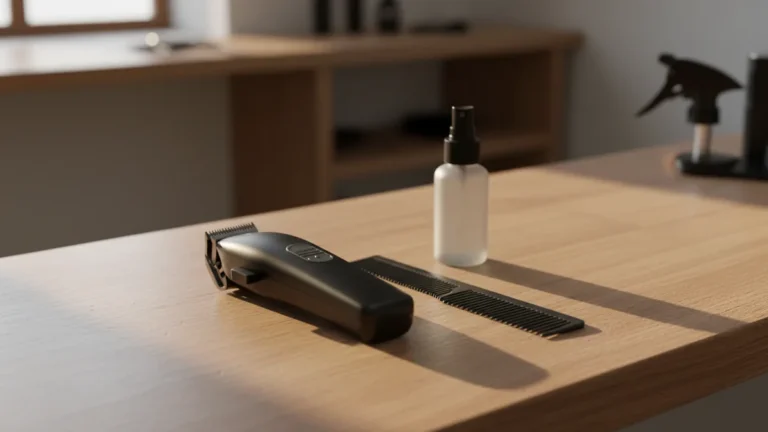
Main clipper. The Wahl Professional 5 Star Cordless Magic Clip is a staple in barber programs for fades and tapers. The adjustable blade lets you blend without constant guard changes, and it typically costs about $135–155.
Check Wahl Professional 5 Star Cordless Magic Clip Price
Outliner. Clean necklines and edges finish a tapered cut. The Andis 04780 T-Outliner is a long-running barbershop trimmer for lineups, at about about $60–80.
Check Andis 04780 T-Outliner Price
Straight razor. Both the barber and master barber practicals include a straight-razor shave. The Feather Standard Styling Razor Kit uses replaceable blades, so you practice with a fresh, consistent edge. It runs about about $50–60.
Check Feather Standard Styling Razor Kit Price
Shears. Shear and scissor-over-comb work blend the top into the taper. An affordable first pair like the Equinox Professional Razor Edge Barber Scissors (about $12–20) is fine for school while you learn what you like.
Check Equinox Professional Razor Edge Barber Scissors Price
Cape. Client preparation is graded on the practical even when the client is a mannequin. Barber Strong The Barber Cape is a washable, shop-grade cape in the about $30–40 range.
Check Barber Strong The Barber Cape Price
Disinfection. Sanitation runs through every NIC practical. A Barbicide Disinfecting Jar (37 oz) (about $25–35) keeps combs and guards in disinfectant at your station.
Check Barbicide Disinfecting Jar (37 oz) Price
See our beginner’s guide to essential barber tools for the full list beyond these six.
How to choose your route
- Pick the license first. Cut-and-shave only? The 800-hour barber license is the fastest path. Want color and chemical services, or flexibility to move? Go for master barber.
- Compare school against apprenticeship honestly. School is faster and structured; an apprenticeship takes at least a year but keeps you in a working shop. Either way, register with OPLC as an apprentice first.
- Find your supervisor carefully. An apprenticeship sponsor must have practiced in New Hampshire for at least two years and file monthly hour sheets with you.
- Price the kit. Kits run about $2,700 to $3,000 at the school that publishes them, so ask whether bringing your own tools is allowed.
- Think regionally. Near the Massachusetts border, a school that also teaches the Massachusetts course can keep both doors open.
FAQ
How many training hours does a New Hampshire barber license require?
The standard license takes 800 hours at a licensed barber school, or a 1,600-hour apprenticeship lasting at least 12 months. The master barber license needs 1,500 school hours, or 3,000 apprenticeship hours spread over 18 months or more.
How long does it take to become a barber in NH?
At a full-time pace, 800 hours takes roughly five months of school, plus time to schedule exams. The apprenticeship route takes at least 12 months by law.
Can I become a barber in New Hampshire through an apprenticeship?
Yes. You register with OPLC as an apprentice and train under a licensed barber with at least two years of practice in the state. You submit monthly hour sheets until you reach 1,600 hours, then take the same NIC exams as school graduates.
What exam do New Hampshire barbers take?
The NIC written and practical exams, given by Prov. The written exam costs $90 and can be taken remotely; the practical costs $110 and is given in Concord on a mannequin. You need 75% on each.
Do New Hampshire barbers need continuing education?
No. Licenses renew every two years for $55, with no CE requirement for barbers in the board’s rules.
Can I transfer my barber license to New Hampshire?
Yes. Under the universal recognition rules, a barber license from any U.S. state or DC qualifies. Master barber reciprocity is limited to Delaware, Georgia, North Dakota, Tennessee and Virginia.
Final take
New Hampshire keeps the barber path short and flexible: 800 school hours or a one-year apprenticeship, national exams you can partly take from home, and low state fees. Decide early between the barber and master barber license, since that choice sets your hours, your exam and your service menu. Then build a kit you can take straight into the Concord practical, starting with a dependable clipper like the Wahl Professional 5 Star Cordless Magic Clip. To compare training options more broadly, see our list of the best barber schools.
Licensing rules, fees and hours can change. This guide is general information, not legal advice. Always confirm current requirements with your state barber board before you enroll or apply.