Disclosure: this article contains Amazon affiliate links. As an Amazon Associate we earn from qualifying purchases, at no extra cost to you. It does not change what we recommend.
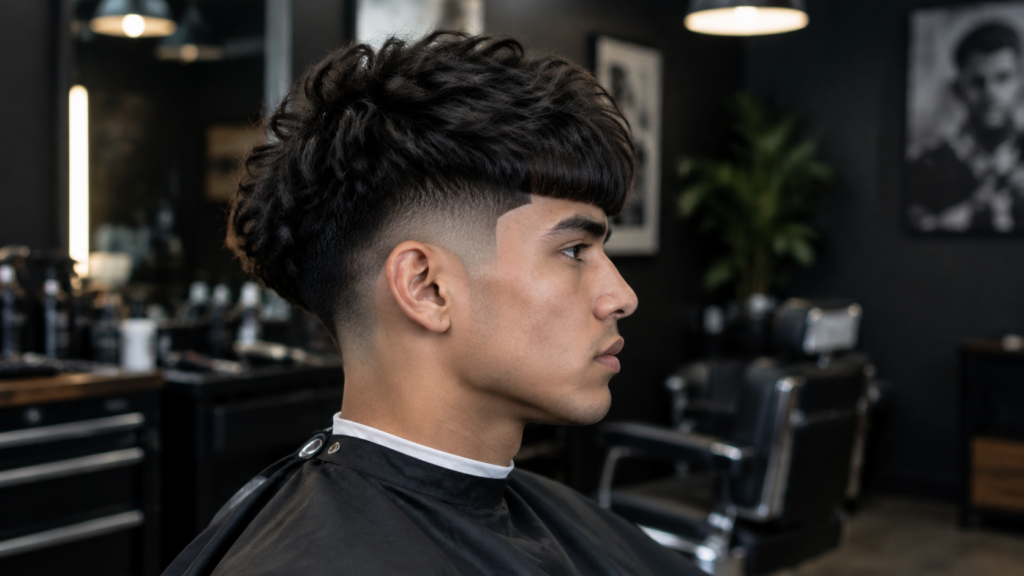
The Edgar is the cut half the internet argues about and every young client asks for by name. It is a crop with a straight fringe and a fade, and the difference between a sharp one and a bowl-cut accident is mostly in how the barber handles two spots: the weight line above the ear, and the bump at the back of the head. Frankthaman, a working barber whose fluffy Edgar tutorials pull serious views, walks through his full method on camera, from the first guard to the texture powder, and the details that make it round instead of square are all there.
A note on the source: the fluffy Edgar tutorial (recorded February 2022) is sponsored by Filoso, Frankthaman’s own razor and product brand, and he plugs his razor holder and texture powder in it. The cutting method itself, guards, angles, and sectioning, is what we pulled from the video, and none of it depends on his products.
In this article
What to Ask For
First, the vocabulary problem, because the Edgar goes by several names. Frankthaman’s answer is reassuring: “Ask them for a French crop or an Edgar, they’ll know exactly what you’re talking about.” Crop top, French crop, fluffy Edgar, the names point at the same family: length and fringe on top, tight faded sides. Bring a photo anyway. His client in the video did exactly that, and the whole cut starts from that reference.
The Shape: Round, Not Square
Before any guideline goes in, two setup moves. Comb the hair out to its full natural state so you can see what you are actually cutting, then clear the bulk: Frankthaman runs a 1 guard with the lever down (a 1.5) over the whole canvas before touching a trimmer. “You want to remove that before you actually put a guideline in there,” he says.
The signature of the fluffy Edgar lives in the clipper over comb work, and his angle rule is the whole trick. Hold the comb at 45 degrees, never straight. “You don’t want to hold it straight, you want to hold it at a 45 to prevent you from going more in,” he explains, “because the shape of this Edgar is fluffy, it’s round. You don’t want it to be square.” He brings that weight line above the ear and connects it into the bangs, which is exactly what creates the rounded, full fringe the cut is known for.
The Fade System
The fade underneath is a three-guideline system: a zero guideline from the trimmer (a precise detail trimmer like the Wahl 5 Star Cordless Detailer Li is what that work calls for), a 0.5 with the clipper lever down, and a 1.5 from the 1 guard lever down. For the clipper itself, the Wahl 5 Star Magic Clip Cordless is the cordless standard this lever-play system is built around. Blend upward and drop the lever as you climb: “The higher you go up in the fade, the more the lever drops.” His tempo tip is worth stealing: do a quick first pass over the whole head before any touch-ups, because barbers who get stuck perfecting one spot lose the flow of the cut.
Two of his warnings separate a clean Edgar from a ruined one. For dark, dense patches (his client’s grew in an M shape at the neck) switch to the corners of the clipper and flick them out; a full blade takes off too much at once. And at the occipital bone, that bump everyone has at the back, fade at 45 degrees and keep it round. “If you guys go in on that, you’re ruining the whole thing,” he says. “Instead of it being round, he’s gonna look like he has a flat head.”
The Top: Wet Shear Work and Texture
The top is shear work, and it starts with water. “Make sure that your client’s hair is fully saturated,” Frankthaman says. “The more wet it is, the more control you have over it.” His client wanted half an inch off, so he sets a mohawk guideline straight down the middle, pointing toward the nose, and matches both sides to it. “You could never get lost like this, because the guideline is down the middle,” he says. His sections run about an inch of hair picked up with comb and fingers, cut, repeat.
Then come the two moves that make it fluffy instead of heavy. Blocking: he squares off the side of the head while still holding the hair at that 45-degree angle, blending the top into the taper with a quarter-inch graduation. And texture: point cutting into one-inch partings, then texturizing shears over the whole top. “How do you create fluff and movement in the hair? By adding texture,” he says. Skipping this step is why most home Edgars sit like a helmet.
The Lineup and Finish
The fringe lineup makes the cut, and Frankthaman’s approach is follow the natural hairline, then listen to the client. His client had a small forehead, and Frankthaman says that left to himself he would have raised the line half an inch, but the client wanted the full bang kept. “Out of respect for him, I have to respect his choice,” he says. It is the right instinct for home cutters too: the sharpest lineup is not always the one the head wants.
Two finishing rules close the video. Shave gel before the razor work on the lineup, because dry shaving hurts and drags. Then a texture powder worked in with the hands to fluff the top and sides into the finished, puffed-out Edgar shape.
FAQ
Is an Edgar the same as a French crop? Same family, per Frankthaman, and most barbers will treat the names as interchangeable. The Edgar label usually implies the straighter, fuller fringe and often a higher fade; a photo settles it faster than vocabulary.
Does the Edgar work on wavy or curly hair? The tutorial’s client has straight-to-wavy hair, and the wet shear work plus texturizing is exactly what tames movement in the top. On tight curls the shape reads differently, so bring a photo of someone with your texture.
How often does it need a cleanup? The fade and lineup lose their edge in two to three weeks. The top can go longer, four to six, because the textured shear work grows out soft instead of blunt.
Can I do it at home? The fade system and the wet shear work are learnable, but the back of your own head is the hard mode version. Frankthaman’s 45-degree comb rule and the occipital warning matter twice as much without a second pair of eyes.
Comb it out, clear the bulk, keep the comb at 45 degrees, fade around the occipital instead of into it, and texturize the top until it moves. That is the whole difference between the Edgar and the haircut people make fun of.