Disclosure: Some links in this article are Amazon affiliate links. If you buy through them, we may earn a commission at no cost to you.
The crew cut is the default answer when a guy sits in the chair and asks for something short. It looks like the simplest cut on the menu, but the difference between a crew cut that grows out clean and one that looks like a helmet is method: the prep, the graduation up the sides, and the blend into the top. This is the full barber method, start to finish.
What makes a crew cut a crew cut
Short back and sides with more length on top describes half the cuts in the book. The real distinction is the silhouette. Most short men’s cuts are built square. A crew cut is built round: the corners come off, the top runs shorter than a flat top or a textured crop, and the whole shape follows the skull instead of fighting it.
Inside that shape you have room to move. Leave the front longer and blend it back for a side sweep, take the top evenly short for the classic college look, or run everything close to the sides for something nearer a buzz. The rounded silhouette is what stays constant, and it is what you tell your barber you want.
The tools you need
The whole cut takes four tools, and the fifth is optional:
- A clipper with a taper lever. The Wahl Magic Clip is the shop standard for this work. The lever opens and closes the blade between guard changes, so you erase lines as you blend instead of swapping guards every pass. Its stagger-tooth blade is built exactly for the graduation a crew cut lives on.
Check the Magic Clip on Amazon - A corded alternative. If you want a plug-in workhorse, the Andis Master runs all day without a battery break, and its flat blade and long lever throw make it the classic clipper-over-comb machine.
Check the Andis Master on Amazon - A rigid barber comb. Clipper over comb is the core technique in a crew cut, and a carbon cutting comb holds its shape against the clipper blade instead of flexing. A flexy comb gives you a wavy taper.
- Cutting shears. A pair of Equinox 6.5 inch cutting shears handles the top and the final connection into the sides.
Check the Equinox shears on Amazon - Thinning shears (optional). A pair of 30-tooth thinning shears softens weight lines and cleans up dark patches without taking length. Not required for the cut, useful for the finish.
Prep: wet the hair and comb it into place
Every short cut starts the same way: wet the hair and comb it into its natural pattern before a clipper touches the head. Dry, uncombed hair stands up in every direction, and the clipper ends up chasing loose hairs instead of cutting the actual shape. Wet hair combed into place shows the true lay of the head, so every pass cuts what you think it is cutting.
The sides: guard work and clipper over comb
Set the foundation with a guard first. A 1.5 guard around the back and sides gives you a consistent short length to blend from, and it keeps the bottom edge honest while you learn the shape.
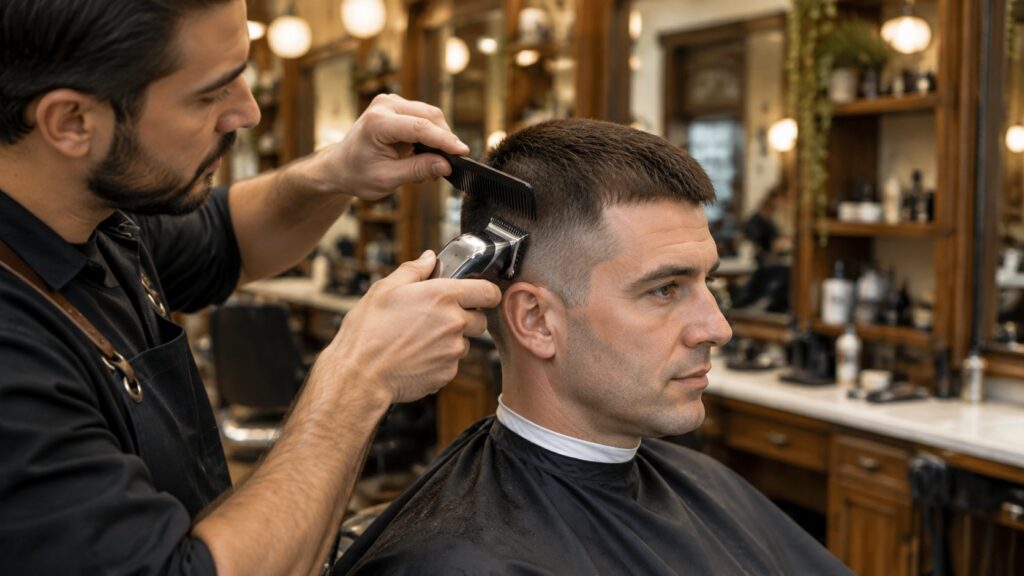
Then switch to clipper over comb for the graduation. Comb everything straight down, set the comb into the hair, and angle it away from the scalp. The comb angle decides the taper: tight to the head at the bottom, opening as you climb. The clipper runs across the comb in a steady rhythm, never stopping mid-section. On the first section there is no guide, so set the taper by eye, then use that finished section as the reference for everything to the left and right of it. It takes more practice than guard work, but it is faster and cleaner once the rhythm clicks.
Watch a full shop version of the pass here:
Blending into the top
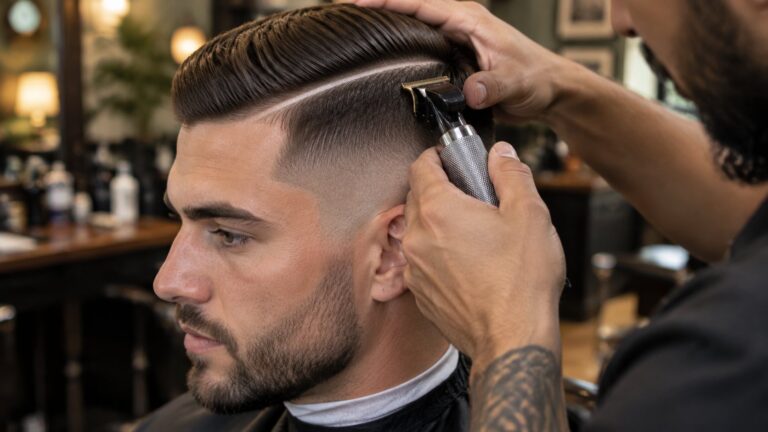
The move that makes a crew cut look like a crew cut instead of a bowl cut is the blend from the sides into the top. As the clippers travel up the head, elevate them away from the skull so the hair gets progressively longer the higher you go. Done right, the sides already flow into the top before the scissors come out, and the connecting scissor work takes minutes instead of half the haircut.
Clipper over comb does the same job through comb angle: tighter to the head at the bottom, opening up as you approach the parietal ridge, that corner where the side of the head rolls into the top. Different tool, same principle. Length increases with height, and nothing gets a hard line.
This second walkthrough spends real time on the blend and the comb angle:
Cowlicks and head shape
Wavy hair, cowlicks, and dents in the skull create dark and light patches that no amount of blending fully erases. Hair sitting in a swirl reflects light differently than hair lying flat, and a dip in the bone reads as a shadow even when the length is even.
The fix is not a shorter guard. Leave problem areas a touch longer, because longer hair is easier to control and lies flatter over irregular growth. Chasing a dark patch with the clippers usually makes a bald spot where there was only a shadow.
Mistakes to avoid
- Skipping the prep. Cutting dry, uncombed hair gives an uneven result no matter how careful the clipper work is.
- One guard everywhere. A single guard over the whole head gives a flat, square result with no shape. The crew cut lives in the transition.
- Digging the clippers into the head. The blade should ride the skull at the bottom and elevate away as it climbs. Pressing in at the top carves a shelf.
- Fighting cowlicks with length removal. Shorter makes swirls and dents more visible, not less. Leave them longer and let the hair lie down.
- Cutting the top before the sides are blended. Set the graduation first. The top length is chosen against what the sides are doing, not in isolation.
Keeping a crew cut sharp
Short hair shows growth fast, and the blend is the first thing to go. Plan on a recut every two to three weeks to hold the shape, which lines up with the cadence barbers recommend for short cuts generally. Between visits, the neckline is what goes scruffy first; a careful neckline cleanup between haircuts buys you a cleaner grow-out without touching the shape on top.
FAQ
What guard number is a crew cut?
There is no single crew cut guard. Most barbers set the sides between a 1 and a 2 (a 1.5 is the common foundation), then blend up into a longer top. The shape comes from the transition, not the number.
How do you ask a barber for a crew cut?
Give three things: the guard you want on the sides, the length on top in fingers or inches, and the word rounded. “One and a half on the sides, about an inch on top, rounded shape” gets you a classic crew cut anywhere in the world.
What is the difference between a crew cut and a buzz cut?
A buzz cut is one length everywhere, done with a single guard. A crew cut keeps a graduated shape: shorter at the back and sides, longer on top, with a rounded silhouette.
Can you cut a crew cut on yourself?
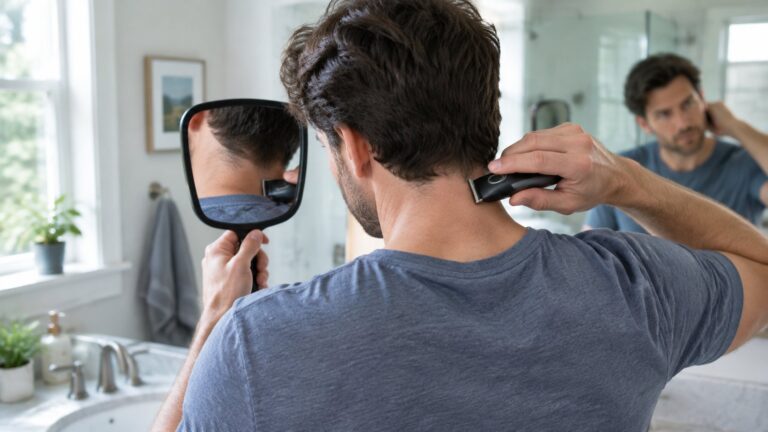
The sides and back are the hard part because you cannot see them. A handheld mirror and patience get you most of the way, but the blend into the top is where home cuts fall apart. If you are doing your own, go longer than you think you need. You can always take more off.