TrustedBarber is reader-supported. If you buy through links on this page, we may earn a commission from Amazon at no extra cost to you.
Curly hair shrinks as it dries, which is why men’s curly cuts go wrong at home. This guide pulls the method from two pro tutorials: The One Minute Barber’s step-by-step scissor cut for long curly hair, and a dry cutting walkthrough from Kenra Professional. You will see when to cut wet or dry, how to section, how to find a guide so you never get lost, and how much length to leave.
Wet cut or dry cut: decide before you pick up the scissors
Curly hair changes length when it dries. A section that hangs past your ears wet can spring up to your jaw once it dries, so the first choice in any curly cut is when to cut. Hairdresser Karina, working with Kenra Professional, gives a simple test. Wet a section and run a comb through it. If the curl pulls straight back up into a spring, cut that hair dry, because you want to shape it where it actually sits. If the hair has deeper waves and hangs lower without much bounce, she says a more traditional wet cut works, since gravity pulls it into roughly the same spot it lands when dry.
“Wet cut or dry cut, in my opinion I tend to base it on the client’s curl pattern… with hair this springy, I’m going to create all the layering with a dry cut.”
– Karina, Kenra Professional
Michael Holm of The One Minute Barber, who says he has cut hair for 21 years, takes the other route for his long curly men’s cut: he wets the hair down and scissor cuts it wet. The difference is not a contradiction. He plans for the springback instead of cutting after it, and he says so throughout the video. Whichever way you go, the rule is the same: take less than you think you need and leave room for the curls to pull up.
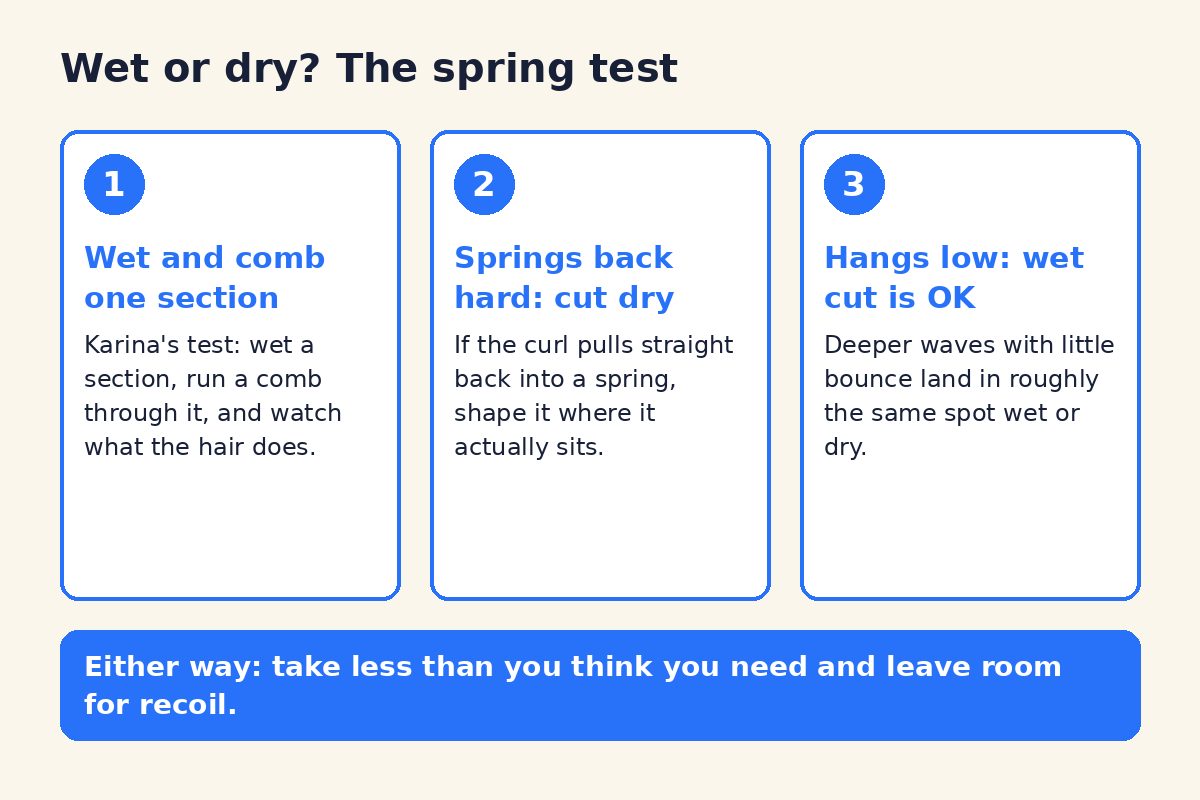
The practical takeaway: if your curls spring up hard when they dry, cut dry or leave extra length when wet. If your hair is wavy and relaxed, wet cutting is safer.
Sectioning and finding your guide
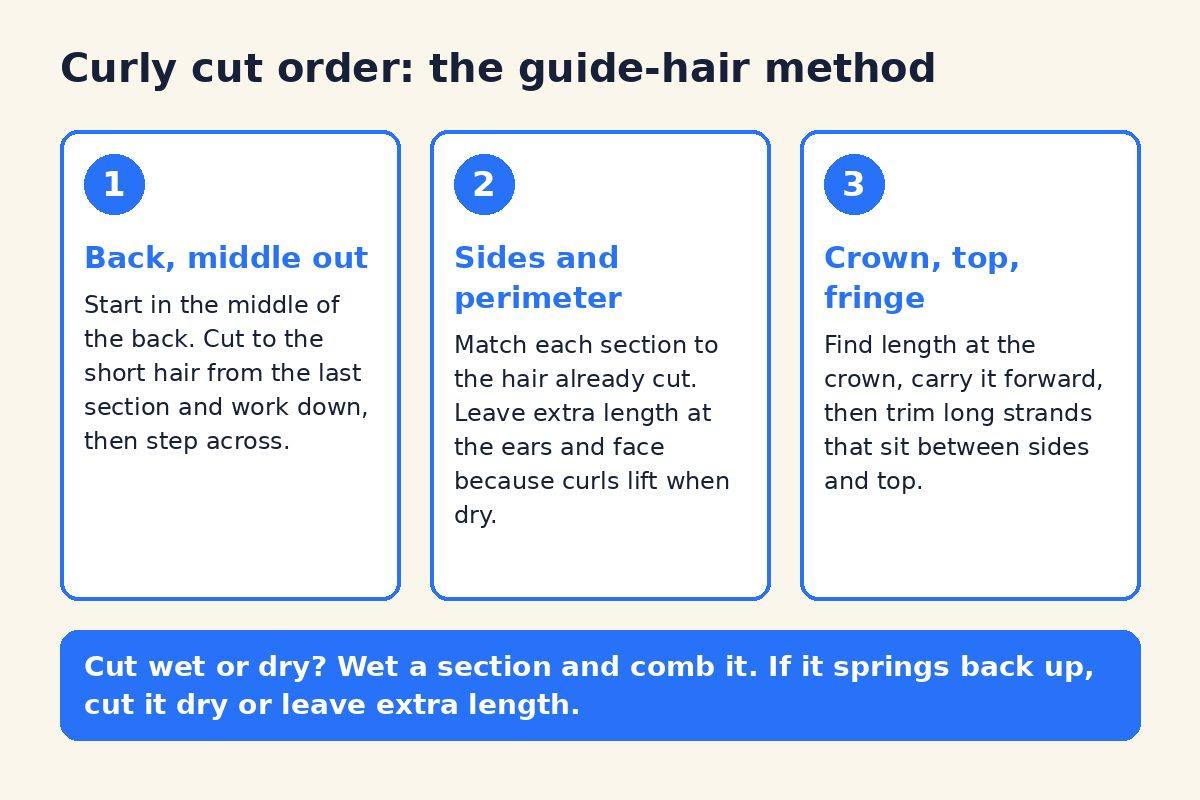
Holm starts in the middle at the back of the head and works in sections, top first and then down, following a set pattern. He picks up hair with a comb and finds his guide in his knuckles, meaning the short hair from the section he already cut. Each new section is cut to match that guide. When he reaches the bottom, he steps across to the next column and repeats. He cuts one side to the middle, then the other.
Kenra’s Karina begins with four quadrants and uses her fingers to make the parts, not a comb. Her reasoning is that a comb can rip through curls, and she wants to keep some of the spring. If a spot is tangled, she works it apart with her fingers to avoid breakage.
Holm names the biggest fear people have with long hair: getting lost. You cut, lose the guide, and keep taking more off. His advice is to slow down and take thinner, cleaner sections. He also points out that long curly hair is forgiving. A millimeter or two off, even a centimeter, is hard to see once the hair curls in. He adds a warning for straight, coarse hair, which shows every scissor mark and needs a near-perfect cut.
“The good news about long hair is it’s very forgiving. If you’re a millimeter or two out, even a centimeter, it’s almost impossible to notice.”
– Michael Holm, The One Minute Barber
- Start in the middle of the back and work down in a repeating pattern
- Use the hair you already cut as the guide for every new section
- If you lose the guide, make the sections thinner
Cutting the back, the crown and the perimeter
Holm first removes bulk from the back with a rougher pass, then refines with scissor over comb. He lets the hair relax on the comb and does not pull it out with his fingers. His reason: tension changes how curly hair lies, and hair held tight will not recoil the way it does when it is released. He lifts the hair at 90 degrees from the scalp wherever it is, higher above the occipital bone and lower toward the nape, which gives one even length all the way around. The occipital bone is the bump at the back of the skull.
“I’m not pulling it out with my fingers, because it’s curly hair. If I put it under tension, it’s not going to recoil.”
– Michael Holm, The One Minute Barber
Next is the crown, the spot on top of the head where the hair spirals out. He cuts across the crown, finds the short hair in his fingertips, and uses that as the guide for the top. Around the ears and face he pulls the hair down but adds a little extra length at the perimeter. When it dries it recoils and lifts, so a perimeter cut too short when wet ends up really short when dry. You can always take more off later when it is dry.
Tie the sides to the top
After the sides and top are cut, Holm lifts sections from back to front and looks for long hair sitting between the two shorter zones. Trimming it away connects them. Karina does a version of this on her model: she looks for the long hair from the top that lies over the shorter hair underneath, and trims it so the haircut connects and is not just a long top over a short base.
The fringe
Holm shows a trick for the fringe. On straight hair you pull the front down to the bridge of the nose and cut across your fingers, which leaves a clean length at the eyebrow. On curly hair he goes longer and pulls down only to about halfway down the nose, since the hair will lift higher once it is dry. He is clear that you rarely see him pull hair down with his fingers like this, but curly hair at the front needs to come out even, and he knows where it will land once released.
Finishing: check, texture and dry to 80 percent
Holm finishes by combing the back down with the fine teeth of a comb under tension and taking off only the very ends of any hair that sticks out. For styling he sprays a little salt spray all the way around and dries the hair only until it is about 80 percent dry. A little moisture left in the hair keeps the dryer from turning curls into frizz. He then works the hair with his fingers.
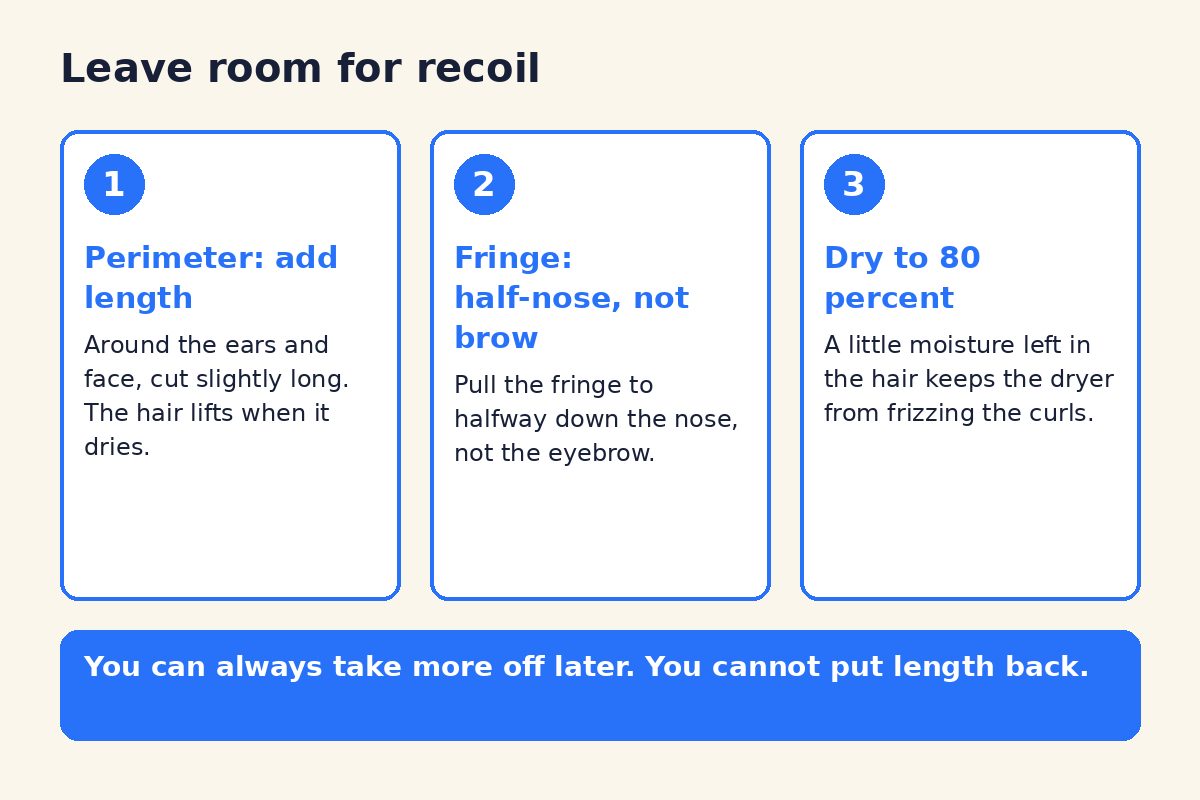
“Only dry the hair until it’s around about 80 percent dry, so that the hair dryer doesn’t turn your curly hair into frizz.”
– Michael Holm, The One Minute Barber
Karina also shows a styling step after her dry cut, and her general advice fits the same idea: shape the hair where it lives, then style it so the curl pattern does the work. If you want product ideas for the day-to-day, our curly hair routine for men covers what to use after the cut.
Tools that make this easier
A curly cut at home needs fewer tools than a fade, but three of them matter. A spray bottle keeps the hair damp while you cut. A proper cutting comb helps with sections, and scissors that are actually sharp stop you from chewing the ends.
The Bardeau 8.75-inch carbon cutting comb is the anti-static kind barbers keep at the chair, with fine teeth on one end for parting and wider teeth for lifting.
Check the Bardeau carbon comb on Amazon
The Sirabe 10-piece shears set includes cutting and thinning shears, combs, clips and a case, which makes it a low-cost way to get a first pair of proper shears. Our shears guide explains how straight and thinning shears differ.
Check the Sirabe shears set on Amazon
For finishing, a sea salt spray such as Tidal Wave adds the texture Holm is after. Use a few sprays, not a soak.
Sectioning clips hold the four quadrants apart while you work, the way Karina parts the hair with her fingers.
Check sectioning clips on Amazon
A barber cape keeps the cut hair off your clothes, which matters more on a long scissor cut.
Check the Barber Strong cape on Amazon
Check Tidal Wave sea salt spray on Amazon
Watch the full tutorials
Michael Holm’s step-by-step curly men’s scissor cut, from The One Minute Barber. He mentions a barbering course and links to his scissors in the video description.
Video credit: Men’s Scissor Cut | Step by Step|The One Minute Barber on YouTube
Karina’s dry cutting walkthrough for longer, layered curls. This video was made with Kenra Professional, so the product mentions are sponsored, but the cutting method stands on its own.
Video credit: Kenra Professional on YouTube
FAQ
Should you cut curly hair wet or dry?
It depends on how springy the curl is. Karina’s test is to wet a section and comb it. If it strings back up into a spring, she cuts it dry. Holm cuts wet but leaves extra length on purpose. In both cases the goal is to cut for how the hair will sit when it is dry.
Why does curly hair look shorter after it dries?
Curls recoil. The hair pulls up and bunches, and a section that hangs low when wet can lift a long way. That is why Holm adds length at the perimeter and halfway down the nose at the fringe when cutting wet.
How much should you take off in one go?
Less than feels right. Holm notes you can adjust when it is dry, but you cannot put length back. Thin sections help you stay in control.
Is a fade the same as a curly cut?
No. A fade is clipper work; this is scissor work. If you want a clipper blend on the sides, our fade at home guide covers it.