Disclosure: this article contains Amazon affiliate links. As an Amazon Associate we earn from qualifying purchases, at no extra cost to you.
A shear that folds hair is not automatically ready for sharpening. Dirt, tension and a damaged edge call for different checks. Start with the care instructions for your exact shears rather than a fixed sharpening calendar.
The sequence below follows Kamisori’s shear-care guidance: wipe the blades after each cut, clean and dry them at the end of the workday, lubricate the joint with the maker-specified scissors oil, check tension and store them protected. Other models may have different instructions.
Cleaning, Oiling and Storage
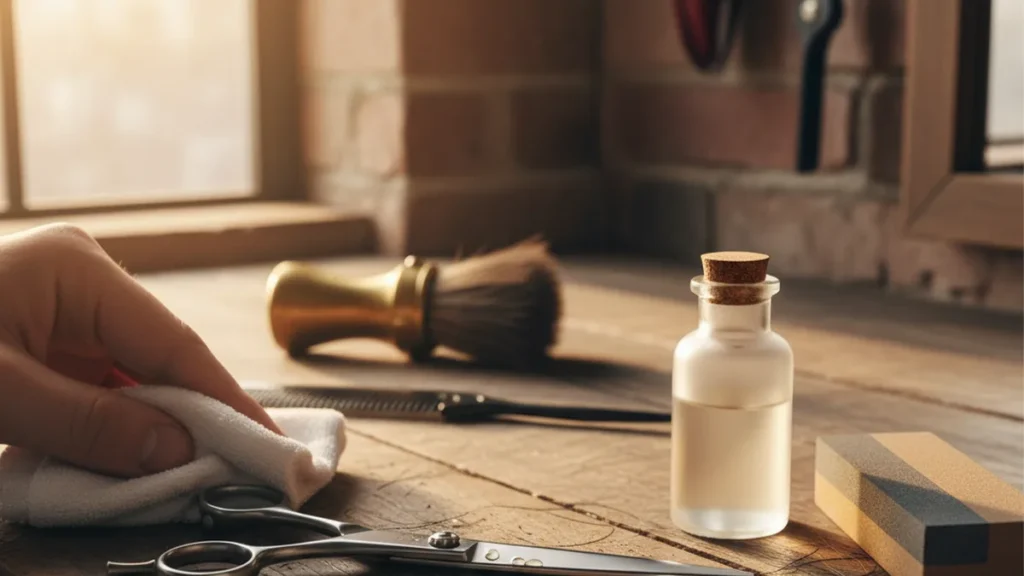
1. Wipe the blades. Kamisori says to wipe its shears and blades with a soft cloth after every cut to remove chemicals and debris. Keep the cloth clear of the cutting edge.
2. Dry between the blades. Kamisori calls for thorough drying at the end of the day. Do not put dirty or damp shears straight into a case.
3. Lubricate the joint. For its shears, Kamisori specifies one or two drops of the supplied scissors oil in the joint after cleaning and drying, at least once a workday. Use the lubricant specified for your model rather than assuming every clipper oil is interchangeable.
4. Check tension. Kamisori calls for a tension check at least once each day. Follow the adjustment method for the tension system fitted to your shears.
5. Store the blades closed and protected. Kamisori recommends the supplied case or a leather case or holster, with the shears secured rather than loose in a drawer. It also warns against magnetic storage.
Keep cleaning chemistry model-specific too. Kamisori warns against contact with comb-sterilizing, perm and color solutions. Follow the shear maker’s compatibility guidance and the product label rather than applying a general clipper-cleaning routine to every shear.
Watch: Scissor Maintenance Done Right
Excellent Edges publishes the scissor-maintenance video below. The written care instructions here are grounded in the linked Kamisori guidance, which should not be treated as a manual for every other brand.
Video credit: Excellent Edges, SCISSOR MAINTENANCE via YouTube
Inspecting the Blades
Kamisori recommends checking sharpness at least once a month and warns against using shears nicked by a drop. A change in cutting feel is a reason to stop and inspect the tool, not to force it through the next haircut.
Keep the edge protected from anything other than clean hair. If the shears have been dropped or damaged, ask the maker or a qualified shear-service center to assess them before using them again. Do not run a finger along the cutting edge to check for a nick.
Tension: The Check Most Barbers Skip
Kamisori explains that loose tension can fold hair, while excessive tension causes wear and fatigue. Its test is to hold the tips upward, lift one handle to a right angle and let the blade fall: it should close about two-thirds of the way, not completely. Use the test specified by your own maker.
Adjustment hardware varies. Kamisori warns owners of its jeweled dial to turn it from the ridged side rather than pressing on the jewels. Check the instructions for your tension screw before changing it; there is no universal fraction-of-a-turn setting.
Sharpening: Professional Service
Kamisori says that when resharpening is needed, use a professional service with the facilities and experience to sharpen high-quality Japanese-style shears. Ask about the blade design before booking the service.
A home whetstone routine is not a substitute for that service. Kamisori warns that damage from improper sharpening can void the warranty. Ask about the sharpener’s experience with your blade geometry before handing over the shears.
If cutting performance changes, check cleaning and tension against the maker’s instructions before deciding that sharpening is the answer. A nicked or dropped shear needs professional assessment; continuing to cut can make a tool problem harder to diagnose.
What Never to Do
- Do not store shears dirty or loose in a drawer.
- Do not use shears nicked by a drop.
- Keep the edges away from anything other than clean hair.
- Avoid chemicals the shear maker says are incompatible.
- Do not alter tension for storage unless your maker instructs it.
Clipper Oil Is Not a Universal Shear-Care Substitute
Wahl Clipper Oil
Wahl clipper oil belongs in a clipper-maintenance kit. For Kamisori shears, the maker specifies its supplied scissors oil instead. Keep the bottles identified and follow the lubricant specification for each tool.
FAQ
How often should I oil my shears?
For Kamisori shears, the published guidance says to clean, dry and lubricate at the end of each workday. Use your own maker’s timing and oil specification for a different model.
Can I use clipper oil on shears?
Not automatically. Wahl clipper oil is sold for clipper blades; Kamisori specifies its supplied scissors oil for its shears. Check with your shear maker before substituting a different lubricant.
Should I sharpen my shears at home?
For Kamisori shears, the maker specifies professional sharpening by a service experienced with Japanese-style shears. Follow the service route for your model instead of treating a general whetstone tutorial as its maintenance instructions.
How do I know my tension is right?
Use the exact maker’s test. For Kamisori, hold the tips upward, lift one handle to a right angle and release it; the blade should close about two-thirds of the way. A different shear may use a different test.
What kills shears fastest?
The avoidable problems in Kamisori’s guidance are dirty storage, incompatible chemicals, loose drawer storage, use after a nicking drop and cutting anything other than clean hair. Protect the edges and use the care instructions supplied with the tool.
The Bottom Line
Clean, dry, lubricate with the specified oil, check tension and store the blades closed in their case. Those are maker-backed habits, not a promise that an edge will last a set number of months or years. For tool choices, see our barber shears guide.