As an Amazon Associate, TrustedBarber earns from qualifying purchases.
If you want to know how to become a barber in Michigan, the short version is 1,800 hours: either at a licensed barber college or as a registered apprentice in a licensed barbershop. Then you pass the national theory and practical exams run by PSI and pay a $63 license fee to the state. Full-time students can finish school in about 13 months, and the clippers you buy on day one, often a cordless Wahl Professional 5 Star Cordless Magic Clip, will carry you through the practical exam.
Quick answer: Michigan barber license
- Hours: 1,800 at a licensed barber college, or 1,800 as an apprentice
- Exams: NBCP theory and practical, run by PSI (online or at a test center)
- State fee: $63 application plus 2-year license; $60 to renew
- Minimum: age 17 and 10th grade completed
- Time to license: roughly 13–18 months full-time
- Board: Michigan Board of Barbers (LARA)
Barber school kit picks
- Wahl Professional 5 Star Cordless Magic Clip (about $135–155)
- Wahl Professional 5 Star Detailer Li (about $110–130)
- Andis 01410 Master Dual Magnet Comb Set (about $30–40)
- Barbicide Disinfecting Jar (37 oz) (about $25–35)
Prices are typical Amazon ranges and change often.
Michigan barber requirements at a glance
Michigan regulates barbering under Article 11 of the Occupational Code, and the Board of Barbers sits inside the Department of Licensing and Regulatory Affairs (LARA). Everything below comes from LARA’s Barber Licensing Guide (revised January 26, 2026) unless noted.
| Item | Michigan rule |
|---|---|
| Training | 1,800 hours (college or apprenticeship) |
| Age / education | 17+ and 10th grade or equivalent |
| Exams | NBCP theory + practical (PSI) |
| Application + license | $63 |
| Renewal | Every 2 years, $60 |
| Out-of-state route | Endorsement after 1 of last 3 years licensed |
Two details trip people up. First, Michigan’s education floor is lower than many states: the guide asks for the tenth grade or an equivalent education, not a diploma, for the license itself. Second, a Michigan barber license only lets you work in a licensed barbershop or barber college. The guide’s FAQ is blunt that a barber licensee cannot work in a licensed cosmetology establishment, so plan your job search around barbershops.
Barber college vs. apprenticeship in Michigan
Michigan gives you two roads to the same 1,800 hours. The first is a course of study at a licensed barber college. The second is an apprenticeship inside a licensed barbershop, which LARA explains in its Barber Apprenticeship Guide.
The apprenticeship is run by the shop, not by you. The barbershop applies for your apprentice registration through MiPLUS (a $20 processing fee), must confirm you have a high school education or the equivalent before taking you on, and has to make sure every hour of your training is given by someone holding an active Michigan barber license. You can’t be required to attend more than 40 hours a week, the shop has to keep daily attendance and progress records for three years, and it must give you its own exam before certifying that you’ve finished. A shop can train no more than two apprentices at a time.
One risk is specific to Michigan’s rules: if the shop’s license lapses, or the shop is sold or moves, the apprentice registration is voided, and hours earned while either license wasn’t active don’t count. Before you sign on with a shop, look it up on the state license search and ask how long the owner plans to stay put.
School costs more but moves on a fixed schedule with a built-in clinic floor full of real clients. An apprenticeship can pay you while you learn, but it depends on finding a willing, stable shop. If you’re comparing options, our guide to choosing a barber school near you walks through the trade-offs.
The NBCP exams: theory and practical
Since October 2, 2024, Michigan has used the National Barber Cosmetology Program (NBCP) exams developed and scored by PSI, replacing the old state exam. LARA’s NBCP FAQ says the knowledge and skills tested are essentially the same as before, and that you can take both the theory and the practical exam virtually or at a PSI testing center.
Timing matters: passing scores on the theory and the practical have to come within one year of each other, and a passing score is valid for one year from the date you earn it. Your license application and fee are also only good for one year, so don’t apply and then sit on it.
PSI sets the exam fees and publishes them, along with a content outline for both parts, in its Candidate Information Bulletin on psiexams.com. LARA said the fees did not change with the switch to NBCP. Download the current bulletin before you book, because the practical supply list in it is what your exam kit has to match.
Michigan barber license fees
LARA’s fees are short and simple:
- Barber license by exam or reciprocity: $63, which covers the application and the 2-year license.
- Renewal: $60 every 2 years.
- Relicensure (lapsed license): $100.
- Apprentice registration (paid by the shop): $20.
- Mailed paper license: $10 per license; an emailed copy is free.
PSI’s exam fees are on top of these. Fees are paid by card in MiPLUS.
Step-by-step: how to get your Michigan barber license
- Pick your route: enroll at a licensed barber college, or line up a licensed barbershop willing to register you as an apprentice.
- Complete 1,800 hours. Apprentices: the shop uploads the Certification of Completion to MiPLUS when you finish.
- Apply for the barber license in MiPLUS and pay the $63 fee. Apprentices get an exam authorization email from LARA first, with instructions.
- Once PSI confirms you’re eligible, it emails you to schedule. Book the theory and practical exams, online or at a test center.
- Pass both within a year of each other. LARA then issues your license.
Renewal and continuing education
Michigan barber licenses run for two years. You renew online in MiPLUS no sooner than 90 days before the expiration date, pay $60 and accept the renewal attestation. LARA’s renewal checklist lists no continuing-education hours for barbers, which makes Michigan one of the easier states to stay licensed in. If you let the license lapse for more than three years, you either retake the exams or show an active license from another state for at least one of the last three years.
Moving to Michigan with a barber license
Michigan licenses out-of-state barbers by endorsement. You need verification, sent straight from your current licensing agency, that you hold or have held a barber license in good standing for at least one of the three years before you apply. If you were trained but never licensed elsewhere, you can submit official transcripts showing 1,800 school hours, or a Verification of Work Experience form for 1,800 hours as a barber or apprentice.
Foreign-trained barbers need an education evaluation from a NACES member. If the board decides your other license isn’t substantially equivalent, you’ll be asked to take and pass the NBCP exams.
Recent changes in Michigan
- National exam: the NBCP replaced the state exam on October 2, 2024. Candidates already scheduled for the old exam were switched over automatically, and already-licensed barbers don’t need to retest.
- Remote testing: both parts of the exam can now be taken virtually.
- Updated guides: LARA revised its barber and apprenticeship licensing guides in January 2026. Check the board page for the newest versions before you apply.
What barbers earn in Michigan
According to the U.S. Bureau of Labor Statistics Occupational Employment and Wage Statistics (May 2025), barbers in Michigan earned a mean of $44,490 a year ($21.39 an hour) and a median of $35,490 ($17.06 an hour). Nationally, the mean was $47,070 and the median $38,210. BLS didn’t publish a Michigan employment count.
Take those numbers as a floor. OEWS counts only wage-and-salary employees, so booth renters, shop owners and other self-employed barbers, who make up a large share of the trade, aren’t included, and tips may be under-reported. A self-employed barber with a full book can earn more than these figures show.
Barber schools in Michigan
These are three real, currently operating Michigan programs, with details taken from each school’s own website and the U.S. Department of Education’s College Navigator in October 2026. Always confirm current tuition and start dates directly with the school. For a wider shortlist, see our roundup of the best barber schools.
Michigan Barber School (Detroit)
Michigan Barber School, at 8990 Grand River Ave in Detroit, offers a barber/styling program and a barber instructor program. Its tuition page lists 1,800 hours of tuition at about $13,200, plus a $150 registration fee, about $900 for tools and $260 for textbooks, for a total of about $14,500 (checked Oct 2026). The school says financial aid is available to those who qualify, and students paying cash can spread payments over 17 months after a 10% down payment.
Metro Detroit Barber College (Detroit)
Metro Detroit Barber College, at 7443 W. McNichols in Detroit, opened in 2009 and offers day and evening classes. Its 1,800-hour program takes 11 to 22 months depending on the schedule. College Navigator lists 2024–25 tuition and fees of about $14,400 for its 1,800-hour barbering program, and a 13-month average completion time. Navigator currently states that students cannot receive federal aid there, so ask the school about payment options before you enroll.
Douglas J School of Barbering (East Lansing)
Douglas J, best known for its beauty schools, runs a barbering program at its East Lansing location. Its barbering page lists 1,800 hours for Michigan, says the full-time program can be completed in as little as 13 months, and splits training into a first 13-week theory phase followed by hands-on work with real clients. Tuition isn’t posted on that page, so request it from admissions.
Barber school kit: what students need
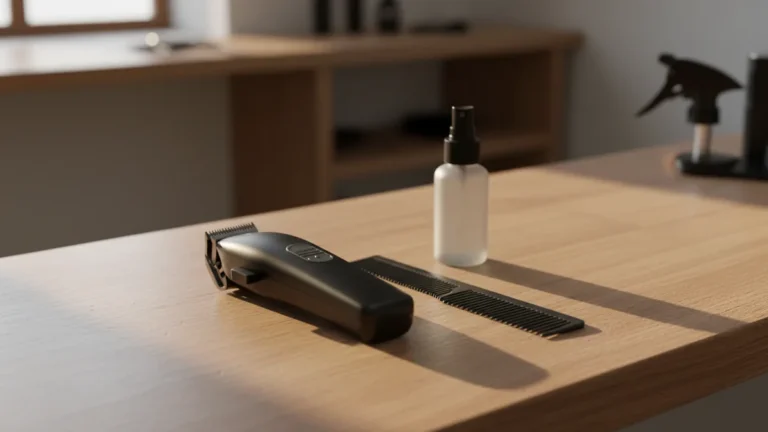
Many barber colleges include a starter kit (Michigan Barber School builds about $900 of tools into its published cost), but students almost always add to it, and you’ll want reliable tools for the NBCP practical. Here are the pieces Michigan students reach for most, with typical Amazon price ranges. For a deeper comparison, see our guide to the best clippers for barber school.
The Wahl Professional 5 Star Cordless Magic Clip (about $135–155) is a common student fade clipper. Its adjustable blade handles blending and tapers, and running cordless matters when you’re working a crowded student floor.
Check Wahl Professional 5 Star Cordless Magic Clip Price
For lineups, necklines and outlining beards, a trimmer like the Wahl Professional 5 Star Detailer Li (about $110–130) gives you the sharp, close edge the practical graders look for.
Check Wahl Professional 5 Star Detailer Li Price
The Andis 01410 Master Dual Magnet Comb Set (about $30–40) gives you a full set of magnetic guards for Andis Master-style clippers, handy when an instructor wants you practicing guard work and clipper-over-comb side by side.
Check Andis 01410 Master Dual Magnet Comb Set Price
Sanitation is part of every barber practical. A Barbicide Disinfecting Jar (37 oz) (about $25–35) keeps combs and implements in disinfectant at your station.
Check Barbicide Disinfecting Jar (37 oz) Price
For shaving and razor work, the Feather Standard Styling Razor Kit (about $50–60) is a popular student choice because it uses replaceable blades.
Check Feather Standard Styling Razor Kit Price
Finally, keep blades cool and clean between clients with Andis Cool Care Plus 5-in-1 Clipper Spray (about $10–15).
Check Andis Cool Care Plus 5-in-1 Clipper Spray Price
How to choose a Michigan barber school
- Check the license. Hours only count at a barber college licensed by LARA. Look the school up on the state license search.
- Compare total cost, not tuition. Michigan Barber School’s published total is about $1,300 more than its tuition once registration, tools and books are added.
- Ask about schedules. An evening track like Metro Detroit Barber College’s can stretch 1,800 hours toward 22 months; full-time programs land closer to a year.
- Ask about federal aid. College Navigator shows which schools can take federal aid, and it changes. Check it the month you enroll.
- Ask how they prep for the NBCP. Since the exam switched in 2024, a good school should be teaching to the PSI bulletin, including the virtual testing option.
FAQ
How many hours do you need to become a barber in Michigan?
1,800 hours, either at a licensed barber college or as a registered apprentice in a licensed barbershop.
How long does barber school take in Michigan?
Full-time programs commonly take about 13 months or a little more (College Navigator lists a 13-month average at Metro Detroit Barber College). Part-time and evening schedules can run up to about 22 months.
Is it illegal to cut hair without a license in Michigan?
Providing barber services for pay requires a license under Article 11 of the Occupational Code, and barber services can only be provided in a licensed barbershop or barber college. Students and apprentices work under those licenses while they train.
Can I take the Michigan barber exam online?
Yes. Since the switch to the NBCP in October 2024, LARA allows both the theory and practical exams to be taken virtually or at a PSI test center.
Do Michigan barbers need continuing education?
LARA’s renewal checklist for barbers lists the online application, the $60 fee and an attestation, with no continuing-education hours. You renew every two years.
Can a cosmetologist work as a barber in Michigan?
Barbering and cosmetology are licensed separately in Michigan, and a barber license does not let you work in a cosmetology establishment. If you hold a cosmetology license and want to barber, check with LARA about which hours will count.
Final take
Michigan keeps the path straightforward: 1,800 hours, two national exams you can even take from home, a $63 license and no continuing education. The real decisions are school versus apprenticeship, and which school’s schedule and total cost fit your life. Start with the board’s licensing guide, compare two or three schools, and budget for a dependable clipper like the Wahl Magic Clip and a Wahl Detailer Li for exam day.
Licensing rules, fees and hours can change. This guide is general information, not legal advice. Always confirm current requirements with your state barber board before you enroll or apply.