TrustedBarber is reader-supported. If you buy through links on this page, we may earn a commission from Amazon at no extra cost to you.
Barber pick
Wahl Magic Clip Cordless. an adjustable-blade clipper for building fades.
This walkthrough follows Nevin The Barber’s burst fade tutorial below (watch it here), which builds the fade around the ear step by step.
Video: Nevin The Barber on YouTube
- What a Burst Fade Actually Is
- Burst vs. Taper vs. Drop: The 30-Second Version
- How a Barber Builds a Burst Fade, Step by Step
- The Guideline Stack Behind the Arc
- Where Burst Fades Go Wrong
- The Tools That Do the Work
- What to Ask For at the Shop
- Who the Burst Fade Suits
- Keeping It Fresh
- Frequently Asked Questions
What a Burst Fade Actually Is
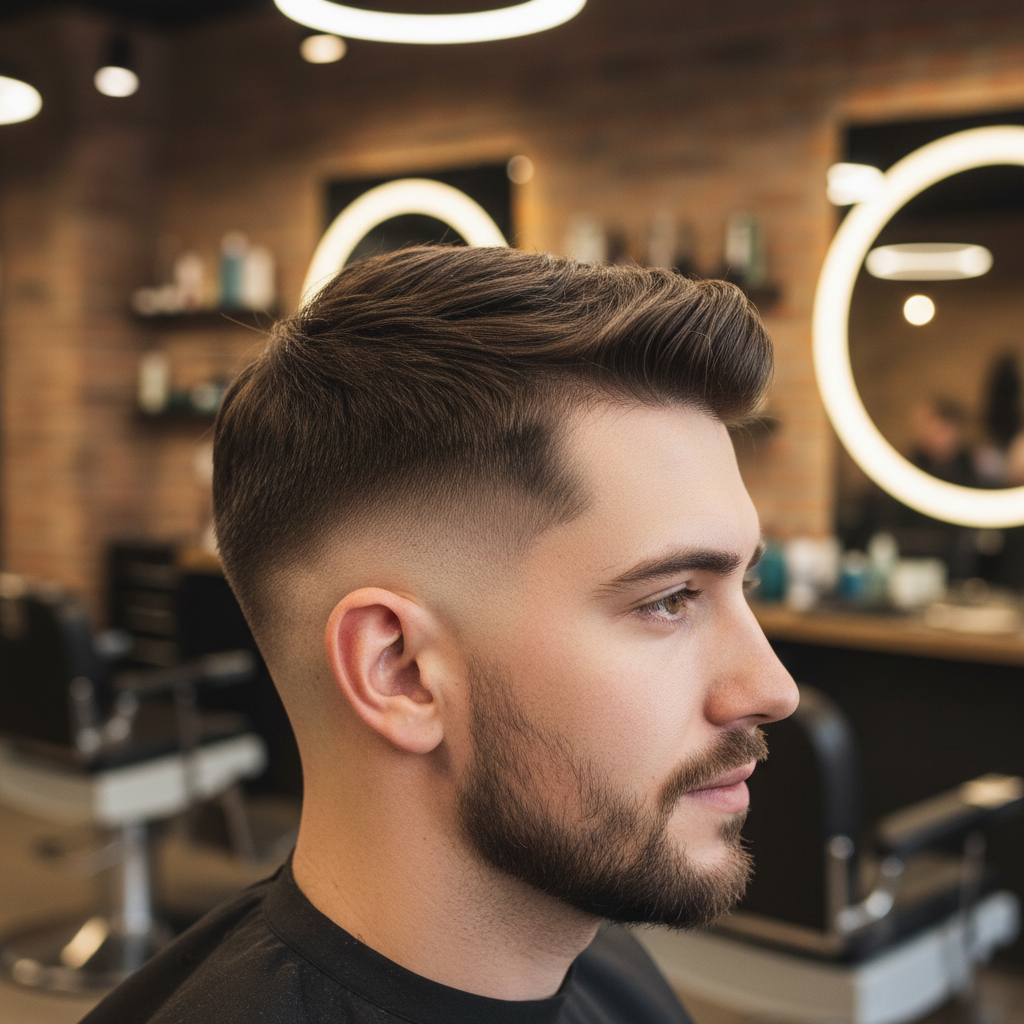
Most fades are rectangles. A burst fade is a circle. Instead of blending hair straight down the side of the head, the barber fades it in a radial arc that wraps around the ear, from the temple down to behind the ear, leaving the ear itself naked in the middle of the burst. Seen from the side, the fade looks like it is exploding outward from the ear, which is exactly where the name comes from. Barbers also call it a South of France fade, a nod to the style’s origins in the classic French crop cut.
That circular geometry is the whole point. A taper fade follows the natural hairline. A drop fade dips behind the ear in a U shape. A burst ignores the hairline entirely and orbits the ear, which is why it pairs so naturally with cuts that leave the ear exposed: mohawks, faux hawks, buzzed tops with longer fringe, and mullet-adjacent styles. If you want hair gone around the ear specifically, the burst is the fade that does it.
Burst vs. Taper vs. Drop: The 30-Second Version
- Taper fade: a subtle gradient along the sideburn and nape. The hairline itself keeps a natural edge.
- Low, mid, high fade: hair blends down the side of the head at different heights, all following a roughly straight vertical line.
- Drop fade: the fade line drops lower behind the ear, tracing a U.
- Burst fade: the fade radiates in an arc around the ear. The back and nape are often left longer or kept separate from the burst entirely.
One more distinction that matters at the chair: a burst fade is a placement, not a grade. You can have a burst skin fade, a burst taper, or a burst that stops at a number two guard. When you ask for “a burst fade,” your barber still needs to know how high you want it to climb and how bare you want the arc around the ear.
How a Barber Builds a Burst Fade, Step by Step
Watch a pro do it in a YouTube tutorial and the order of operations is almost identical across barbers. The specifics vary by head shape, but the framework holds.
1. Establish the anchor line
The barber first decides where the burst starts: usually a point at the temple, a point above the ear, and a point behind the ear, connected in a smooth arc. Everything inside that arc gets faded; everything outside keeps its length. Getting this arc right is 80% of the cut, because a burst that sits too high eats into the parietal ridge and makes the cut look unfinished from the front.
2. Rough out the arc with a guard
With a guard (often a one or a two), the barber carves the arc itself, clipping the bulk inside the line. This is not blending yet; it is defining the shape so the blend has boundaries. A good barber checks the arc from the front, the side, and behind the ear before touching anything else, because a crooked anchor line cannot be blended into looking straight.
3. Fade inside the arc
Inside the boundary, the barber works through the guard ladder, usually starting at the bottom near the ear’s edge and stepping up: skin or a zero on the innermost band, then one, then two, then three, each band overlapping the last. Because the fade curves around a round object, the lever gets used constantly; flicking the lever open as the clipper rounds the ear is what keeps the gradient smooth instead of stepped.
4. Detail the ear and the edges
Around the ear itself, a full-size clipper is too wide to stay controlled, so pros switch to a trimmer. The Wahl Detailer Li is the cordless version of the trimmer barbers reach for most for this exact step, because the T-wide blade lays down a crisp edge along the ear’s curve without digging in. The trimmer also cleans up the sideburn point, which on a burst fade usually gets trimmed shorter than on a taper since the hair around it is already faded.
Check the Wahl Detailer Li on Amazon
5. Finish the top and connect the back
What happens behind the burst depends on the cut. On a mohawk or faux hawk, the burst is the whole show and the nape gets faded separately or buzzed. On a crop with a burst, the back is often left fuller on purpose, which is the signature South of France look. The barber scissor-cuts or clipper-cuts the remaining length to flow into the arc instead of colliding with it.
The Guideline Stack Behind the Arc
The step-by-step above describes the moves; this is the order the guards fall in, which is what actually shapes the arc. In the tutorial embedded above, Evan the Barber builds the whole fade on three guidelines laid down before any blending starts: the skin line the trimmers carve around the ear, a 0.5 line cut with the clipper lever all the way open, and a 1.5 line set with the 1.5 guard fully closed. None of them get erased until the blending pass, which is the opposite of how a lot of home cuts go wrong.
The order matters as much as the numbers. The trimmer line comes first because, as the tutorial puts it, it is the foundation of the fade: carve it too high or too low and every guideline after it inherits the error. The clipper line goes in next at 0.5, left deliberately intact, and the 1.5 line goes in above it while the first two are still visible. Only then does the blending begin, working from the top guideline down: the 1.5 gets blended into the bulk of the hair with clipper-over-comb while the guard is still on, the 0.5 gets flicked out into the 1.5 with the half guard open, and the skin line gets worked last with the lever closed and then opened one notch at a time, blending upward instead of downward.
Where Burst Fades Go Wrong
Most burst fade mistakes trace back to the guidelines, not the blending. Three show up on nearly every cut that goes sideways:
- An anchor line that is not symmetrical. The tutorial stresses carving the first bald line in an even circular shape around the ear, not too high and not too low, because it determines how the rest of the cut lays out. A tilted anchor reads as a tilted fade from three feet away.
- Erasing guidelines too early. Leaving each line standing until the next one is placed keeps the reference points alive through the whole blend. Wipe one out and you are blending against a guess.
- Working with the full blade instead of the corner. The barber in the video cuts with the corner of the blade specifically because it gives a more detailed pass and disperses the hair more gradually. The full blade removes too much at once on a curve as tight as the one behind the ear.
The lever discipline is the other habit worth copying. Every time the lever closes, the blade cuts a little shorter, so the cutting stroke gets shortened to match, one notch at a time. Rushing the lever is what leaves the horizontal banding a burst fade shows off so easily.
The Tools That Do the Work
You do not need a station full of gear to get a clean burst, and barbers repeat the same short list in their videos. A reliable adjustable-clipper does the blending; a detail trimmer does the edges; and for guys maintaining the style at home between cuts, an all-in-one trimmer handles the touch-ups.
- For the blending: the Wahl Magic Clip Cordless shows up in more burst fade tutorials than any other clipper, largely because the staggered tooth blade pattern feeds hair smoothly when the clipper is riding around the curve of the ear.
- For the edges: the Wahl Detailer Li covers the tight arc and the sideburns.
- For at-home maintenance: the Wahl Stainless Steel Lithium-Ion trimmer ships with the guards and detail heads that let you keep the arc clean for a week or two before the next full cut.
If you are attempting the fade yourself, our guide to the best clippers for fades breaks down which machines hold a zero gap well, which matters here more than in any other fade, since the arc shows every guard line.
What to Ask For at the Shop
Say the style first, the fade second. “Mohawk with a burst fade” gives your barber a complete picture. “Burst fade” alone leaves them guessing what is happening on top. Then get specific with three numbers: how high the burst climbs (temple, mid-ear, or above the ear), how bare the innermost band gets (skin or a guard), and what the back is doing (faded separately, left long, or buzzed).
Bring a photo. Burst fades vary more from barber to barber than tapers do, because the arc’s width is a judgment call. A picture of the width you want ends the guesswork. Our walkthrough of cutting a fade at home covers the same lever-flicking fundamentals if you are deciding between the chair and the bathroom mirror.
Who the Burst Fade Suits
The burst flatters heads with prominent ears and strong crowns, because the radial fade draws the eye outward and visually narrows the skull behind the ear. It is also the default fade for anyone with a curly or coily texture on top wearing a mohawk or freeform shape, since the faded arc makes the longer top read even taller by contrast. On fine, straight hair, a burst works best paired with a textured crop, because a fine-haired mohawk over a burst can look sparse where the two meet.
Growth patterns matter too. If your hair whorls badly behind the ear, tell your barber before they start; a double crown near the arc line is the one situation where a burst fade fights the hair instead of working with it, and most barbers will shift the anchor line slightly to accommodate it.
Keeping It Fresh
A burst fade shows growth faster than a taper because the faded band is wide and circular. Plan on cleanup around the ears every one to two weeks and a full re-fade every three to four, depending on how low you run the skin band. Between cuts, the same Wahl lithium-ion kit with a foil shaver head or a number-zero guard keeps the arc tight without touching the length on top. And if your style runs the length over the ear into a mullet or freeform shape, our guide to the hard part shows how a shaved line can frame the burst and give the arc a hard edge to sit against.
Frequently Asked Questions
Does a burst fade work with a beard?
Yes, but the two are connected. Because the burst ends at the sideburn, your barber will either fade the sideburn down into the beard or leave a deliberate gap. Our guide to fading a beard covers how barbers bridge that transition.
How long does a burst fade take?
Plan on 45 minutes to an hour. The arc work and the detail pass around the ear are what stretch the appointment past a standard taper’s timeline.
Is a burst fade professional?
It depends on the top. A burst under a short crop or a neat textured top reads clean in almost any office. A burst under a two-foot mohawk reads like a two-foot mohawk. The fade itself is not the loud part; what sits above it is.
What guards does a burst fade use?
The common stack is skin, 0.5, and 1.5, which is exactly what the tutorial above runs: trimmers for the skin line, the clipper lever open for the 0.5, and a 1.5 guard closed for the top guideline. Higher-coverage bursts swap the 1.5 for a 2 and add a guideline, but the three-line build is the standard starting point.
Why does a burst fade come out streaky?
Usually the lever moved faster than the blend. The method in the video closes the lever one notch at a time and shortens the cutting stroke with each notch, then goes back and opens the lever notch by notch on the final skin-line blend. Skipping notches leaves visible steps on a curved surface where the eye catches every one of them.
Do you need trimmers as well as clippers for a burst fade?
Yes, because the jobs split. The trimmer draws the anchor line and cleans the edge around the ear, which the Wahl Detailer Li is built for, while the clippers do every guideline and the blending. One machine cannot do both cleanly, which is why our rundown of the Wahl Magic Clip Cordless pairs with a detail trimmer in the tool list above.