
TrustedBarber is reader-supported. If you buy through links on this page, we may earn a commission from Amazon at no extra cost to you.
Growing your hair out is the easy part. The hard part is that one bad trim can undo a year of patience, and most guys with long hair cannot explain to a barber what they actually want. Stephen Marinaro, the licensed cosmetologist behind TheSalonGuy, has two videos that solve both sides of that problem: one explains what layers really do to long hair, and one is a full step-by-step cut of the “bro flow,” the medium-long layered style most men are picturing when they say they want to keep their length. This guide combines both.
What layers actually do
Marinaro’s definition strips the mystery out: layering is a technique designed to remove weight from the hair. On heavy hair, layers relieve some of that weight so the hair lifts slightly and softens, while the overall length stays. One-length hair is the opposite choice. With no layers at all, the hair sits as flat and heavy as it possibly can, which is exactly what some guys want.
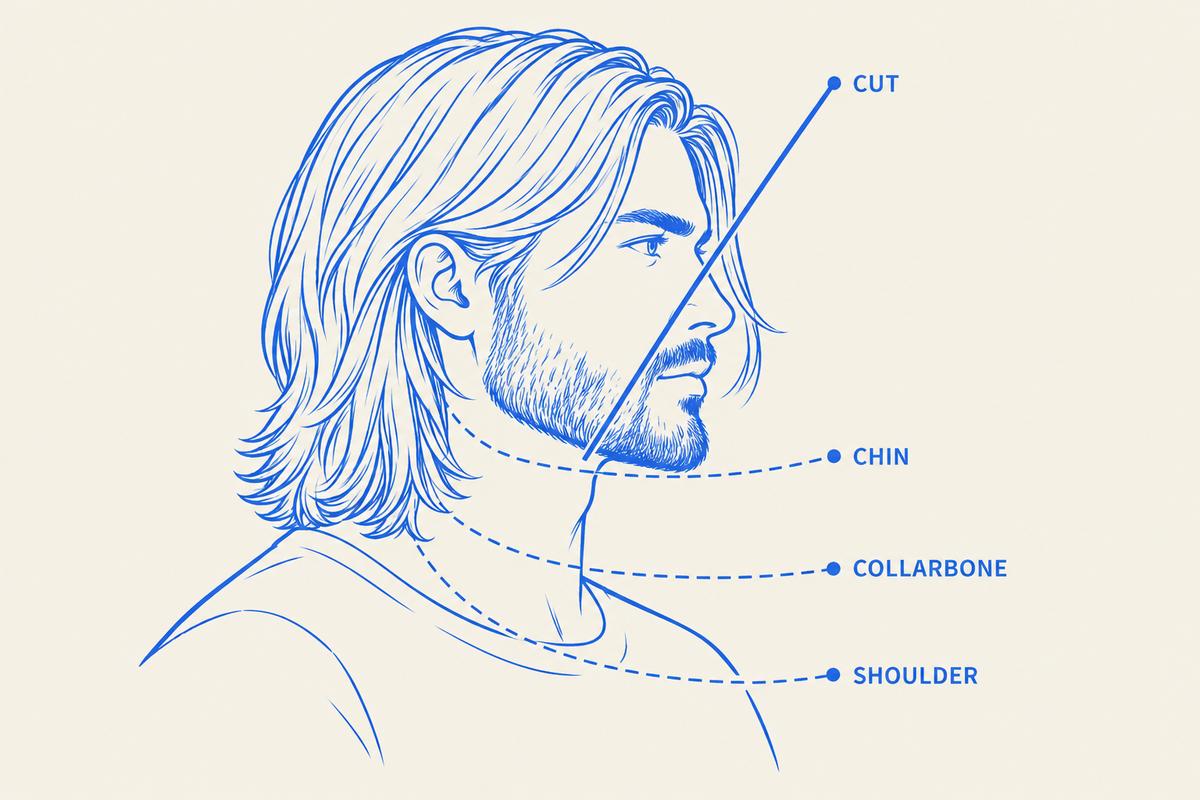
His other rule is about where a layer lands. Wherever the hair is cut is where it falls. Cut a section at chin height and that piece will live at chin height forever after. The angle of the cut is controlled by the elbow: the higher the elbow toward the sky, the shorter the layers. Going from very short layers into very long length requires slide cutting to blend, and it can look unbalanced. For most men growing their hair, his recommendation is a medium layer starting around the chin or lower, which adds texture and movement without sacrificing the ponytail option.
Three ways to wear the length
From the explainer video, the decision tree is simple. If you always wear a ponytail, keep any front layers long, because short face-framing pieces will fall out of the tie and hang in your eyes all day. If you want maximum weight and a flat, smooth look, stay one length and just trim the ends every three to four months so it never turns stringy. If you want softness without losing that weight, ask for an angled face frame: the hair keeps its one-length heaviness through the back while the front is cut on a diagonal from a starting point you choose, which looks like a layer but keeps the fullness.
The cut, step by step
The bro flow tutorial is the practical half. Marinaro starts by finding the natural parting: comb the hair back, push it forward, and let the hair show where it wants to split. The cut is then built around that parting, because fighting it means styling against the grain every morning. He sections into four quadrants, two in front and two panels in back, mostly to keep long hair out of the way and the cutting line visible.
The first real cut is the length itself: a straight line across the back, taken off at whatever length the client wants to keep. He calls this the foundation of the whole haircut and compares it to building a house, because every later section is measured against it. Then he connects the sides to that back length, holding the front corners back and cutting downward with his fingers pointed up, which keeps his body position clean and his eye on the shape. His warning at this stage is about balance: if the front pieces come out too short relative to the back, the cut drifts into mullet territory, which is only fine if that is the goal.
Corners, weight and cross-checking
The corners, where the head rounds, are where long-hair cuts go wrong. Marinaro’s method is to protect the length through the corners first and only then remove the weight, because cutting the corner away early leaves nothing to work with. His blunt explanation of the common failure: stylists who cut too much at the corners cause the holes and gaps that make a long haircut look chewed. He finishes by cross-checking, combing sections straight out from the head and snipping only the stray pieces that break the balance, and by standing in the same spot and turning the chair rather than reaching around the client.
What to tell your barber or stylist
Marinaro is direct about venue: maintaining long hair is a stylist’s job, not a job for a shop that only runs clipper fades all day, though a barber who is comfortable with scissor work can do it. His script for the chair is specific. Say that you like the length but the hair is heavy, that you do not want short layers up high, and that you want the shape to start lower, around the chin, so the texture lives through the bottom. If a previous cut took the layers too short, say that you are growing them out and only want the length cleaned up. And if the person cutting starts taking big sections up high and removing visible piles of hair, that is the moment to speak up, because after it is cut it is too late.
Tools for the job
Long hair is scissor work, so the shears matter more than any clipper. The Equinox Professional razor edge shears are the budget-friendly benchmark for home trims, and a carbon cutting comb handles the sectioning without static. For styling the finished flow, Marinaro reaches for a sea salt spray for texture; his own Tidal Wave sea salt spray is the one he makes and uses in the video, five to six spritzes and no more so the hair never feels gritty. If your texture is curly rather than straight, our curly hair routine covers the wash side, and our thinning shears guide shows the texturizing alternative to slide cutting.
Check the Equinox shears on Amazon
Check the Tidal Wave spray on Amazon
Check the cutting comb on Amazon
Watch the full tutorials
The complete bro flow cut, from parting to cross-check:
Video credit: TheSalonGuy on YouTube. He mentions his own styling product line and the mannequin brand he trains on in the video.
The companion explainer on what layers do to long hair and how to ask for what you want:
Video credit: TheSalonGuy on YouTube.
FAQ
How often should long hair be trimmed?
Marinaro’s baseline is a trim every three to four months, even while growing it out. Taking the dead and split ends keeps the length looking intentional instead of stringy and thin at the bottom.
Can straight hair pull off the bro flow?
Yes, and the tutorial is cut on a straight-haired mannequin to prove it. Wavy hair makes it easier, but the cut itself creates the shape; styling just decides whether it reads polished or messy. Parting against your natural part adds volume, parting with it keeps the hair flatter.
Will layers ruin a ponytail?
Only short ones near the face. Keep the face-framing pieces long enough to reach the tie, and the rest of the layering through the back does not affect the ponytail at all.