Disclosure: this article contains Amazon affiliate links. As an Amazon Associate, Trusted Barber earns from qualifying purchases, at no extra cost to you. It does not change what we recommend.
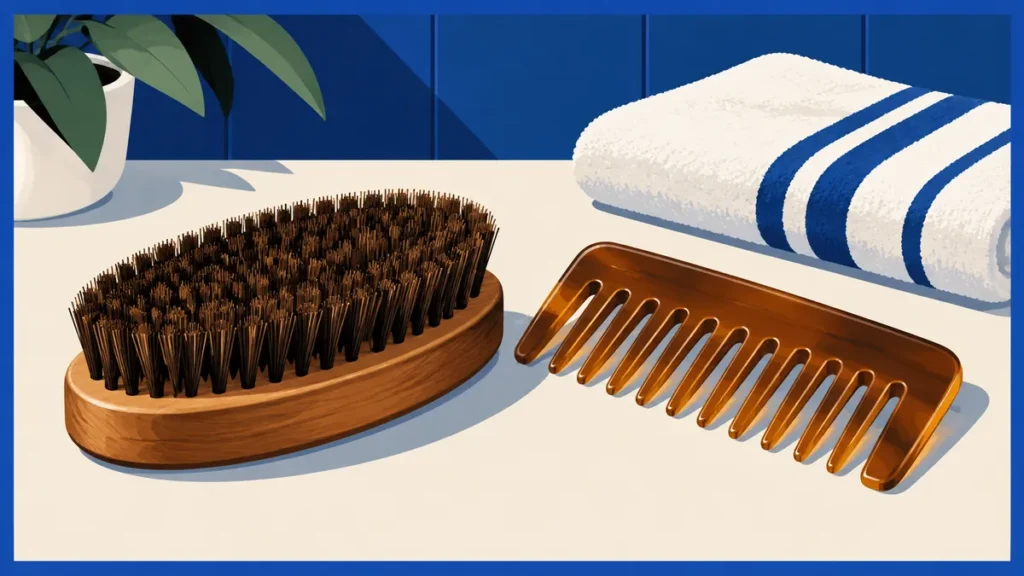
A beard brush and a beard comb can sit in the same kit without doing the same job. If the missing piece is a grooming product rather than a tool, our beard oil, balm and butter comparison covers that separate choice. Before buying either as a holiday gift, find out whether the missing tool is for an overall tidy finish, a tangle, or precise mustache work.
The quick choice
A brush: compare bristle feel, the shape in the hand and the finish it is meant to give. Beardbrand describes brushing as a way to distribute oil and groom the beard.
A comb: compare tooth spacing, size and the area it needs to reach. A small fine mustache comb is a different purchase from a wider-spaced comb for working through a fuller beard.
Buying both: makes sense when there are two jobs to do, not because every kit needs more pieces. Include the tools’ cleaning instructions in the choice.
Choose by job, not a growth calendar
Kent’s beard-tool range separates brushing from shaping and detangling. Its description gives the comb’s rounded teeth a specific role in shaping facial hair, while the brush helps distribute oils through the beard. That distinction is more useful at checkout than asking which tool is better in the abstract.
“A beard brush and a beard comb do two different jobs”
Beardbrand’s comparison also treats the comb as the more precise styling tool and discusses wider teeth for tangles in longer, thicker facial hair. Its brush advice focuses on grooming a dry beard and distributing product. These are different tasks even when one person uses both tools in the same morning.
You do not need a fixed number of weeks of beard growth to notice the difference. Look at the job in front of you: whether the tool reaches the hair you want to work through, whether its teeth are suitable for that section and whether the grip gives you useful control. A calendar cannot choose a tooth pattern for someone else.
A video companion on the changeover
Dan C Bearded’s Beard Brush to Beard Comb… When to Switch!? takes up this same buying question. The video is a companion to deciding when a different tool earns its place. The model and care details below come from the named makers’ current pages.
Credit: Dan C Bearded, Beard Brush to Beard Comb… When to Switch!?.
Tooth spacing changes the comb’s job
Kent’s A 81T is a useful example of a specific purchase: an all-fine beard and moustache comb with a listed overall length of 73mm. Kent says it is cut from cellulose acetate sheets rather than molded and describes its teeth as rounded.
That is a compact detail tool, not evidence that the same fine teeth are the answer to every dense or tangled beard. Beardbrand advises using a comb‘s wider teeth for long, thick hair that tends to knot. Match the tooth pattern to the section you need to reach instead of buying a pocket comb and expecting it to replace every grooming tool.
Small fine comb
Check: overall size, tooth spacing and whether the maker identifies it for beard or mustache work. Kent A 81T fine-tooth comb two-pack is an all-fine example, not a wide-tooth model.
Wider-spaced comb
Check: whether the spacing suits the hair you need to work through. More teeth are not automatically more useful when the job is a tangle.
Bristles and handles change the brush’s feel
Do not stop at the word beard on the box. Kent’s range includes different sizes and bristle arrangements, and GQ’s beard-brush guide distinguishes palm brushes, handled brushes and soft or firmer bristle options. Shape and feel are part of the purchase, not decorative extras.
A person who already likes a compact palm brush may not want a long handle in the travel bag. Someone who wants more reach or a different grip may prefer a handle. Check the actual model’s materials and dimensions rather than assuming that two brushes from the same range are interchangeable.
Keep preference separate from performance promises. Neither the size of the brush nor a firmer feel proves that it is the right tool for every wearer. A gift recipient’s existing brush is a useful clue about how they like to hold and use it.
Check left and right-handed models
Some details are easy to miss in a gift set. Kent identifies BRD2 as its right-handed wooden beard brush and BRD3 as the left-handed version. Both product descriptions name specially cut and shaped boar bristles and a storage bag.
“This brush is suitable for right-handed gents.”
If you are buying for a left-handed person, do not rely on the product photograph or the family name. Check the model identifier. That one letter-and-number change can matter more to the recipient than adding another bottle to the bundle.
Cleaning is part of the purchase
Kent’s aftercare page gives separate directions for its bristle brushes and handmade combs. For the relevant brushes, it says to remove loose hair, clean the bristle tips with lukewarm water and a little shampoo or mild detergent, and keep water away from the wood. It explicitly says not to submerge the brush.
“Ensure the hairbrushes are not submerged in the water.”
The same page says to let those brushes dry naturally with the bristles pointing down and to keep them off heat sources and out of direct sunlight. For handmade combs, it instead describes wiping with a cloth and using a soft toothbrush on the teeth to ease away oil or dirt, then allowing the comb to dry.
Those are Kent’s instructions for the specified tool groups. Use the care guidance for the actual tool you buy rather than soaking every wooden grooming accessory together. A brush that collects oil and styling residue needs care as part of the routine, even if its packaging makes it look like a simple gift.
Use wearer reports for fit, not a universal winner
A November 2024 r/BeardTalk discussion about tightly curled beards shows why a single winner is hard to name. The original poster said an Afro-style comb had worked better for them than other tools, while commenter u/cmcfalls2 described preferring a round brush with teeth for the way their longer beard hung. These are individual reports about different hair and routines.
The useful takeaway is the question to ask: what does the current tool fail to do? If the answer is precise mustache styling, shop for that job. If it is a tool that feels awkward in the hand, compare grip and shape. Buying a second copy of the wrong pattern does not solve either problem.
What to check before gifting a set
Check the contents by model, not just the number of pieces. Kent BRD5 brush, 81T and FOT comb set may be a good fit for someone who wants those exact tools. It is not automatically a more useful gift than the one comb or brush they are missing.
For an animal-free preference, check the actual bristle materials and the maker’s description. Do not assume a wooden handle tells you what the bristles are made from. For a travel gift, check the overall dimensions and whether a cover or bag is included.
Skip it if it duplicates the wrong tool
Skip an all-fine comb when the recipient specifically wants wider spacing. Skip a handed brush when you cannot confirm the appropriate version. Skip a bulky set if the goal is something that fits an existing small kit. Buy for the missing job rather than filling a stocking with extra pieces.
FAQ
Do I have to choose either a brush or a comb? No. They can do different jobs in the same routine.
Are all small beard combs wide-toothed? No. Kent A 81T fine-tooth comb two-pack is explicitly all-fine. Check the tooth pattern.
Can I soak a wooden beard brush? Kent’s relevant brush-care instructions say not to submerge it and to keep water away from the wood. Follow the maker’s instructions for your own tool.
Does a bigger brush do a better job? No. Kent’s own range lists different sizes and bristle arrangements, and its guidance treats size as a matter of what you need to reach. Neither a larger brush nor a firmer feel proves better performance; match the tool to the job.
Is a gift set worth it? Check the contents by model, not just the piece count. A set with a brush, a small fine comb and a bag suits someone who wants those exact tools; a single BRD2 brush covers the same brushing job on its own, and a wide-spaced comb preference still rules an all-fine set out.