As an Amazon Associate, Trusted Barber earns from qualifying purchases.
Curtains, the middle-parted, face-framing cut that defined 90s hair, are fully back. The modern version keeps length and flow on top with softer, shorter back and sides. The guidance below follows TheSalonGuy’s full middle-part curtains tutorial, with community comments at the end, labeled as anecdotes.
What a curtains haircut is
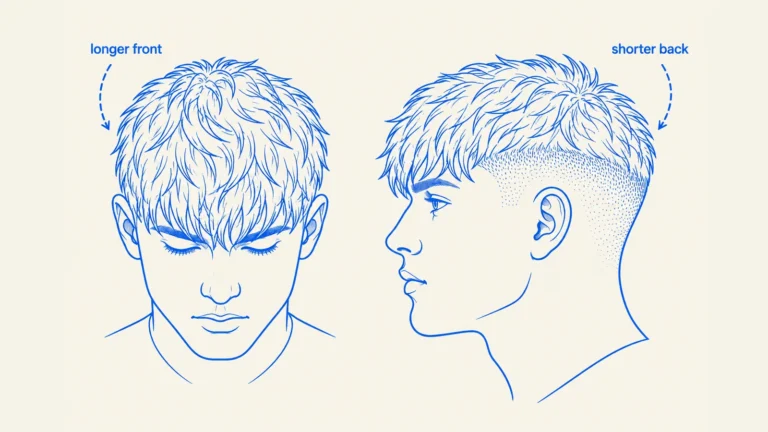
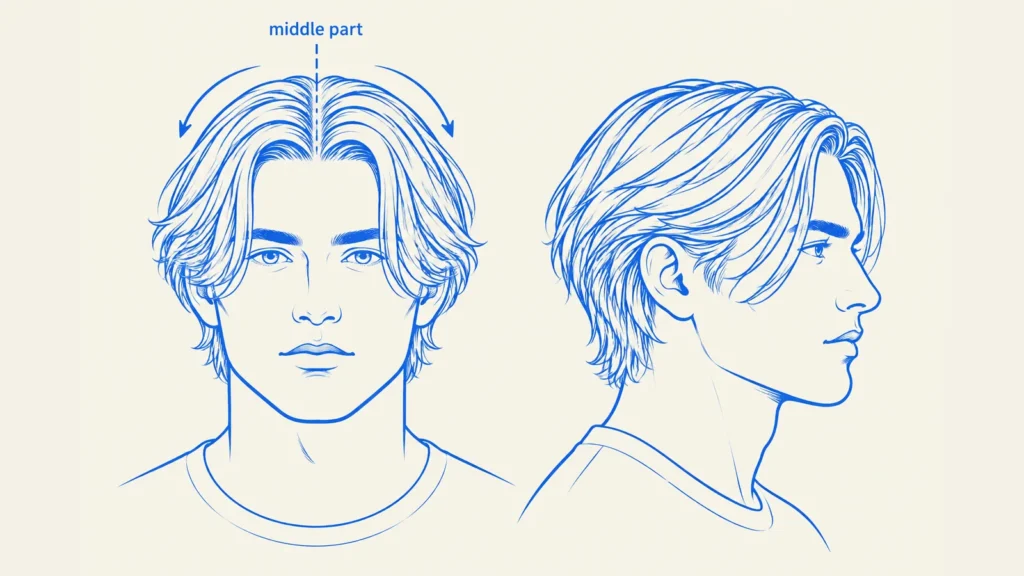
Curtains are a longer men’s cut parted down (or near) the middle so the front falls to both sides of the face, like a curtain opening. The 90s original was often one length and heavy; the 2020s version is layered and connected, with the back and sides taken shorter so the shape has flow instead of bulk. The signature is movement: the front pieces sweep back off the face and blend into the rest of the cut. In TheSalonGuy’s 43-minute middle-part curtains tutorial, the goal he sets at the start is a connected shape with flow and volume on top.
I want a connected curtains shape with a middle or near-middle part. Keep the front at the length in this photo, blend it into the sides and show me how to style the part.
A middle part describes where the hair separates, not one fixed cut. Compare the two-block haircut tutorial if your reference has a more distinct separation between the short sides and longer top.
Who it suits
Use the tutorial as a reference for the fall and connection, rather than a promise that one cut suits every face. Ask your barber to check how your own front pieces separate and how much weight the sides need before choosing the length. One practical note from the tutorial: this is a versatile cut, not a single look. The same head of hair can be pushed into a side part one day and worn as classic curtains the next, so you are not locked into the middle part.
Growing it out first
You cannot cut curtains out of short hair. The front needs real length before a barber can shape the fall. If you are coming from a short back and sides, keep the front length you need for the reference photo while arranging any tidy-up around that goal. Tell your barber the end goal at the first of those visits so they stop taking length off the top early enough.
How to ask your barber
Say “curtains” and then add the details that decide whether you get the 90s or the modern version:
- Layered and connected, not one-length. You want the front pieces to blend down into the sides with no shelf. TheSalonGuy checks that the finished front, sides and back flow together without a suddenly short corner.
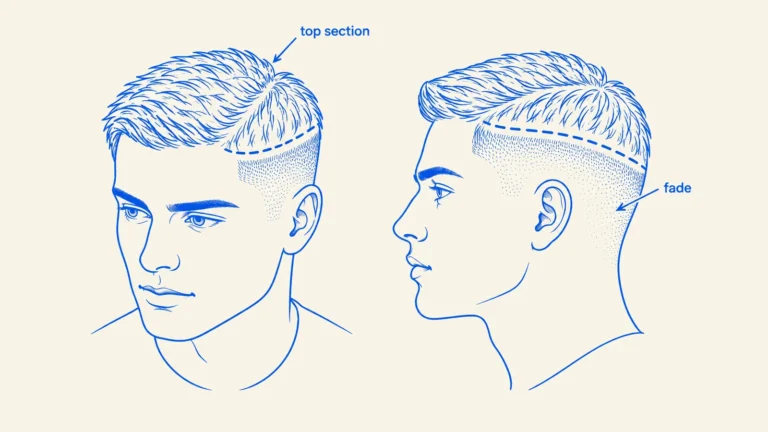
- How short the back and sides go. Anything from a soft scissor taper to a low fade works; a skin fade under curtains is a different, sharper style.
- Front length. Cheekbone, jawline, or longer: pick one and say it.
A photo settles it. If your barber has never cut curtains, that photo matters twice as much.
How a pro cuts it
TheSalonGuy starts by sectioning the hair into four panels, what he calls the map of the haircut:
Map the haircut before cutting. TheSalonGuy separates four panels so he can see the shape he is building.
TheSalonGuy, Middle Part Curtains tutorial
He sets a guide at the back, holding the hair about a finger length from the scalp, and pulls every section back to that one point so the whole back connects at the same length. Then he works palm-to-palm down the sections, keeping the cut close to the head so the layers stay soft. For texture, he skips aggressive point cutting in favor of a looser approach:
TheSalonGuy uses light freehand point cutting to remove weight and bulk rather than cutting aggressively into the shape.
TheSalonGuy, Middle Part Curtains tutorial
He adds some slide cutting through the top for movement, then reads which way the hair wants to fall before styling. The cut is designed around the hair’s natural direction, not against it.
Why this cut is harder than it looks
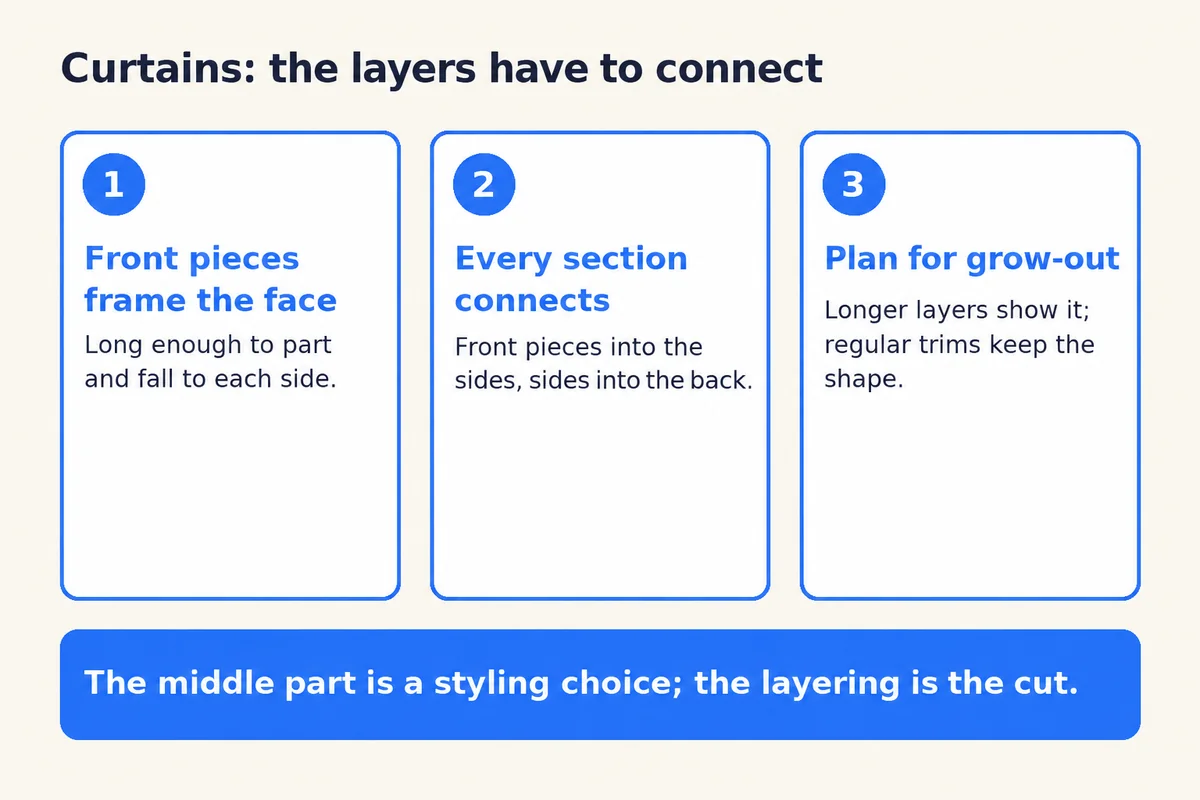
Curtains live or die on the layering. Every section has to connect, front pieces into sides and sides into back, or the fall breaks and you get the dreaded shelf. TheSalonGuy describes the connected flow as difficult to achieve, even when the finished hair falls into place. That has two practical consequences. First, this is not the cut to hand to an inexperienced barber without a photo and the specifics from the “how to ask” section. Second, maintenance matters more than with a short cut: a longer layered shape shows grow-out, so regular trims are part of owning this cut; how often is covered in the FAQ below.
Styling it
The styling is deliberately light: a few spritzes of sea salt spray for volume, then a blow-dry using his fingers rather than a brush:
TheSalonGuy blow-dries with his fingers, using his hands to direct the shape rather than a brush.
TheSalonGuy, Middle Part Curtains tutorial
Blow-dry the front back and away from the face, then rake it into the middle part with your hands. His finish rule for this cut is to let the haircut do all the work, with no more product on top. His finished demonstration uses the cut and blow-dry for the shape, rather than adding a second finishing product.
For keeping sideburns and the neckline clean while you grow the top out.
One cut, more than one style
A detail worth knowing before you commit: a well-cut curtains shape is not married to the middle part. In the tutorial, TheSalonGuy styles the same finished cut two ways: pushed into a side part first, then parted down the middle into classic curtains, because the layering supports both. He reads which way the hair wants to flow before deciding where the part should sit, and you can do the same at home: blow-dry the front back, then let it split where it naturally separates. If your hair fights a dead-center part, a slightly off-center split usually sits better and still reads as curtains.
What the community says (anecdotes)
Individual experiences, not data:
- One commenter lived the full trend cycle: “I tried this hairstyle back in 2017 and everyone called me outdated and that hairstyle looked weird……Now is a trend.” (comments, TheSalonGuy tutorial)
- Another started cutting it at home for a familiar reason: “everytime he asks for this he always ends up with something else” at the barbershop, which is why the “how to ask” section above exists. (comments, TheSalonGuy tutorial)
- One viewer describes using a zigzag hairband after blow-drying. That is a commenter’s routine, not a timed step in TheSalonGuy’s demonstration. (comments, TheSalonGuy tutorial)
From our best clippers for fades roundup, if you maintain the back and sides at home between barber visits.
Watch the credited source tutorials
Video credit: Middle Part Curtains Haircut Tutorial, TheSalonGuy.
FAQ
Does curtains work on curly hair?
Yes, and often better than on straight hair, because the curl does the framing work the cut sets up. What changes is the length: curls spring up, so the front pieces are usually left longer than a straight-haired reference photo suggests.
Are curtains the same as a middle part?
The middle part is how you style it; curtains are the cut that makes the style work: layered, connected, with enough front length to frame the face. You can also wear a curtains cut as a side part.
How long does my hair need to be?
The front pieces need enough length to part and fall to either side. How much that is depends on your hair’s texture and weight, so bring a photo of the fall you want.
Do curtains work with a receding hairline?
They can, but the parting sits exactly where recession shows most. Compare the middle-parted and side-parted finishes in the video before choosing how much hairline you want to show.
Can I combine curtains with a fade?
Yes, but know what you are asking for: a skin fade under curtains is a sharper, more high-contrast style than the soft, scissor-cut 90s version. Both are current; they just read differently, so put the choice in your reference photo rather than leaving it to chance.
How often does it need a trim?
There is no fixed rule here. A longer layered cut shows grow-out differently than a short one, and how fast that happens depends on your hair. If you keep the back and sides short, they will want a tidy sooner than the top.