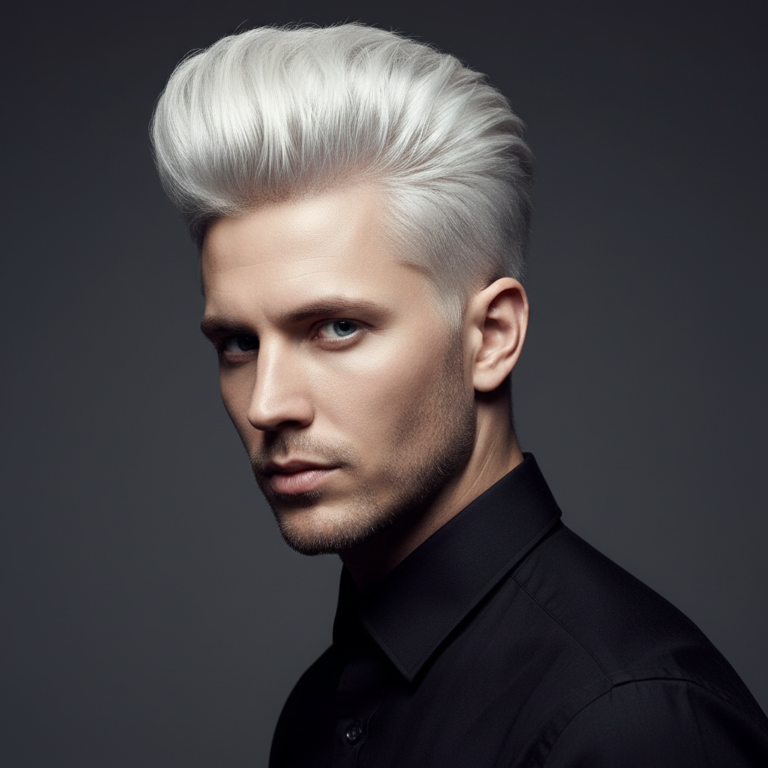

The two block haircut is the rare style that looks effortless and is actually built on strict geometry. The name says the whole concept: the hair is cut in two blocks, one block being the back and sides, the other being the top, with a visible line of intent between them. In this tutorial the barber behind the channel builds the cut from the bottom up on jet black hair, and along the way makes an observation worth taking seriously: requests for this cut are climbing while fade requests decline.
Below is his method, in the order he cuts it, with the techniques that make the two blocks read crisp instead of accidental.
Affiliate disclosure: As an Amazon Associate, TrustedBarber earns from qualifying purchases.
Start with a number three and a C-curve, not the skull
The opening move is a #3 on the clipper, and the technique that defines the whole style: he does not follow the shape of the skull. Starting at the nape, with even pressure, the clipper curves out in a C motion, away from the head, as it travels up. The guard is running higher than the point where it touches the head, which is deliberate: curving away from the skull is what leaves length as the clipper climbs.
The whole bottom block stays below the occipital bone, the bone that sticks out the most at the back of the head. That landmark matters so much to this channel’s method that it is practically a signature. Everything above that bone belongs to the top block; everything below it gets the buzz.
The occipital bone is the border of the style. Below it, buzz. Above it, build.
A squared taper at the back
At the back he builds a taper, which in his definition means the hair disappears down into nothing at the nape. It starts with a zero, lever closed, no guard, and the line he cuts is completely straight across, very square, deliberately not following the curvature of the hairline. From that hard baseline he lifts the line higher with progressively longer grades, starting with the half guard, the lever pushed down, then stepping up.
Attack the line and flick away. Every extra millimeter up with the guard costs the taper its shape.
His #1 technique is flick discipline. The clipper attacks the line only: when it touches the line, it flicks away, and that is all he cuts. Going higher with the guard causes the problems that ruin tapers. Where the nape has a whorl, hair growing sideways or almost upward, the clipper travels down with the growth instead of against it.
The number two joins it together
Next, a #2 runs on the back and sides, the last piece that joins the lower buzz into the #3 from the opening pass. This is the connective tissue of the cut: without it, the two blocks are just two haircuts on one head.
The 2 is the connective tissue. Without it the two blocks are two haircuts on one head.
Then the part he calls his favorite: framing. Straight lines worked really straight down the back and sides give the taper its beautiful, crisp finish. On hair color he offers an honest note: jet black hair stands out the most and shows the crispest definition here. The lighter the hair gets, the less definition the framing shows. That is not a reason to skip the cut, just a reason not to beat yourself up when lighter hair reads softer.
De-bulk before you refine
The top block’s back section gets de-bulked before any finish work: sections pulled out from the head at the back, a good amount taken off with each pass, but always keeping enough length for the hair to lie down all the way to the occipital bone. Roughly the same length comes off each section. Perfection does not matter at this stage; this is bulk removal, and the refinement comes next.
That refinement is scissor over comb, and his description of it is the best short version you will find: a messy method with no tension. You do not pull the hair out with your fingers; the scissors work on the hair as it sits in its natural state. He likes it precisely because you watch the hair fall as you cut, which shows how the haircut is actually progressing. Working from the top down toward the bottom, each step steps down toward the taper. The tell that you are done with a zone is hair volume: as you near the bottom, less hair comes off. When that happens, stop cutting, go back to the top, and work down again.
Scissor over comb means no tension: cut the hair as it naturally sits, and let the falling hair tell you when to stop.
The ridge that supports the sweep
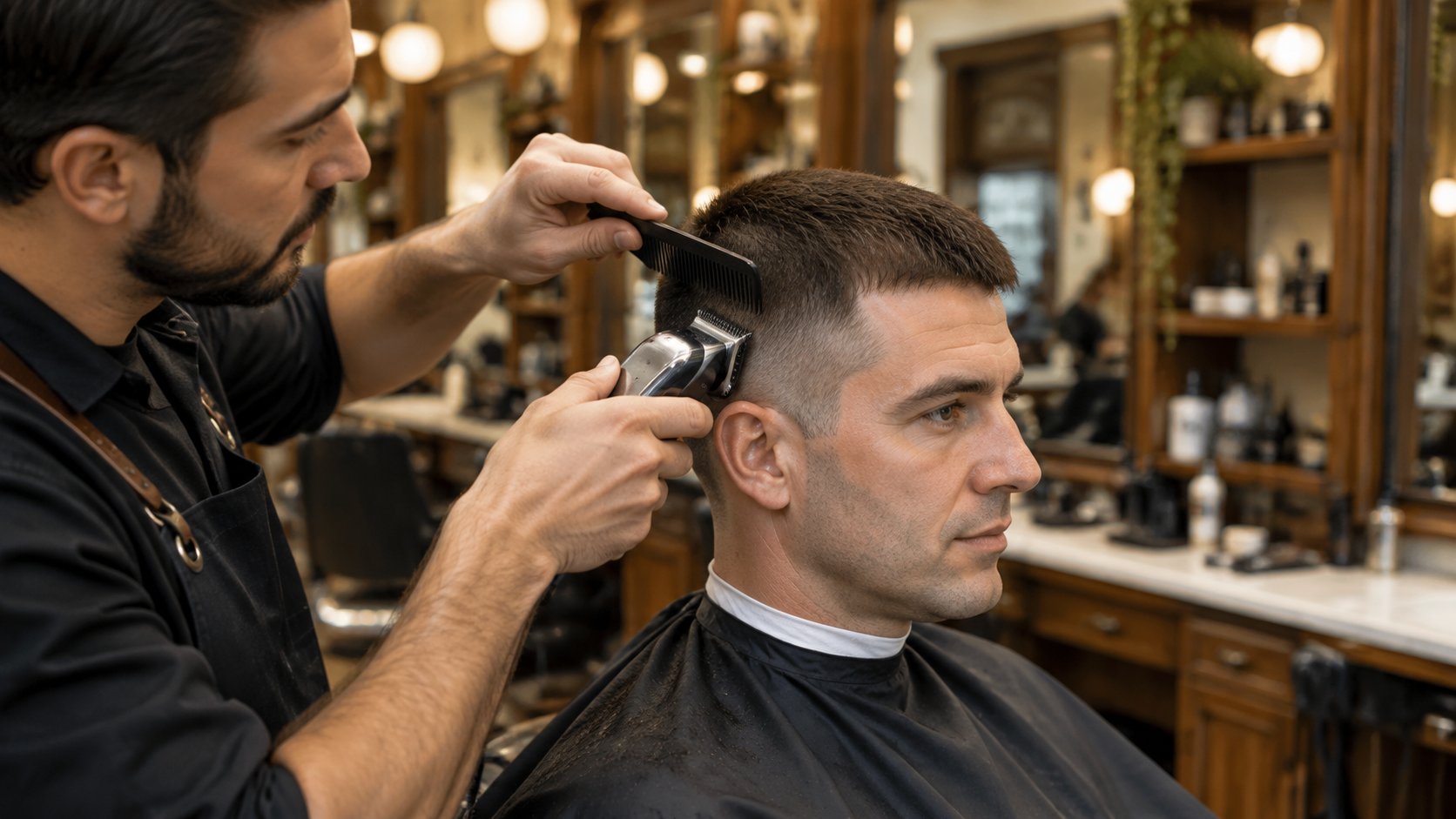
On the sides, the cut forms a ridge, and the ridge has a job: it supports the hair swept over from the top. With the #3 again and a comb guiding the height, he works toward the back, and the ridge dips down as it goes, because the whole shape has to come down into the taper at the back. The comb is the gauge; the hair should never rise above where the ridge is set.
The comb sets the ridge height and the hair stays under it. Guide first, polish later.
It looks rough at first, and he says so: that is fine, because the ridge gets tapered and neatened afterward. The guide comes first, the polish comes second.
The top block: yours to interpret
This particular two block is finished with a middle part swept to the side, getting longer toward the front. But he is explicit that the top is open territory: some two blocks pull forward more, closer to an Edgar framing, and it does not matter, because the main thing is that the hair is cut in two blocks. That is the gist. The bottom is the discipline; the top is the personality.
The bottom is the discipline; the top is the personality.
The practical consequence is that the top block is where the client’s input matters most. Middle part, side sweep, pushed forward, textured or precise, all of it works over the same engineered base. When you sit in the chair, spend your words on the top and trust the bottom to the method.
Why the two block is winning right now
The video’s most interesting comment is commercial, not technical: he is getting a lot of requests for two blocks, and a lot fewer people asking for fades. His read on the shift is that young people want to do more with their hair rather than cutting half of it off, and he frames the fade’s decade of dominance as a style having its time in the sun, the way every haircut eventually does.
A two block grows into a longer two block. A fade grows into a blur.
That tracks with the style’s structure. A fade commits you to a maintenance cycle measured in days; a two block keeps real length on top and a softer, more forgiving perimeter, which means it grows out into a longer version of itself instead of into a blur. If you are weighing it against the faded alternative, our guide to low, mid, and high fades explains exactly what you would be giving up, and our buzz cut guard numbers guide shows how far this sits from the zero side of the spectrum.
It also says something about where men’s haircut taste is heading. The two block keeps hair worth styling, and styling it is half the fun of the style. A fade, by design, removes the material that product, texture, and direction work with. If the pendulum is swinging back toward length, the two block is the cut that made the swing comfortable: short enough to look deliberate, long enough to play with.
The tools doing the work
Nothing exotic is required, which is part of the appeal. The clipper carrying the C-curve, taper, and join is a cordless workhorse you can spec with our clipper guard sizes chart in the Wahl Magic Clip class, the same do-everything machine most fading barbers run. The comb guiding the ridge is the kind of long-tooth barber comb that stays out of the way while you work; the Bardeau Professional barber comb is the standard example. And for the squared framing lines down the back, a sharp trimmer in the Wahl Cordless Detailer Li class is what keeps those lines crisp enough to photograph; the edge-holding story is the same one behind the Andis T-Outliner Cordless.
Three tools carry the whole cut: clipper, comb, trimmer.
Living with a two block
Maintenance is the quiet selling point. The perimeter softens gradually instead of collapsing, the top just gets longer, and the boundary between the blocks survives weeks of growth before it needs redrawing. The cut to book is a straightforward conversation: number three curved below the occipital bone, a squared taper at the back, a two to join, and a top cut to the length and direction you actually want. For the phrase-by-phrase version, our guide on telling your barber what you want has you covered, and if you want to see how the same two-block logic looks with more length on top, our wolf cut walkthrough is the adjacent style.
Finding the occipital bone on real heads
The whole cut hangs off one landmark, so it is worth knowing how to actually find it. Run your finger up the back of the head from the nape and you will feel a ridge that protrudes further than anything around it; that is the occipital bone, and its ridge is the border the bottom block respects. On most heads it sits noticeably low, which is why the buzzed block of a two block looks shorter than people expect when they first see the cut specified.
Heads vary. A pronounced occipital ridge gives you a natural shelf to cut to, and the C-curve reads dramatic; a flat occipital means the barber has to draw the boundary more deliberately, because nothing on the skull volunteers the line. Either way the principle holds: find the bone first, decide the boundary second, cut third.
Find the bone first, decide the boundary second, cut third. The two block is geometry before it is style.
The forward variant, and when to ask for it
He notes that other two blocks pull forward more, closer to an Edgar framing, and the distinction is worth a sentence in the chair. The swept-back or side-swept top of this build reads softer and grows out more gracefully. The forward-pulled version, hair combed down over the forehead in a blunt fringe line, reads sharper and more graphic, and it shows the two-block boundary more prominently because the eye travels straight down from fringe to buzz.
Same base, two personalities: swept reads soft, forward reads graphic.
Practical guidance: rounder or longer face shapes usually wear the forward version well, because the horizontal fringe line shortens the face, while the swept version suits people who want the length visible without a hard line across the forehead. Both use the identical base; only the top’s direction changes, which is exactly why the barber calls the top the personality of the cut.
Two block on wavy and coarse hair
The tutorial is shot on straight, jet black hair, the easiest canvas the style has, so it is fair to ask what changes on other textures. On wavy hair the top block gains movement for free, and the swept middle part works almost without styling; the trade is that the boundary reads softer, since waves break up the crisp line the framing pass creates. Ask for a slightly higher boundary point on wavy hair to keep the two blocks visibly separate.
Waves soften the boundary. Set the border a touch higher to keep the blocks visibly separate.
On coarse or thick hair, the de-bulking stage matters most. This cut depends on the top lying into its shape rather than standing off it, and coarse hair resists that until the weight comes out. The scissor-over-comb refinement is doing that job in the video, and on coarser heads it simply takes more passes. What does not change on any texture: the C-curve, the squared taper, and the flick discipline at every guard line.
FAQ
What exactly is a two block haircut?
A cut in two blocks: the back and sides buzzed short, the top left long, with a defined boundary between them, traditionally at the occipital bone. Think of it as the Korean-style cousin of the undercut with more length kept up top.
How is a two block different from an undercut?
Degree and blend. Undercuts go very short and hard-edged; the two block typically runs a 2 or 3 on the sides with a soft taper at the back, so the transition reads intentional but not skin-tight.
What guard is used for the two block sides?
In this tutorial, a 3, applied in a C-curve that lifts away from the skull, joined with a 2, and tapered at the back with zero, half, and 1 flick passes.
Does a two block work on light or thin hair?
Yes, with adjusted expectations. The barber’s note: jet black hair shows the crispest definition; lighter hair reads softer. The structure works on any color, the visual punch just varies.
How often does a two block need a trim?
Longer cycles than a fade. The top grows out gracefully and the perimeter softens slowly, so most people stretch three to five weeks between cuts.