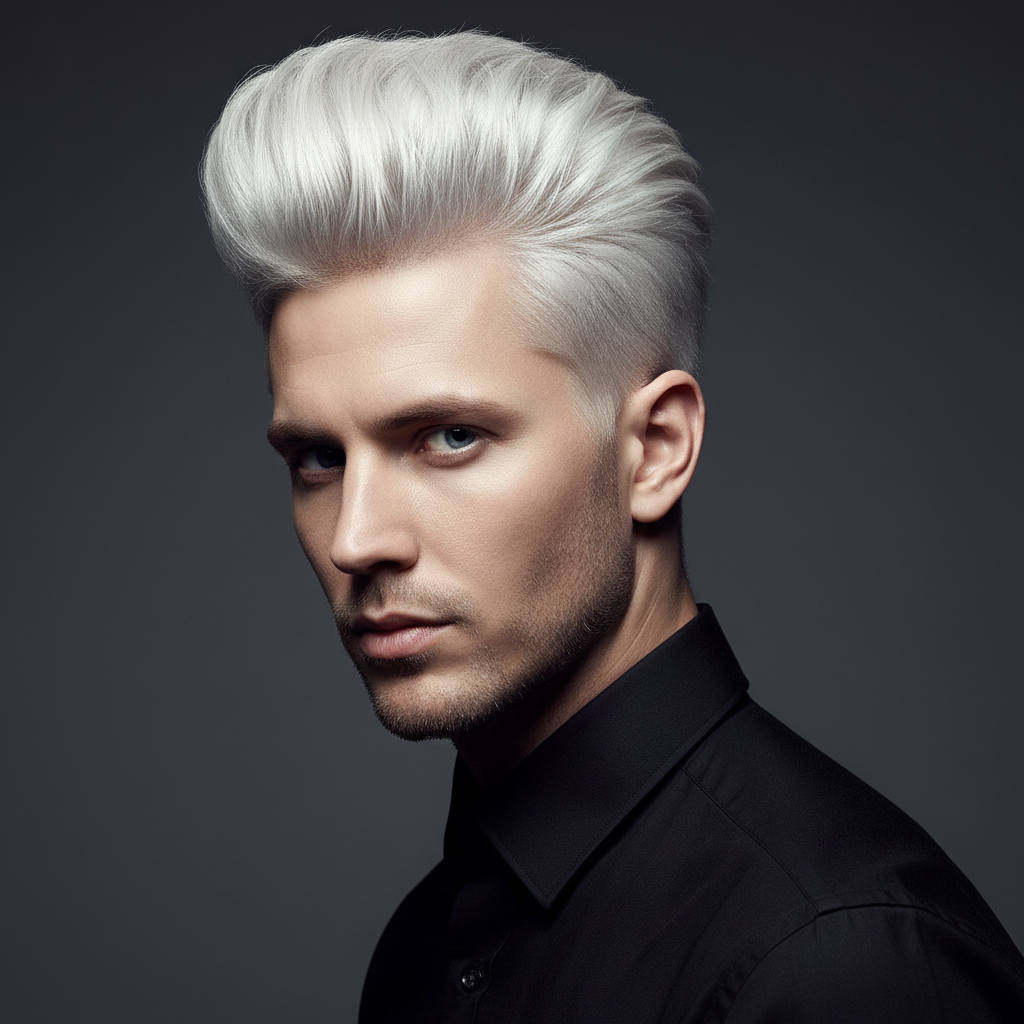
The quiff lives or dies on a proportion almost nobody talks about: the relationship between the buzzed sides and the stretched top. Get the ratio wrong and you get either a mushroom or a flat-top with pretensions. In this tutorial, TheSalonGuy builds the whole cut around one guiding idea, length that climbs from about an inch at the crown to around two and a half inches at the front, and every guard choice, scissor pass, and styling move serves that gradient.
What follows is his method laid out in the order he works it, including the color work that turns this into the platinum, stand-up-front version, and the exact numbers to recite if you are asking your own barber for it.
Affiliate disclosure: As an Amazon Associate, TrustedBarber earns from qualifying purchases.
Buzz the sides on a three and three quarters
The foundation is a #3 and three quarters blade on the sides and back. His reasoning is a balance: you do not want to go too short, because the quiff needs the sides to support it, and you do not want to leave it too long, because the contrast is what makes the top read tall. Three and three quarters splits the difference almost perfectly for this style.
He adds a translation note home cutters will appreciate: the three and three quarters is an Oster blade number, not a plastic guard number. If your clipper runs on plastic guards, start at a 4, because guard systems and blade systems do not map one to one. Guessing the conversion is how people end up two shades shorter than they asked for; our clipper guard sizes chart keeps the systems straight.
Then a refinement pass: a #3 and a half, a touch shorter, taken right around the bottom edges and the back to tighten the perimeter. The two-blade approach gives the bottom a slightly tighter read than the upper sides, which keeps the outline clean without committing to a fade.
Blade numbers and guard numbers are different languages. Three three quarters on a blade is roughly a four on a plastic guard.
Blending by hand, scissor over comb
With the buzz done, the blend into the top happens with scissors, not another guard. Working at the back, he goes scissor over comb, lifting small sections and cutting to where the buzzed edge melts into longer hair, stopping around an inch and a half at the very top back of the head. From there the same treatment moves to the sides: comb the hair down, scissor over comb upward, and work the extra length into the top and back.
Scissor over comb reads growth, not machinery. That is what keeps the buzz-to-top transition invisible.
The goal he describes is a pattern, not a line: everything blends, but the front stays deliberately longer so there is material left to shape at the end. Scissor over comb is the right tool for this because it reads natural growth rather than a machined edge, and it lets you step down gradually on hair that would show any guard line.
The top: a length ladder from back to front
Now the top gets connected, and the whole cut compresses into three numbers. At the back top, sections are cut to about an inch. Working forward, around the middle of the head he starts over-directing slightly, pulling each section back toward himself before cutting, which leaves a little more length as he moves toward the front. At the mid-top that lands around an inch and a half. The front target is about two and a half inches, the length the quiff actually stands on.
The final front pass is the signature move: comb the hair straight up, get your desired length, and cut straight across. That is what creates the blunt, even platform the front lifts from. Then the corners: comb the hair straight out from the head at each corner, find the longer hairs that stick out past the line, and cut just those. Rounding the corners slightly is what lets the front spike up cleanly instead of splitting into wings.
One inch at the back, one and a half at the middle, two and a half at the front. Cut it straight up and straight across.
Why the corners get their own pass
It is worth slowing down on the corner work, because it is the step most home attempts skip. The quiff’s silhouette is not a straight line from temple to temple; it is a lift in the middle that tapers into the corners. If you cut the whole front at one length, the corners either spike with the middle or get hacked down and kill the shape.
The corners are their own small blend. Skip them and the front spikes into wings.
His answer is to treat each corner as its own small blend: comb straight out from the head, identify only the hairs that overhang, and remove them, then round the edge slightly. Two minutes of work that decides whether the finished cut photographs as a quiff or as an accident.
The color: bleach to near white, then toner
The platinum look is a separate project from the cut, and he is refreshingly honest about the trade. To go this light, the hair has to be bleached to almost a white blonde, which realistically means leaving the bleach on for an hour to an hour and a half depending on how dark the hair starts. Stop short of that and the result is orange and yellow, which is the most common DIY bleach failure there is. His warning is blunt: bleaching this aggressively can fry and damage the hair, so care is part of the method, not an afterthought.
Near-white or orange, the clock decides. Under an hour of bleach reads yellow every time.
The rescue for warmth is toner, and his mix is pearl with violet in it. The logic is straight color theory: blue tones cancel orange, violet tones cancel yellow, and together they neutralize the leftover warmth that bleach leaves behind. That is what turns a damaged-looking yellow into the cool, near-white finish the style is going for.
The blow-dry that sets the height
With the cut and color done, the blow-dry does more work than most people expect: he blows everything straight up, root first, with no product in at that stage. Drying the hair straight up trains the root direction the quiff depends on. Do the dry lying flat or forward and no paste will fully recover the height afterward, because the root has already been set the wrong way.
Train the root straight up first. Product cannot recover a root that was dried flat.
Only after the hair is fully dry and standing does product go in, a little at a time, worked around the front to finish the shape.
The dry matte paste finish
His stated finish is a dry matte paste, and the choice is precise for this look. A quiff with height needs a product that holds the vertical without stacking shine on bleached hair, because shine plus platinum reads greasy fast, and a wet-looking product flattens the very height you spent a blow-dry building. A matte paste gives grip with none of that cost.
Matte holds the height; shine reads greasy on platinum. Pick accordingly.
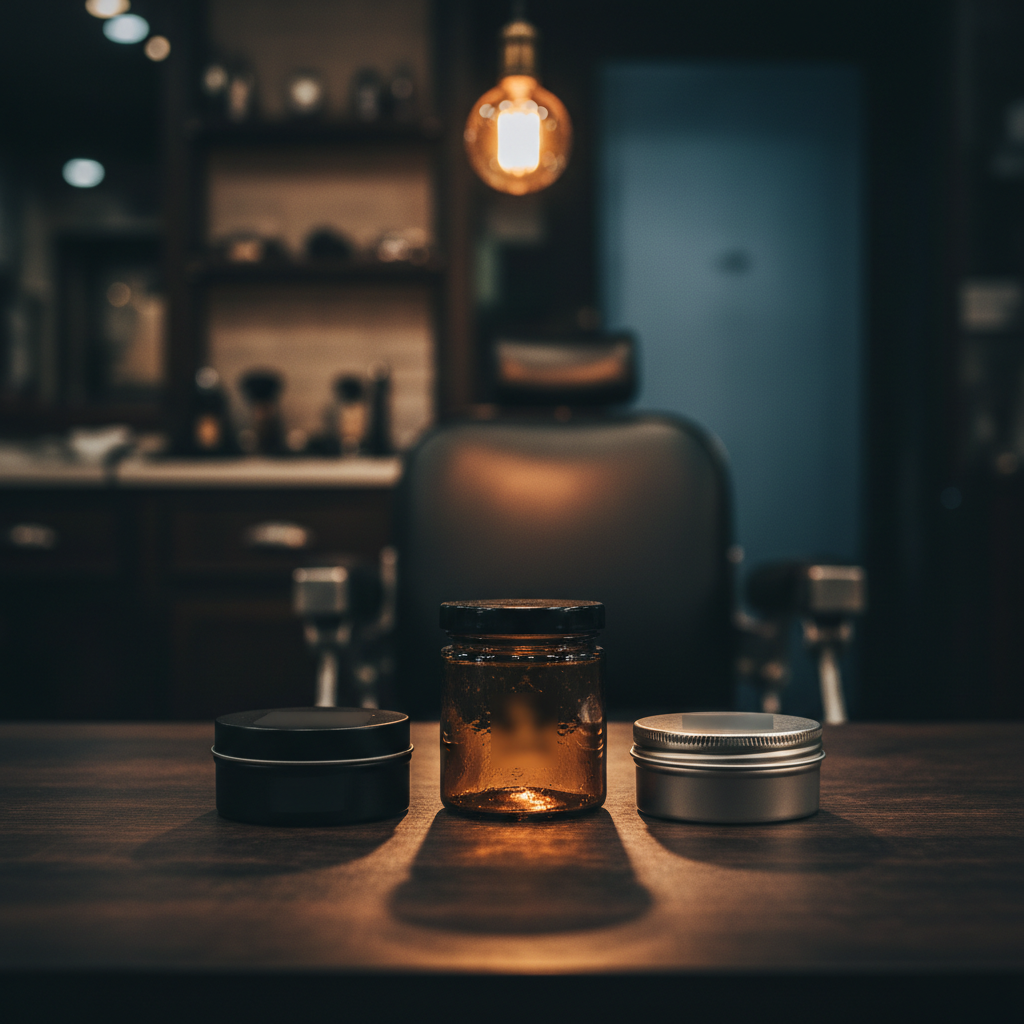
Three proven options in that family: Slick Gorilla Lightwork is the lightweight matte clay built exactly for texture without weight, Layrite Cement Matte Clay brings stronger hold for thicker hair that fights the lift, and American Crew Fiber remains the classic fiber paste that pliable, dry finish was practically named after. Any of the three will hold the shape the cut was built for.
Exactly what to ask your barber for
He closes the video with the script, and it is worth copying almost verbatim. Ask for a three and a half around the bottom edges, a three and three quarters above it on the sides and back, the blend done by hand, and the top worked in at about an inch, then an inch and a half, two inches, and about two and a half to three inches at the very front. Finished with a dry matte paste. Hand your barber that paragraph and you have handed them the whole cut. If the vocabulary itself is the hard part, our guide on how to tell your barber what you want covers the rest.
How the quiff differs from its cousins
It helps to know what you are not asking for. The pomade-and-comb pompadour keeps its height swept back and tight to the head, where the quiff stands up and forward; our classic pompadour walkthrough and our at-home pompadour guide both cover that shape. The faux hawk pushes the same front energy into a tighter ridge down the center of the head, a more aggressive read than the quiff’s relaxed volume, and our faux hawk walkthrough covers that build. And the taper that anchors this cut sits on the same spectrum as the low, mid, and high fades; a three-and-a-half bottom edge is far gentler than a true skin fade, which is part of why this version wears as classic rather than sharp.
Height forward is a quiff, swept back is a pompadour, ridge down the middle is a faux hawk.
Choosing the edge: buzz bottom or a soft taper
This build stops at a three and a half around the bottom edges, which keeps the neckline soft and the overall read classic. It is worth knowing the alternative before you commit: running the sides down into a proper taper or fade trades some of that classic softness for a sharper, more modern outline, and it buys the top more visual height by removing more of the frame. Neither is more correct. The three and a half edge grows out gracefully and needs less upkeep; the tapered edge photographs harder and starts demanding touch-ups within a week or two.
If you are undecided, ask for the softer version first. You can always take more off the next visit, and the quiff’s shape survives the experiment because its height lives in the top ladder, not in the sides.
The quiff’s height lives in the top ladder, not the sides. You can always cut closer later; you cannot glue length back.
How the quiff wears between cuts
The style’s maintenance profile is friendlier than its sharp look suggests. Because the blend is done by hand with scissors rather than machined into a skin-tight fade, there is no hard baseline to blur first. What you notice at week two or three is the front: the two and a half inches of lift softens into a tousled wave, and the corners, the part that got its own pass, start to round off into the temples. That is the signal to rebook, and it is also why the front ladder is cut slightly long: it leaves the style room to fall back into a workable shape instead of collapsing.
No hard baseline means no hard blur. The front is what tells you to rebook.
Between cuts, the blow-dry routine is the whole game. Two minutes straight up at the root keeps the silhouette for days; skipping it costs the style even with product in. Anyone maintaining a quiff at home should treat the dryer as the product and the paste as the finish.
Keeping the color cool
The bleach and toner work in the video is a snapshot, not a permanent state, and platinum wearers learn this fast: toner is a visit, not a tattoo. Every wash pulls a little cool out of the hair, and the warmth creeps back from the ends first. The practical routine is to re-tone on a cycle rather than re-bleach, since the lift is already done and only the tone has faded, and to wash less often than you think you need to. Bleached hair is also drier by nature, which is the real argument for a conditioning habit alongside the styling one; the matte paste that styles the cut is doing none of that work.
For anyone keeping the color long term, plan the budget honestly: the initial near-white lift is the cheap part, and the upkeep is what the style actually costs.
FAQ
What blade is a three and three quarters?
It is an Oster-style blade size sitting between a 3 and a 4. On clippers that use plastic guards, start with a 4 and adjust from there, since guard and blade systems are not directly equivalent.
How long should the top be for a quiff?
Think of a ladder: about an inch at the back top, an inch and a half through the middle, and two and a half to three inches at the front. The front length is what the height stands on.
Do you have to bleach hair for this look?
Only if you want the platinum version. The cut works on any color. Bleaching to near white takes an hour to an hour and a half and genuinely risks damage, and a pearl and violet toner is what cancels the orange and yellow warmth.
Why does my quiff fall flat by lunchtime?
Usually the root direction, not the product. Blow-dry the hair straight up at the root before any product goes in, then apply a dry matte paste. Product on damp, flat-trained hair cannot recover the height.
What product holds a quiff best?
A dry matte paste or clay. Matte finishes avoid the greasy read on lighter hair and hold the vertical shape without weighing it down.