As an Amazon Associate, Trusted Barber earns from qualifying purchases.
The textured fringe, longer hair pushed forward over the forehead, with the back and sides faded or tapered down, is one of the most requested men’s cuts of the last few years. The guidance below follows two barber tutorials, David Falla’s fluffy long fringe and Nevin The Barber’s blowout taper with a textured fringe, with sources linked where they are used. Community comments appear at the end, labeled as anecdotes.
What a textured fringe is
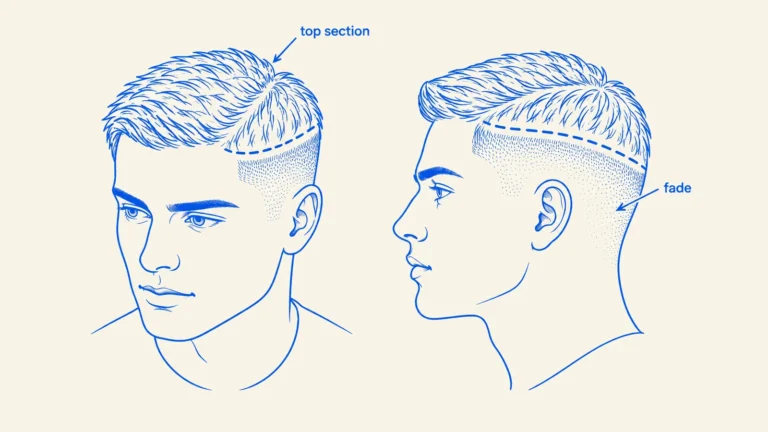
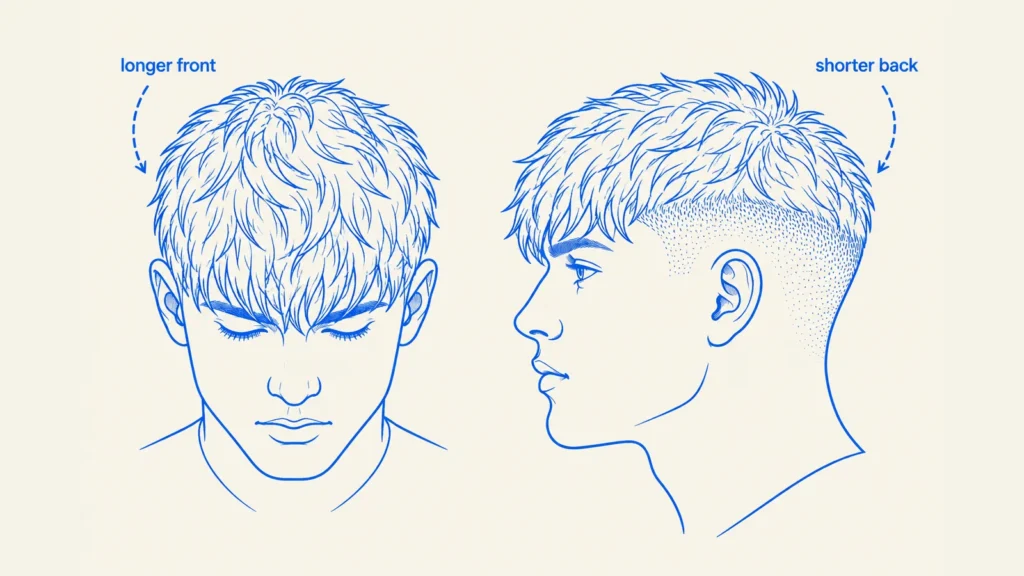
A textured fringe leaves real length on top, especially at the front hairline, and cuts it so it falls forward with visible separation instead of lying as one solid sheet. “Textured” is the working part: the barber removes weight through the top with point cutting or shear techniques so the fringe moves and sits with volume. The back and sides can go anywhere from a low taper to a skin fade. Nevin The Barber’s blowout taper tutorial pairs the fringe with a low, blurry taper, while David Falla’s fluffy long fringe tutorial keeps the sides longer for a softer look.
I want a textured fringe with a piecey finish. Keep the front at the length in this photo and show me the taper or fade height before cutting. Please check how much weight my crown needs.
Fringe, crop, or Edgar: the differences
Fringe and crop overlap: both can bring the front forward, and both can have texture. Our French crop tutorial shows a short forward shape with a point-cut finish, so blunt versus textured is not a reliable dividing line. Choose the front length, the edge you want across the forehead and the side height. Bring a reference photo instead of expecting one haircut name to settle all three.
Who it suits
Because the weight sits forward, the fringe works especially well for guys with a higher hairline or a bigger forehead, and for straight to wavy hair that can hold texture. Falla says his local clients include people asking for longer hair rather than skin-short tapers, and that those requests vary by area. Thick hair gets the most from the texturizing step, since removing bulk is what creates the fluffy finish instead of a heavy curtain over the eyebrows.
How to ask your barber
Three specifics get you the cut in the reference photo:
- Front length. Say how far the fringe should reach: eyebrows, between brow and eye, or longer. This single number defines the cut.
- Taper or fade, and how high. A low taper keeps the blend beneath the occipital bone at the back; anything higher reads as a fade. In Nevin’s demonstration, keeping the back blend below the occipital bone is what separates his low taper from a higher fade.
- Texture level. Ask for the top point cut or thinned for texture, and say if you want to keep weight at the crown. Nevin preserves most of his client’s crown length while texturizing the front.
Bring a photo. Falla tells barbers not to copy a demonstration blindly; the approach should fit the client in the chair. Use the photo as a starting point and adjust for your hair.
How barbers cut it
Falla starts by separating the top from the sides and reading the growth pattern first, so he knows which direction everything falls. He sets a short lower layer as a foundation, then cuts a profile section down the middle, shorter at the back and longer toward the front, because that weight distribution is what creates volume. Get it backwards and the style collapses:
Falla warns that leaving the back too long and the front too short works against the fluffy volume he is building.
David Falla, Fluffy Long Textured Fringe tutorial
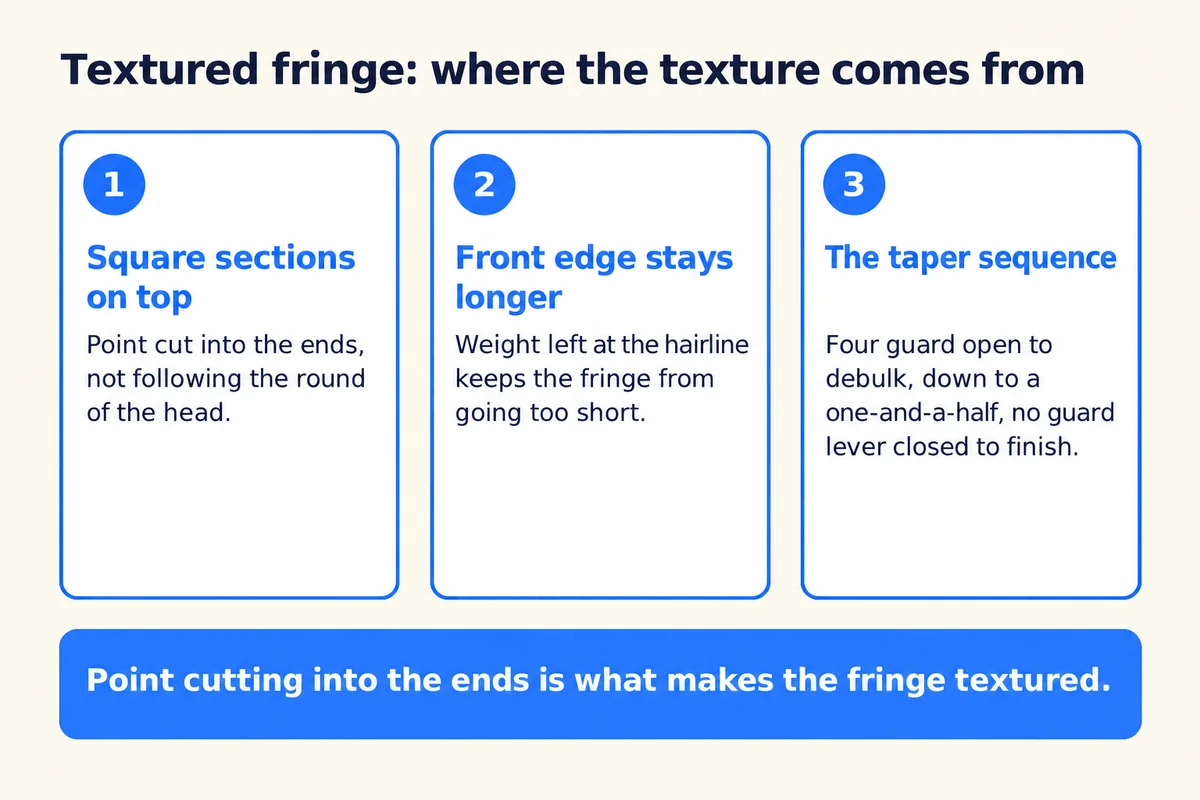
Nevin builds the taper on a set foundation: he debulks the parietal ridge with a number four guard all the way open and sets a trimmer guideline, so the fade has a foundation for the blend. From there he works down to a one-and-a-half guard and erases the last guide with no guard and the lever fully closed. His summary of where the fade actually lives:
Nevin separates the skin-to-one-and-a-half fade from the work above it, where he connects into the bulk and crown.
Nevin The Barber, Textured Fringe Haircut tutorial
For the texture itself, Nevin uses a shear technique called slithering on the fringe, with the shears going in at a 45-degree angle:
Nevin uses slithering to thin bulky fringe sections and give this client’s front more visible texture.
Nevin The Barber, Textured Fringe Haircut tutorial
Falla point cuts his sections to a square shape instead of following the round of the head, which keeps the front from going too short.
Styling it
Both barbers blow-dry the fringe into place before calling the cut finished, not just for looks. Falla checks the hair dry so he can judge how the finished shape actually sits, rather than sending the client out with that still hidden by wet hair. He works a small amount of clay through first, then uses a round brush to lift the front. At home, that is the whole routine: towel dry, a fingertip of clay or matte paste, blow-dry forward or up with your fingers, done. Use the dry finish as the check: Falla lifts his client’s front with a round brush rather than assuming the cut will style itself.
The pro clipper from our best clippers for fades roundup, if you clean up your own sides between visits.
Keeping it sharp
Between full cuts, the fringe itself needs the least work. The tidy-up is around the edges. Nevin finishes his taper by cleaning the C-cups and neckline with trimmers over a comb, and his rule there is to stay right at the natural hairline so everything grows back in evenly. Falla does the same with a natural, unsharpened line on his client. If you touch up your own neckline at home, follow that same rule: chase only the stray hairs below the natural line, and leave the line itself alone. The other quick win is the front: Nevin’s last pass on the fringe removes only the dead flyaways, keeping the length the client asked for while making the shape read clean.
What the community says (anecdotes)
Individual experiences, not data:
- A beginner barber under Nevin’s tutorial said what a lot of people feel watching these: “Im a new barber looking for simple templates for my clients..” The guideline system in that video is exactly that. (comments, Nevin tutorial)
- Another viewer asked for more on the lever work: “It would be nice to see how you open and close your guards to give the audience a better understanding.” That is the part of fading that confuses people most. (comments, Nevin tutorial)
- Under Falla’s video, one commenter noted “That slicing technique works great” and said they had seen it used on side-swept bangs, the same shear logic. (comments, Falla tutorial)
For keeping the neckline and sideburns tidy between cuts.
Watch the credited source tutorials
Video credit: Textured Fringe Haircut: Barber Tutorial, Nevin The Barber.
Video credit: Fluffy Long Textured Fringe Taper Fade Tutorial, David Falla.
FAQ
Can a textured fringe grow out badly?
It grows out softer than it starts, which is the honest trade: the pieces lose their separation first, then the fringe starts sitting heavy. A quick tidy of just the fringe between full cuts keeps it reading right.
What product works best on a textured fringe?
Whatever your barber finishes the cut with is the honest answer, because the texture is cut in, not styled in. A matte paste or clay brings the separation out; heavy gloss products glue the pieces together and undo the point cutting.
Is a textured fringe the same as a French crop?
The names overlap, and texture alone does not separate them. Compare the front length, forehead edge and side height in your reference photo. Our French crop tutorial also uses point cutting, so a textured finish does not automatically make a cut something else.
How long does my hair need to be?
The front needs real length to work with. If you are growing it out, ask for the back and sides tidied only, and leave the top alone until it gets there.
Does it work on thin hair?
It can, with lighter texturizing. Removing too much bulk from fine hair makes the fringe see-through, so ask your barber to go easy on the thinning and keep the point cutting shallow.
How often does it need a trim?
The taper or fade wants cleaning up as soon as the grow-out shows; the fringe itself can go longer before the texture grows out and it starts sitting heavy.