As an Amazon Associate, TrustedBarber earns from qualifying purchases.

A patchy mustache is a season-one problem, which is exactly why Movember turns so many first-time growers into skeptics by week two. The gaps you see at day 10 are usually not a verdict on your face. They are a mix of uneven growth speed, hairs that need length before they lie in the same direction, and styling choices that pull attention to the thin zones instead of framing them. This guide covers what a patchy mustache actually looks like under the skin, the four-week plan that gets most growers through the awkward stretch, and the small kit that helps, starting with a comb made for the job like the Kent 81T fine mustache comb.
Quick answer
Through week 3: stop shaving the corners, comb daily, and keep the lip line clean with Tweezerman mustache scissors and comb.
Week 3 onward: a medium-hold wax like Can You Handlebar Primary moustache wax directs longer hairs over thin zones.
Daily: a few drops of Honest Amish beard oil keeps short hairs soft so they lie flat instead of standing apart.
Tweezerman mustache scissors and comb on AmazonCan You Handlebar Primary moustache wax on AmazonHonest Amish beard oil on Amazon
In this guide
What patchy actually means
There are two kinds of patchy, and only one of them fixes itself. The first is timing: hair follicles wake up at different speeds, so the corners and the gap under the nose fill in weeks behind the center. Given length, most of these zones close on their own. The second is density: some men genuinely have fewer follicles in a spot, and no amount of combing changes the count. Even then, the visual fix is the same, because mustache styling is about direction and coverage, not raw thickness.
The fastest way to tell which kind you have is to stop shaving for a full month and look at week 4, not week 2. If the thin zone has filled in or the hairs there are clearly longer, it was timing. If a bald patch of skin still shows through at week 4, it is density, and the answer is to style around it. A firm diagnosis saves you from trimming a growing mustache out of impatience, which is the number one way men restart their own progress. Our patchy beard guide covers the beard-side version of this problem, and the principles are the same.
The four-week plan
| Week | Focus | What to do |
|---|---|---|
| Week 1 | Leave it alone | No trims at all; wash and oil the skin under the hair |
| Week 2 | Lip line only | Clip the hairs crossing onto the lip with scissors, nothing else |
| Week 3 | Direction | Comb outward and down from the center every day; start light wax |
| Week 4 | Shape | Define corners and lip line, judge the gaps, style over them |
The scissors discipline in week 2 matters more than it sounds. A mustache that crosses the lip is annoying, and the fix is small: brush the hair down over the lip, snip only what clearly hangs past the line, and leave the length above it. Vertical growth into thin zones comes from length, and every early trim of the top growth resets the clock. Scissors beat trimmers here because they let you take one or two hairs at a time; a trimmer guard on a 2-week-old mustache takes whole zones off.
Styling that covers the gaps
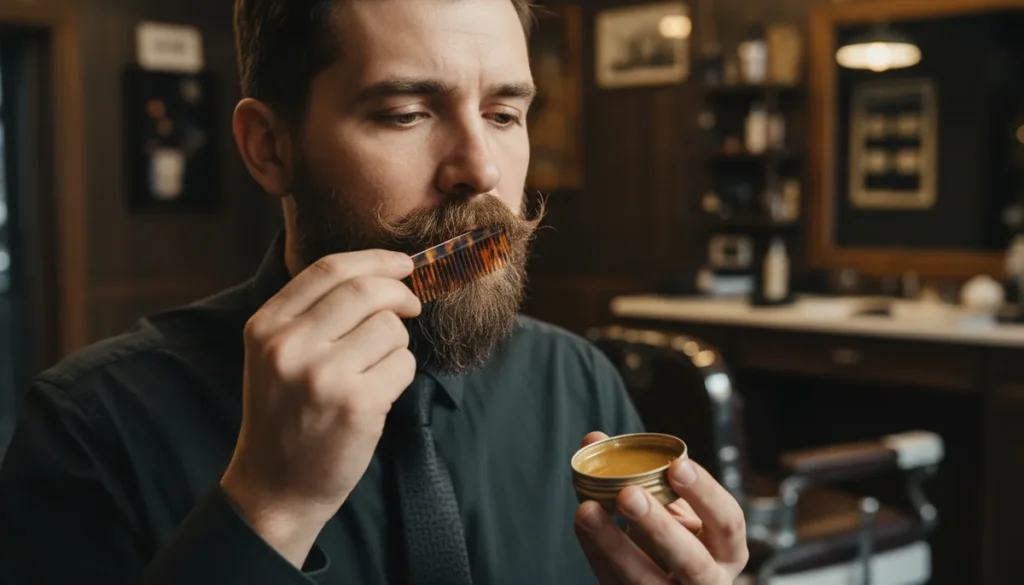
Mustache styling is direction first. Combing from the center of the philtrum outward and downward spreads the longer central hairs toward the corners, which are the thinnest zone in most men. This is why a mustache that looks thin at day 14 can look presentable at day 21 with nothing but a comb: the same hairs, aimed better. A fine-tooth comb like the Kent 81T grips short hairs well; wider combs slide past 2-week-old growth. Comb after applying oil on damp skin, then again dry before you head out.
The second trick is the Chevron effect: as the mustache grows past the lip line, the mass of hair itself fills the visual gaps. Length is the cheapest density there is. This is why Movember, with its no-trim rule for the first weeks, is genuinely good advice for patchy growers even beyond the charity point. Our first Movember guide covers the month as a whole, including the itch phase.
Wax: when and how
Wax earns its place around week 3, when hairs are long enough to be aimed but too springy to stay where you comb them. A medium-hold, daily-wear wax is the right tool: the Can You Handlebar Primary is built for exactly this job, around the budget mark, and it rubs in clear so it does not read as product on short hair. For corners that need real support, a strong hold like Can You Handlebar Secondary or the Fisticuds Strong Hold moustache wax pins the ends of a handlebar or locks the corners down; both run about budget money. Our mustache wax hold and finish guide compares the finishes in detail.
Application is small and specific: warm a pea-sized amount between fingertips until it turns clear, work it from the center outward, then comb through to distribute before shaping. Wax on uncombed hair locks the mess in place, which is the classic beginner result. If you want a scented everyday option, Beardbrand Mustache Wax at about budget money sits between the two holds and works for both mustache and light beard edge control.
The small kit that helps
Three tools carry a patchy mustache through its first month. Scissors first: the Tweezerman Moustache Scissors and Comb pairs tiny precision shears with a mini comb, usually budget pricing, and the comb-side snip method keeps the lip line straight without guards. The comb itself: Kent 81T for daily training, or the folding ZEUS pocket mustache comb if you comb on the go, around budget each. And oil: short mustache hairs stand apart when they are dry and coarse, so 2 to 3 drops of Honest Amish Classic or the unscented Viking Revolution beard oil every evening keeps the hair lying in one direction, roughly budget money a bottle.
One more tool earns a mention for the cleanup edges only: a detailer like the Andis Slimline Pro II shaves the stray hairs on the cheeks below the mustache line and sharpens the corners without touching the growth you are protecting. Keep it away from the lip line itself; that zone gets scissors only. It usually runs at pro-to-premium-tier pricing, which is a big spend for a mustache, so this is a buy if you already keep one for beard work.
The skin under the mustache
Half of what reads as patchiness in the first month is actually skin showing through sparse, dry hair, and the skin part is fixable this week. The skin above the lip gets shaved for years, then suddenly has to carry a forest, and it reacts by flaking and tightening. Wash the area with a gentle cleanser rather than bar soap, which strips the barrier, and skip strong anti-dandruff actives on the mustache zone itself unless you actually have flaking there. A few drops of beard oil worked down to the skin twice a day, morning and night, does more for the look of a 2-week mustache than any product marketed at growth.
If the skin under the mustache gets oily by afternoon, flip the routine: wash in the morning, and use a light, unscented hydrator like Scotch Porter Hydrating Hair and Beard Spray, around the budget mark, as the midday touch. Dry-but-flaky and oily-but-flaky need different handling, and getting it wrong is why some growers give up on oil entirely. The goal is simple: skin comfortable enough that the hairs stand where you comb them instead of springing apart over irritated skin.
FAQ
Can a patchy mustache fill in? Timing-based patches usually fill by weeks 4 to 8; true density gaps do not. Style covers the difference in both cases, which is why the four-week plan above works before you conclude anything.
Should I trim a patchy mustache? Only the lip line in the first month. Trimming the top or the corners resets the growth you are waiting on and keeps the mustache short enough to show every gap.
Does oil or wax fix a patchy mustache? Neither grows hair. Oil makes short hairs lie flat and look denser, and wax aims longer hairs over the thin zones. Both are styling, not treatment.
How do I handle the itch in week 2? Oil under the mustache, wash the area daily, and resist the scratch. The itch peaks in days 8 to 14 and fades as the hairs gain weight. Our new-beard itch guide has the routine.
What if it is still patchy at week 8? You have your answer on density. Choose a style that fits the growth you have, such as a shorter chevron or a light natural look, and use wax and comb direction to carry it. A barber can map the corners for you in one visit.
Should I use beard oil under the mustache? Yes, 2 to 3 drops worked down to the skin, morning and night in the first month. It keeps the short hairs lying flat, which is most of the visual game early on.
Verdict
Give a patchy mustache four honest weeks before you judge it: no trimming past the lip line, daily combing from the center outward, oil on damp skin, and a medium-hold wax like the Can You Handlebar Primary from week 3. Most of what reads as patchy at day 12 is a growth-timing problem that styling solves. The rest is shape, and shape is a decision, not a deficiency.