As an Amazon Associate, TrustedBarber earns from qualifying purchases.
Every November, men around the world shave clean on the first of the month and spend the next thirty days meeting their own upper lip for the first time. A Kent 81T pocket comb and a tin of wax are about all the month requires. Movember turns moustache growing into a month-long conversation about men’s health, and whether you are growing for the cause, growing for a dare, or growing because November finally gave you an excuse, the experience is the same: two itchy weeks, one awkward photo, and a crash course in how little grooming advice actually covers the moustache. This guide walks a first-time grower through the whole month, from the morning after the clean shave to the last day, with the small routines that make the difference between a moustache and a mistake.
Quick answer
Grow for two weeks before touching a trimmer, wash and condition the moustache like the rest of the beard from day one, comb it daily to train the hairs away from the lip, and start waxing around week two when the hairs get long enough to poke your mouth. Most first-time moustaches fail from trimming too early, not from growing too little. A tin of Fisticuffs strong-hold moustache wax and a pocket comb are the only purchases the month truly requires.
Top picks for first-time growers
Check Price on Fisticuffs Strong Hold Mustache Wax
In this guide
Weeks one and two: what actually happens
Day one feels great. Day three starts to itch. Day seven is the day most first moustaches die, because the stubble on the upper lip is just long enough to drag across the lip with every word and just short enough to do nothing about it. That scratchy stage is a normal part of growing out stubble, and it usually eases as the hairs get longer and softer, so do not give up and shave it off. Wash the area with warm water and a gentle cleanser in the morning, pat it dry, and work a few drops of beard oil into the skin beneath the stubble. Our guide on how to end new beard itch covers the routine in more depth, and the same habits apply one inch higher. If irritation persists, talk to a doctor or dermatologist.
The second thing that happens in week one is the patch check. You will stare at the mirror deciding whether the moustache is coming in full or coming in sparse, and the honest answer is that nobody can tell at day seven. Density reads very differently at 2 millimeters than it does at 8, and the sparse-looking gap at the corner of the lip frequently fills in by week three. This is the strongest argument for the no-trim rule that follows: the moustache you judge at two weeks is not the moustache you will have at four. When the beard underneath needs care during this stretch, our guide to starting a beard routine explains the order products enter.
One practical note for week one that most Movember guides skip: eat carefully and carry a napkin. Until the hairs clear the lip line, everything you drink ends up in the moustache, and a damp moustache smells like coffee by ten in the morning. Rinse it after lunch the way you would rinse your hands. It is a small indignity with an end date, and it is part of the package the cause is asking you to grow.
Pick a style your growth can back
Moustache styles are promises about hair direction, and the hair you grew this month gets a vote. There are four honest categories for a first moustache. The natural moustache lets the hairs grow and hangs over the lip line, needing nothing but patience and a comb; it flatters medium growth and forgives patchiness at the corners. The chevron, the Tom Selleck silhouette, keeps a full width across the lip and trims only the bottom edge; it needs decent density and reads best on larger faces. The handlebar grows the corners long and curls them up with wax, which is the classic Movember flex but takes a month of length plus a wax routine to reach; our handlebar training guide covers that path for when this month ends and you decide to keep going. The pencil line, a thin strip above the lip, needs steady hands and steady growth, and it is unforgiving of both patchiness and wobble.
The honest advice for a first Movember is to start natural and let the month decide. Around day fourteen, look at the corners: if the hairs reach the corner of the mouth with room to spare, a chevron is on the table. If they are already curling away from the face on their own, the handlebar is asking to happen. If the center is lush and the corners are shy, a natural style with a clean lip line will look intentional, while a forced chevron will look unfinished. Choosing the style at day fourteen rather than day one keeps the month’s options open, which is the whole trick of a first moustache.
The daily routine that keeps it presentable
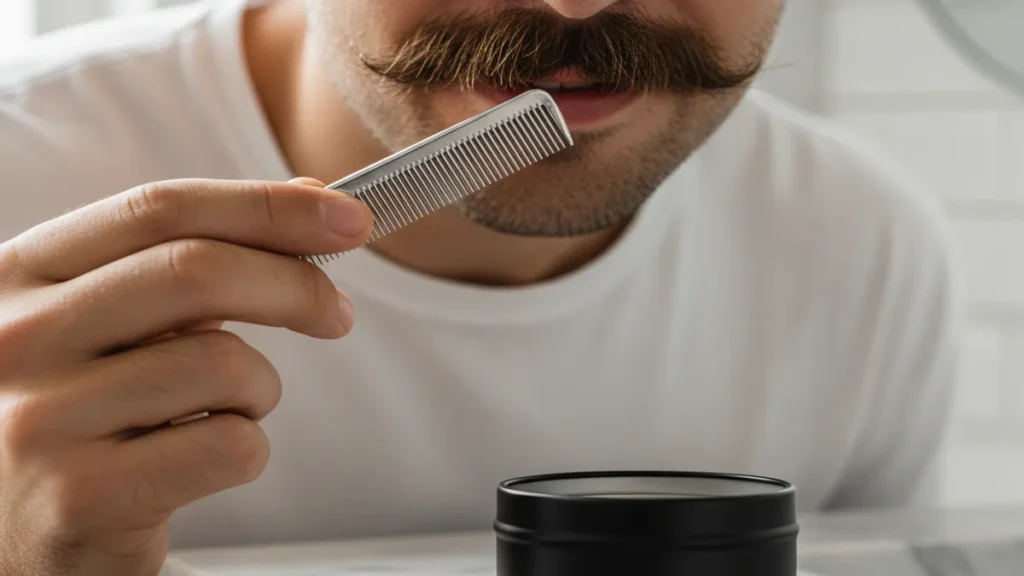
A first moustache needs three minutes a day, and the order matters more than the products. Start with the rinse: warm water in the morning, or a dab of gentle face wash if the morning coffee already claimed it. Pat dry. Then comb, and this is the step that does the real work. Comb the moustache outward and slightly down from the center of the philtrum toward the corners, every day, from the first week. A Kent 81T pocket comb is the standard tool for exactly this: small, fine-toothed, and shaped for the upper lip, at around $8–12. Daily combing trains the hairs to lie where the eventual style needs them, and it keeps the lip line clear of the hairs that would otherwise curl into your mouth mid-meeting.
Then oil, if the skin under the stubble is dry or itchy, and this is where a first-timer usually over-buys. An Honest Amish beard oil at around $10–14 handles the skin-under-stubble problem for the whole month, and an unscented option like the Viking Revolution unscented beard oil at around $9–19 suits office days when a cedar-forest three inches from a coworker’s face is a lot before 9 a.m. Two or three drops, worked down to the skin, not left sitting on the hairs. The difference between oil, balm, and butter, and which of them a short moustache actually needs, is laid out in our beard product comparison; for a first moustache, oil is the honest answer and wax arrives on schedule in week two.
Wax: when to start and how to use it
Wax has one job: hold the hairs where you put them. It does not grow hair, thicken hair, or cure patchiness, and any tin implying otherwise is selling the tin. What wax does do is solve the two problems that arrive together around day twelve to fourteen: the hairs that have grown long enough to reach the mouth, and the hairs at the corners that have started drifting sideways or downward in the wrong direction.
The technique is small and repeatable. Scrape a matchhead-sized amount of wax with a fingernail, rub it between thumb and forefinger until it turns from paste to clear, then work it through the moustache from the center outward, combing after each application. The Fisticuffs Grave Before Shave strong-hold moustache wax at around $8–14 is the usual recommendation for training stubborn hairs, because strong hold is what pulls drifting corners back in line. If you want a softer, more natural finish for daytime, the Honest Amish Original Beard Wax at around $10–16 behaves more like a styling balm than a lacquer, which suits a natural moustache better than a competition hold.
Start light. A first-time waxer’s most common error is using triple the amount the moustache needs, which leaves a stiff, shiny strip above the lip that photographs exactly as stiff and shiny as it looks. One matchhead holds a two-week moustache in place. If it does not, the problem is direction, and the fix is another pass of the comb, not another scoop of wax. Our moustache wax guide goes deeper on hold levels and finish once the growth gets serious.
Trimming decisions as the month goes on
The first trim decision comes around week three, and it should be small: the lip line, and nothing else. Hairs that sit on the lip itself, past where the skin meets the lip’s wet line, are the ones that make eating uncomfortable and make the moustache read as unkempt rather than grown. Comb the moustache down over the lip, then use a small scissors set like the PAFASON facial hair scissors at around $8–12, which includes straight and curved blades with rounded tips, to snip only the hairs crossing the wet line. Scissors, not a trimmer, for a moustache this young: a trimmer guard removes length in a straight block, which is how a first moustache loses its shape, while scissors let you take individual strays. Our full moustache trimming guide covers the two-trim method in detail.
Hold off on length trims until the month is nearly done. Every millimeter you cut in week three is length you will not get back by December 1, and the natural taper at the corners of a moustache, the part that makes it look styled rather than accidental, only exists because the hairs there are longer. If the moustache reaches the corners of the mouth and starts to merge with anything on the cheeks, that is a neckline decision, and a single careful line with the scissors along the natural corner keeps the moustache from migrating onto the face.
The last decision of the month is the keep-or-shave call, and it is worth deciding deliberately rather than at midnight on November 30. If the moustache earned a permanent spot, the transition to December is a matter of maintaining the lip line and starting a real comb-and-wax routine. If it did not, shave it before the office sees it at its worst, take the photo, log the donation, and let the month mean what it meant. Either choice ends the month properly; drifting into December with an unmaintained moustache is the only wrong answer.
FAQ
Should I shave the whole beard off for Movember?
Movember’s rules put the moustache front and center, and a clean-shaven face is what makes the moustache read as a statement rather than an accident. Some participants keep their beard and grow only the moustache region; that is a personal call. What matters for the first-timer is that whatever face you start with, you keep it consistent for the month, because a moustache growing out of a freshly trimmed beard reads differently than one growing alone.
My moustache is patchy at the corners. Do I quit?
Not at two weeks. Corner density is the last thing to fill in, and most first-time growers overestimate the problem because they are judging stubble against a finished moustache. Give it to day twenty-one. If the corners are still sparse, a natural style with a slightly shorter length at the weak corners reads as intentional, and wax pulls the neighboring hairs into the gap.
Can I use beard balm instead of moustache wax?
For a light hold on a short moustache, yes, and a soft wax like Honest Amish Original Beard Wax splits the difference. But balm is built for conditioning with light structure, and a moustache that needs to hold a direction all day, or curl at the corners, needs an actual wax. Start with balm if you already own it; upgrade to strong-hold wax when the hairs start winning.
How do I stop the moustache from getting into my mouth?
Combing down and outward from the philtrum every morning, plus a light wax coat once the hairs are long enough, redirects the growth pattern within a week or two. Hairs that persistently cross the wet lip line get one careful scissor snip at the line. Beyond that, the style choice matters: a chevron sits naturally above the lip, while a natural moustache that hangs over it will always need more daily attention.
Is Movember just about the moustache, or should I donate too?
The moustache is the conversation starter; the cause is the point. The Movember Foundation funds men’s health projects covering prostate cancer, testicular cancer, and mental health and suicide prevention. Registering your moustache on the Movember site ties the growth to fundraising, and plenty of growers find that a small donation from their own pocket, plus the moustache doing its talking, is the honest way to do the month.
The verdict
A first Movember moustache is less about grooming skill than about restraint: two weeks of no trimming, three minutes of daily combing, oil for the skin underneath, and wax arriving on schedule at week two. The Kent 81T and a tin of Fisticuffs strong hold together cost about twenty dollars, which is the entire hardware budget of the month, and the scissors can wait until week three. Grow it for the cause, judge it at day twenty-one rather than day seven, and if it survives the month, the handlebar guide is waiting for December.