TrustedBarber is reader-supported. If you buy through links on this page, we may earn a commission from Amazon at no extra cost to you.
Nobody on YouTube has taught more people to wave than 360Jeezy, and his after-shower method video is exactly what it sounds like: the routine he runs on a normal day, from the towel to the shower to the products to the durag. Here is the method, in his order.
Step 1: the hot towel
Before anything touches product, the routine starts with a hot towel. He microwaves a towel until it is steaming, puts it on his head so it covers everything, and lets it sit until it stops steaming. That heat and moisture softens the hair and opens the routine up, the same prep logic a barber uses before a shave.
It is a small step to skip, but skipping it means working product into stiff, dry hair. The steam is what makes the rest of the routine glide.
Step 2: the shower routine
In the shower, the detail that matters is how the products go in: brushed, not just rubbed. He puts his shampoo in and brushes it through with a shower comb, rinses it out, then puts his conditioner in and brushes that through the same way before rinsing. Working everything through with the comb means the product reaches every strand in the direction you are training the hair, which is the whole point of the wash for a waver. He credits that brushed-in conditioner step for leaving the hair silky smooth.
Step 3: the products
Out of the shower, his product pair for the day is Cold Label’s Wolfin pomade and the SheaMoisture Curl Enhancement Smoothie. The pomade is the hold layer for the wolfing stage, and the smoothie is the moisture layer he works through after. He is open about being a product junkie, but the principle underneath the picks is simple: one product for hold, one for moisture, both brushed through.
Check the Curl Smoothie on Amazon
The rest of the kit
The two tools the routine leans on hardest are the brush and the durag. For the brush, a medium curve palm brush is the standard waver’s shape: the Torino Pro #530 by Brush King is made with boar bristles and fits the daily brushing this method calls for.
Check the Torino Pro brush on Amazon
And the durag is not optional decoration: it is part of his normal daily routine, the compression layer that holds the brushed pattern in place. Any silky durag covers it.
The kit, up close
SheaMoisture Curl Enhancing Smoothie (B083W5G4VM). The listing positions it as a curl cream for thick, curly hair, built on shea butter and coconut oil. For a waver, that translates to a heavy moisture layer that helps the trained pattern stay soft and defined between brushes.
Torino Pro #530. A medium curve palm brush with boar bristles, per the listing. The curve matches the shape of the head, which matters on the sides and back where a flat brush lifts off, and medium bristle firmness suits daily sessions without scraping the scalp.
Silky durag. Any smooth, low-friction durag does the compression job; the listing for this one highlights long tails for a firm wrap and a silky fabric that does not pull moisture back out of the hair.
The full wash and style sequence
In his wash and style video, 360Jeezy runs the complete version of the wash, and the order matters. He washes his hair twice: the first pass takes the dirt out, and the second is the one that really cleans and lathers up. After rinsing, he works in a cholesterol conditioner and lets it sit in the hair, then throws a wave cap on before rinsing it out. Out of the shower, a fresh durag goes straight on to compress everything and lock it in place.
From there the routine is patience, not product. He lets his hair dry all day under the rag, sleeps in it, and only the next morning puts his oils in and starts a full brush session. The compression window between the wash and the brush session is where the freshly trained pattern sets.
The waver community site EveryWaver adds one styling detail worth folding in: leave the shampoo in while you brush. Their method has you apply the second shampoo with the grain of your pattern and brush it through before rinsing, because the pattern forms more easily with the shampoo still in the hair. They also call that moment the key time to position your crown, and recommend ragging up immediately with a thin or mesh durag so rinse water can flow through it.
Video credit: 360Jeezy on YouTube.
What actually builds the waves
360Jeezy is blunt about the limits of any wash method: do not expect the wash and style to take your waves all the way. His framing is that the method helps your hair bounce back after a wash and makes the process a little easier, but putting in the brush work is basically how you get waves. Product and compression set the stage; the pattern itself is earned with the brush, session after session.
Watch the full routine
Video credit: 360Jeezy on YouTube.
The brushing sessions that actually build the pattern
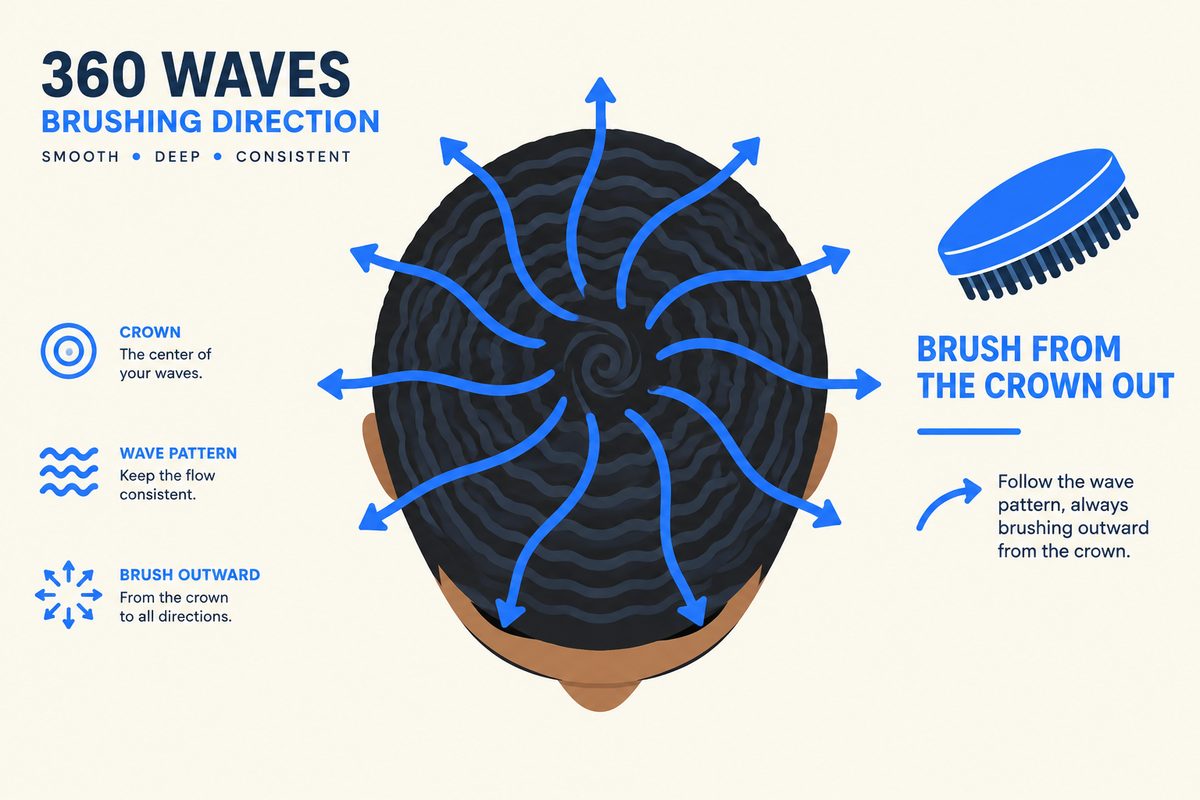
The wash routine above sets the stage, but the waves themselves are earned in the brush sessions between washes, and the waver community’s consensus on the shape of those sessions is consistent: several short-to-medium sessions a day beat one marathon. A common working rhythm is ten to fifteen minutes in the morning, again after any shower, and a final session before the durag goes on at night. What matters is the direction, which the diagram above covers: crown down and forward on top, toward the ear on the sides, down toward the neck at the back. Brushing against your pattern trains the hair in the wrong direction and undoes sessions, so know your pattern before you add pressure.
Pressure itself is a progression. New wavers use a soft or medium brush for the first weeks, both because the scalp needs to adapt and because force is not what builds the pattern; repetition is. The deep, hard-bristle sessions belong later, once the pattern is visible and you are refining rather than creating it.
Wolfing, in plain terms
Wolfing is the practice of letting the hair grow out for weeks without a haircut while you keep brushing daily, so the trained pattern stacks deeper before the barber takes it short. It is the single biggest lever in wave progress: a fresh pattern cut short every two weeks never gets the depth to survive the cut, while a pattern trained through a four-to-eight-week wolf holds its ripple even after the guard takes it down. Wolfing is also where the moisture routine earns its keep, because longer waves tangle and dry out without the product and compression doing their jobs every night.
The haircut cadence question resolves differently for wavers than for most cuts: between wolfs, the trim discipline in our haircut frequency guide applies with one amendment, which is that a waver asks the barber for a low cut with the pattern in mind rather than a reshape.
Beginner mistakes that cost weeks
- Brushing against the pattern at the crown. The crown is the origin point of the whole pattern, and brushing outward from it instead of with the rotation keeps the center a swirl instead of a wave.
- Skipping sessions instead of shortening them. Consistency is the mechanism; a ten-minute daily session outperforms an hour twice a week.
- Sleeping without the durag. Cotton pillowcases and friction undo hours of brush work overnight. The compression layer is part of the routine, not an accessory.
- Cutting too often. Every guard pass takes trained length off. Progress stalls when the cut frequency outpaces the training.
- Overloading product. Heavy product layers weigh the pattern flat and clog the scalp; one hold product and one moisture product, brushed through, is the working kit.
- Ignoring the scalp. Daily brushing and daily compression are hard on skin. Keep it clean, watch for irritation, and the barber advice in our razor bump prevention guide carries the same principle: treat irritation early rather than working through it.
Keeping the hair itself healthy through all of it
Waving is a training program, and hair that gets brushed hard daily needs the moisture side of the routine taken seriously or it frizzes and breaks, which reads as pattern loss. The wash-and-condition logic for textured hair in our curly hair routine guide transfers directly: sulfate-light washing, real conditioning, and moisture sealed before compression. The same goes for the hair’s texture cousins: wavers with coarser or coily textures get targeted tool advice in our textured and coily hair clipper guide when the cutting side matters, and the guard-length question for the low cut that frames a wave pattern is covered in our clipper guard sizes explainer.
The time frame, honestly stated
Beginner waves usually show first ripples within two to four weeks of consistent daily brushing on medium-textured hair, with a recognizable full pattern taking anywhere from a month to a season depending on texture, wolfing discipline, and how quickly your hair trains. Coarser textures take longer and hold deeper once they set. Nobody’s timeline is a promise, but the variables that speed it up are all in your control: direction, repetition, moisture, and compression.
How long should each brushing session be?
Ten to fifteen minutes per session, three to four times a day for most wavers, is the common working rhythm. Longer single sessions fatigue the scalp before they add progress; it is the daily repetition that builds the pattern.
Can I get waves if my hair is curly but not coily?
Usually yes; wavier and curly textures train more easily than dead-straight hair. The brush direction and compression discipline stay identical, and the moisture routine matters even more because looser textures frizz faster.
What haircut should I ask for as a waver?
A low cut all around, typically a one to one-and-a-half guard on the sides with the top left at the depth your pattern has earned, and the neckline cleaned up. The guard math is in our clipper guard sizes explainer above, and the edge discipline around the hairline is the same one covered in our hairline lineup guide.
Do I need a wave cap as well as a durag?
They do different jobs in the routine: the cap works in the shower over the conditioner, as the method above shows, and the durag handles the compression window after washing and overnight. Both together is the standard setup, and neither is expensive.
Why did my waves disappear after a haircut?
Usually a guard too low or a barber unaware the pattern was trained. Waves live in trained length; when a cut takes that length off before the pattern is deep, the ripple goes with it. Communicate the pattern before the first pass, and wolf longer between cuts until the pattern survives anything.
FAQ
Why do wavers wash their hair twice?
Per 360Jeezy’s wash and style routine: the first wash takes the dirt out, and the second is the one that really cleans the hair and lathers up. Conditioner follows, then compression under a durag.
Will the wash and style method give me waves by itself?
No, and 360Jeezy says so directly. The method helps your waves bounce back after washing and makes the process easier, but the brush work is what actually builds the pattern.
What are 360 waves?
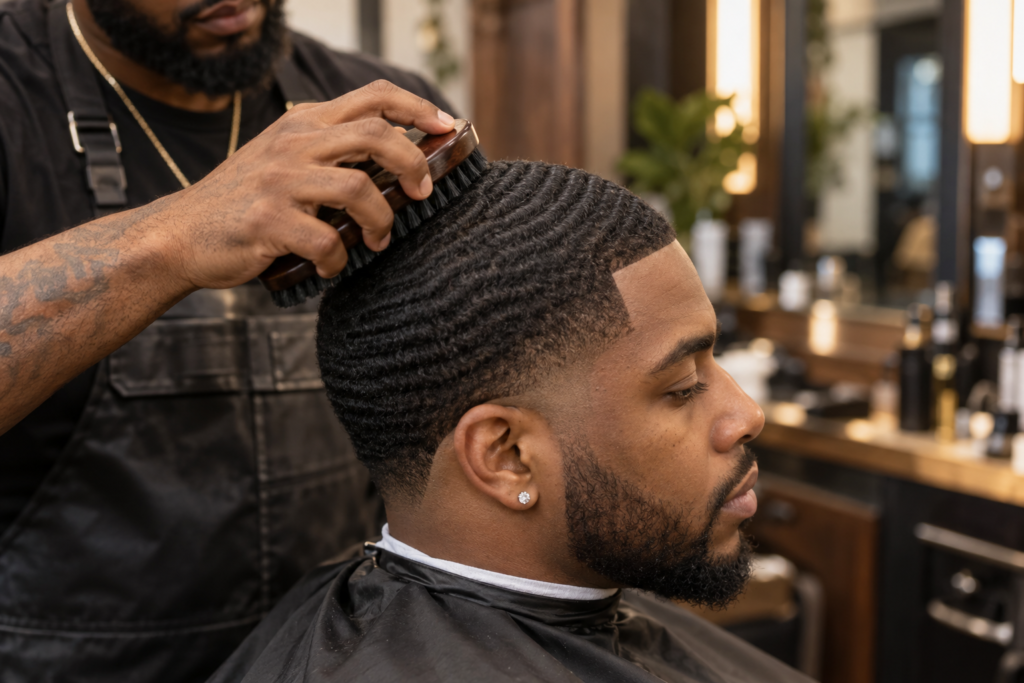
A hairstyle where short, trained hair forms a ripple pattern that wraps all the way around the head. The pattern comes from consistent brushing in one direction, kept laid down by compression and moisture, which is why the routine matters more than any single product.
What products do I need to start waving?
Per 360Jeezy’s routine: a shampoo and conditioner you brush through in the shower, a pomade for hold, a moisture product like the SheaMoisture smoothie, a medium curve brush, and a durag. The method works because the steps stack, so collect the kit before you start counting progress.
Why brush the shampoo and conditioner through in the shower?
Because waves are a direction game. Brushing the products through with a comb works them into every strand along the grain you are training, and 360Jeezy credits the brushed-in conditioner step for the silky smooth finish his hair comes out with.
Is the durag really necessary?
In this routine, yes. It is the compression layer that holds the freshly brushed pattern in place while the hair sets, and 360Jeezy lists it as part of his normal daily routine rather than an occasional extra.