
As an Amazon Associate, TrustedBarber earns from qualifying purchases.
The classic side part is the cut most barbers say they never get asked for anymore, and that is exactly why it is worth studying. When a client walks in wanting the slicked, put-together look, the difference between a part that reads sharp and hair that reads greasy comes down to decisions made before the first guard touches the head. The Regal Gentleman channel filmed a complete classic side part on a client named Ben, and the video doubles as a masterclass in the unglamorous parts: the consultation, the diagnosis of a DIY haircut gone wrong, and the way a double crown changes everything. Here is the full method, with the reasoning behind each choice.
- The consultation sets the whole cut
- Diagnose before you cut anything
- Where the part actually goes
- Wash, dry, and the double crown problem
- The back and sides: three to two, then a hard taper
- The top: longest in the middle, precision not texture
- Blow dry, point cut, and the pomade order
- The products behind the finish
- FAQ
The consultation sets the whole cut
Ben comes in after six weeks, his usual cadence, asking for his normal short back and sides on a number two, with the top combed over. Then he adds the real request: he has always liked the slicked, almost Beckham-style finish but has struggled to get it himself for years, and he wants to know whether it is his texture, his hair color, or his product that keeps getting in the way.
The barber’s answer is the first lesson of the video. Thick, very straight hair has to be left longer to slick back, because short, thick, straight hair forces itself into the direction it wants to grow. The barber points at his own hair as the example: at that length he could not slick it down at all, maybe with the heaviest pomade made, and only with effort. The goal is a style that should be easy and effortless to create. If the plan requires fighting the hair every morning, the cut failed at the chair.
So the target for Ben is longer on top than his current cut, down to a number two on the back and sides, with a hard part to give the style its classic structure.
Diagnose before you cut anything
Before the wash, the barber reads the head and finds two problems. First, the top looks cut very short in patches, and the crown is already sticking out at the back. Second, Ben admits to cutting his own hair during lockdown, and the worst possible spot: the short bits sit right on the round of the head, which is why they stick up. Hair on the crown curve wants to spike forward and up no matter how it is styled.
The rule that comes out of it is stated flatly: no DIY haircuts now that shops are open, because everyone can cut hair, the problem is knowing where to do it. The practical response, though, is not a lecture, it is a plan. Rather than cutting the stray bits to match, which would take the top too short overall, the barber decides to disguise them and cut the rest of the top normally, leaving as much length as possible so the slick style still has material to work with.
There is also a realistic length check here. Ben’s hair is slightly finer than the barber’s, so he can get away with taking off a modest amount and still land the slick finish. The wet check at the wash confirms the crown side that sticks up when dry will behave, which is the barber’s working rule: if it kicks out when wet, it will kick out when dry.
Wet check tells the truth. If a section misbehaves wet, it will misbehave worse dry, so solve it before the clippers come out.
Where the part actually goes
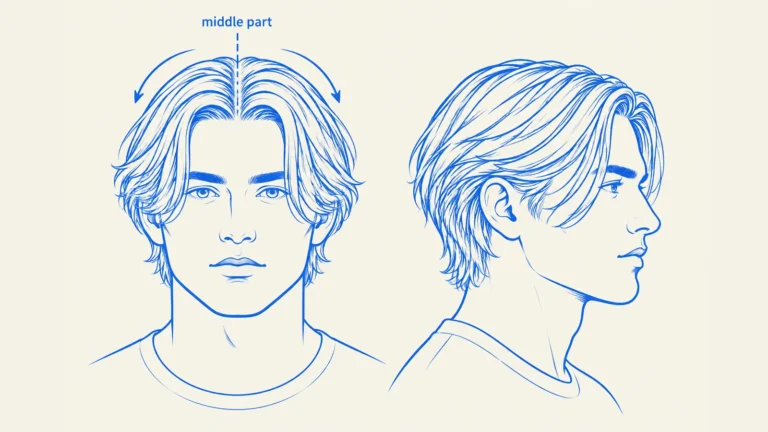
The part is what makes this a classic, and the barber is precise about why. A soft part does not hold a slick style; a slicked, slightly rock-and-roll finish needs a hard part, because hair that is just brushed over with nothing anchoring it reads flat and a little greasy. The part gives the style its classic structure, and it is also the part of the cut a client can learn to maintain at home.
The placement is the textbook one: from the crown straight down to the recession point. On Ben’s head that line sits almost perfectly straight with a slight angle, which makes it learnable. The barber estimates it takes a couple of weeks of practice to place consistently, maybe less, which is honest about the difficulty without pretending it is hard to start.
One constraint from the diagnosis matters here: the DIY short bits sit right on the part line. They get disguised rather than corrected today, with the understanding that the style will improve as the length grows in. That is the right expectation to set with any client whose last cut went wrong: fix what the shape needs, do not chase the mistake deeper.
Wash, dry, and the double crown problem
After shampoo and condition, the second structural surprise appears: Ben has a solid double crown, two crowns spiraling in different directions. The barber’s verdict on double crowns is worth quoting because it is the complete menu: you can work with it, you can cut it right off, or you can leave it super long, and working with it is the best option because you know exactly how the hair will fall when it dries.
So the horseshoe section, the ring of top hair that gets cut last, is built to include the crown instead of isolating it. The crown hair spirals out into the horseshoe on one side, the other crown sits flat and joins on the other side, and the barber clips the lower sections out of the way so nothing dries into the wrong zone. One side sits slightly higher and gets dropped a touch by hand before anything is cut. If double crowns or flat crowns are your recurring problem area, the crown-handling notes in the MC Barber pompadour method cover the same logic from a different angle.

The back and sides: three to two, then a hard taper
The clipperwork starts on a number three through the back, then steps down to a two and a half bridging into the three, and finally a two all over. The reason for starting higher than the target is deliberate: the longer first grade is bulk protection, a safety pass that keeps problem areas visible and gives the fade somewhere to work down from. Skipping straight to the target length removes your room to correct.
The taper that follows is where the classic character comes from. Working between a one and a one and a half with the lever in the middle, then down to the one, the barber builds what he calls a strong, classic taper, cutting in toward zero at the bottom for that sharp finish. The guard opens off onto the bare blade, the lever drops back to half, then opens, then closes down to zero. For the look being built, a tight, disciplined taper matters more than skin, and the distinction is laid out in taper versus fade.
The sideburns get their own decision. Squared off or blended down? Ben chooses squared, always, and the barber moves to a one and a half around the ear to taper, then tips the sideburn so its sharpest point sits where the square line lands. That little tip is what keeps a squared sideburn looking intentional instead of just unfinished.
The top: longest in the middle, precision not texture
The top is cut entirely with scissors, and the guiding principle is stated clearly: never take the first section from where the parting sits, take it from the middle, because the middle-to-part section is the part of the haircut that needs to be the longest. That length is what sweeps over and creates the squareness at the front. Cutting it short starves the part of the hair it needs to fall correctly.
The cutting itself is deliberately undramatic: small sections, cut straight and uniform, because a classic cut is not looking for texture, it is looking for precision and shape. As the work moves toward the crown the barber stops short, leaving the crown zone for later, and builds the guide from both the top line and the clipper line below. Cross-checking shows the sections sitting so close that almost nothing needs correcting, which is the payoff of the uniform method.
The fringe is the asymmetric piece. Because the hair pulls back to the recession point, the fringe is left longest and cut on an angle so it sweeps across and connects into the side, matching down toward the longer side. The crown itself is connected last with a horizontal section, cut with loose tension, which lets the crown hair fall into the shape instead of being forced.
Then the thinning pass, with one hard limit: point cutting thins out only the ends on the right side, from the recession back, because that is where thickness builds up when hair is worn over to one side. The left side keeps its weight, because the weight is what holds the hair sweeping over into the part. Thinning the holding side would undo the whole style.
The weight on the sweeping side is the style. Thin only the built-up side, never the side doing the holding.
Blow dry, point cut, and the pomade order
Styling starts with medium heat and medium speed on a small round brush, starting on the left side facing the part and drying the right side over toward the center. The brush wraps at the roots and rolls over, which sets the direction the part needs. A blast of cold air finishes the set.
The product is where Ben finally gets his answer. The barber brings out Reuzel, calls it the ultimate pomade brand, and picks the green tin, whose scent he describes as citrusy. The amount is small, roughly a pea-sized piece or a touch more, and the application order is the practical takeaway: work it into the part line first, because that is the problem area holding the short bits down, then front to back through the blend, then gloss the back and sides so the light reads one consistent color all over instead of slick on top and dry everywhere else.
A comb sets the final shape, and the leftover product on the hands goes around the blend so the sides match the top. The result is the slick, smart finish Ben had been chasing, and the barber makes the point that it is still flexible: a run-through with the fingers gives a drier, more natural version, and a clay would take it further toward matte while keeping the part. The part stays either way, because with the short bits still growing in, the part is what holds the look together.
The products behind the finish
Everything used in the video is shelf-standard, which is the point: a classic side part is a technique cut, not a product cut. The styling side, though, is where the wrong product ruins the right haircut:
- Reuzel Green Pomade for the slick, medium-shine hold the video finishes with.
- Layrite Super Hold Pomade as the heavier-hold alternative when the hair is longer or thicker.
Check Reuzel Green Pomade Price
- American Crew Fiber for the lower-shine, more natural version of the same style.
- Bardeau professional comb for setting the part and sweeping the final shape.
Check American Crew Fiber Price
For a deeper read on which of those fits which head, the pomade, clay and wax breakdown and the barber-recommended pomade list cover the full range, and the crew cut guide shows the other classic that lives on the same short-back-and-sides foundation. For the clipperwork itself, the guard size chart and the clipper over comb guide cover the taper end.
FAQ
Where should a side part sit?
From the crown straight down to the recession point. That placement follows the head’s natural geometry, and on most heads it lands in a near-straight line with a slight angle, which is what makes it learnable to maintain at home.
Can thick straight hair hold a slick side part?
Yes, but it needs length. The barber’s rule from the video is that thick, very straight hair must be left longer to slick back, because cut short it forces itself into its growth direction. The slick look fails on short, thick hair no matter how good the pomade is.
What guard for the back and sides?
This cut ran a three first as bulk protection, bridged through a two and a half, then finished on a two, with a hard classic taper between a one, a one and a half and the bare blade. The numbers matter less than the order: long safety pass first, target length second.
How often should a side part be cut?
This client books every six weeks, which is the standard cadence in our cadence guide. The part line itself needs more frequent tidying as it grows, and the style is easiest to maintain in the first three weeks after a cut.
What do I ask for at the barbershop?
A classic side part with a two back and sides, a hard taper, squared sideburns, the top left long enough to sweep, and the part taken from crown to recession. Naming the part placement is the detail that separates a real side part from a soft, brushed-over cut, and how to brief your barber walks through the rest of the vocabulary.